Sostenus Wilherm
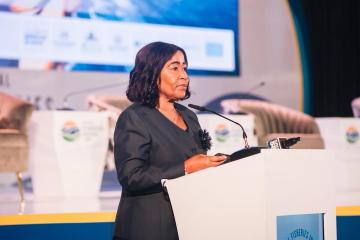
Africa must break away from short-term planning and take greater control of its development agenda if the continent is to turn its vast natural resources, youthful population and emerging industries into meaningful and inclusive economic growth, Vice President Lucia Witbooi has warned.
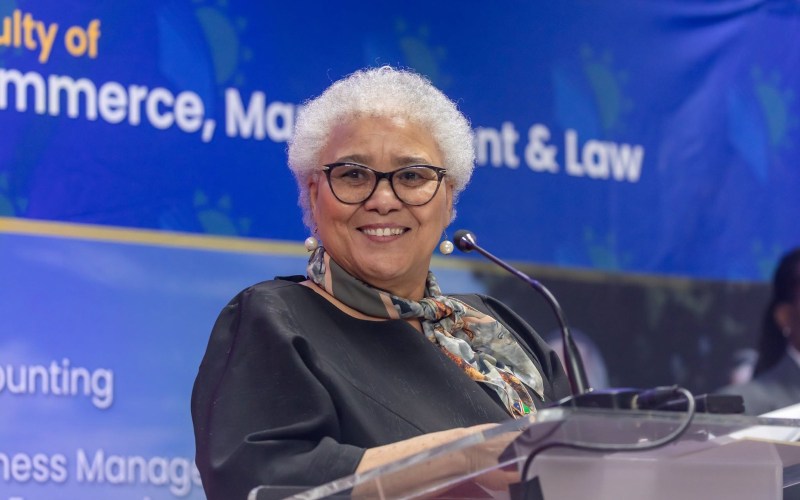
Witbooi made the call on Thursday during the official opening of the Africa’s Future Conference 2026 in Windhoek, held under the theme, “The Future of Business, Governance and Law in Africa: Digital Transformation, Sustainability and Inclusive Development.”
She said Africa was standing at a critical crossroads, with enormous opportunities existing alongside global instability, mounting fiscal pressures and longstanding structural challenges.
“Africa is a continent of great possibilities and great potential. Our Continent is vast and abundant in natural resources. It has a powerful demographic dividend driven by our youth,” Witbooi said.
But she cautioned that Africa’s abundance would not automatically translate into prosperity, saying governments needed to fundamentally rethink how they plan, govern and execute development programmes.
“Therefore, in order for us to bridge the gap between our current situation and our preferred future, we must change how we plan and how we operate moving forward,” she said.
Witbooi said the conference theme should not be confined to academic debate, but should instead drive practical solutions to some of the continent’s most pressing development challenges.
She called for new approaches to business, governance and law that can equip African countries to respond to the rapidly changing economic, technological and social realities of the 21st century.
The conference brought together academics, policymakers, business practitioners and thought leaders from Namibia, Nigeria, South Africa, Germany, Spain and Brazil to deliberate on digital transformation, sustainability, governance and inclusive development.
Witbooi said Namibia’s own development agenda reflected many of the issues under discussion, pointing to the Sixth National Development Plan (NDP6), which focuses on economic growth, human development and institutional resilience.
She stressed that economic progress should not be measured solely through national statistics, arguing that development must ultimately improve the lives of ordinary people.
“We believe, for development to be truly inclusive, it must be felt at the grassroots level,” Witbooi said.
She identified natural resource beneficiation, local value addition, digital transformation and access to affordable development finance as key ingredients for more inclusive growth.
Namibia’s emerging sectors, including green energy, salmon farming and oil and gas, were also highlighted as areas with significant potential, but Witbooi stressed that their development would require transparent, accountable and sustainable governance.
She specifically pointed to Namibia’s newly launched national Local Content Policy for the oil and gas industry as an example of efforts to ensure that emerging economic opportunities generate broader national benefits.
“In this regard, the concept of future proofing business, law and governance is deeply aligned with how we have directed our national policies, such as our just launched national Local Content Policy on oil and gas,” she said.
Witbooi also called for stronger collaboration between governments, universities, the private sector, young people and civil society, saying Africa’s development could not be driven by governments or individual institutions acting alone.
She placed particular emphasis on research that crosses traditional academic disciplines, arguing that complex development problems require knowledge and expertise from multiple fields.
“Interdisciplinary and multidisciplinary scholarship breaks down traditional academic boundaries to tackle complex, systemic issues that a single field cannot fully resolve on its own,” Witbooi said.
She further challenged African countries to build institutions capable of converting research and innovation into practical policy and development outcomes.
Among the mechanisms she proposed were national innovation hubs, science-policy dialogues and community-led research initiatives.
“Therefore, moving forward, Africa needs institutional bridges such as national innovation hubs, science-policy dialogues, and community-led research initiatives,” she said.
According to Witbooi, such platforms could help close the gap between knowledge production and policymaking while strengthening the continent’s institutional capacity to respond to emerging challenges.
She said Namibia was ready to participate in continental initiatives aimed at building stronger institutions and advancing sustainable economic development.
Witbooi concluded by urging delegates to use the conference as a platform for developing practical pathways for sustained dialogue, cooperation and action.
“Let this conference reinforce the fact that the future of our continent relies on our own institutional capacity and structured discipline,” she said.