…as neighbours complete first joint sea patrol
Sostenus Wilherm
Namibia and South Africa have stepped up the fight against illegal, unreported and unregulated (IUU) fishing, completing their first bilateral sea-based fisheries patrol.
The two neighbouring countries aim to strengthen joint surveillance and enforcement across their shared marine environment and resources.
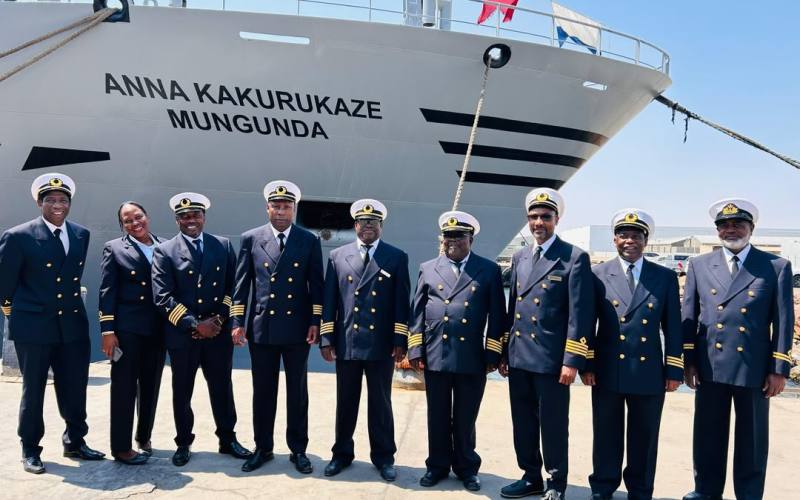
The 25-day operation, which concluded in Walvis Bay on Wednesday, saw Namibia’s fisheries patrol vessel Anna Kakurukaze Mungunda operate across the Exclusive Economic Zones (EEZs) of both countries, with fisheries law enforcement officials from Namibia and South Africa working together at sea.
South Africa’s director for international relations in the department of forestry, fisheries and the environment, Marisa Kashorte, described the operation as a major demonstration of regional cooperation, saying the patrol showed what could be achieved when neighbouring countries unite around the protection of shared marine resources.
“It is a celebration of partnership. It is a celebration of trust. And it is a celebration of what neighbouring nations can achieve when they commit themselves to a shared vision for the sustainable management and protection of our ocean resources,” Kashorte said.
The patrol was conducted under the memorandum of understanding (MoU) on cooperation in fisheries and aquaculture signed by Namibia and South Africa on 21 January 2019.
The agreement provides a framework for cooperation in fisheries management, aquaculture, research, marine resource management and Monitoring, Control and Surveillance (MCS).
Kashorte said the two countries had now moved beyond commitments on paper, with the Joint Technical Committee and its specialised sub-committees translating the agreement into practical enforcement activities.
She said the MCS sub-committee had played a key role in strengthening information sharing, developing joint operating procedures, conducting training and coordinating enforcement activities along the two countries’ borders.
The latest operation took that cooperation offshore, placing officials from both countries aboard the same patrol vessel for almost a month under demanding Atlantic conditions.
“For the past month, officials from our two countries have worked side by side at sea, often under challenging operational conditions, united by a common objective,” Kashorte said.
That objective, she said, was to protect marine resources, improve compliance with fisheries laws, disrupt IUU fishing and safeguard the economic and social benefits generated by the fisheries sector.
According to Hafeni Mungungu, director of operations at the ministry of agriculture, fisheries, water and land reform and co-chairperson of the MCS sub-committee, four South African fisheries law enforcement officers were deployed aboard the Anna Kakurukaze Mungunda vessel.
Two additional South African officers were stationed at Namibia’s fisheries monitoring centre, where they monitored vessel movements, combined intelligence and provided real-time operational information to the team at sea.
“Jurisdiction dictates our laws, but our shared resolve dictates our enforcement,” Mungungu said.
He described the operation as an example of “African solutions for African resources”, arguing that the joint approach had strengthened both countries’ ability to protect marine resources from illegal fishing.
The patrol departed on 5 September and returned to Walvis Bay on 30 September, making it the first bilateral joint sea-based fisheries patrol between Namibia and South Africa.
Mungungu noted that the two countries had previously participated in a joint sea operation in the early 2000s under the auspices of SADC and the European Union, also involving the Anna Kakurukaze Mungunda vessel.
However, the latest mission represents a new chapter in bilateral fisheries enforcement and the practical implementation of the 2019 cooperation agreement.
Mungungu said the operation reflected the two countries’ shared responsibility for the Benguela Current Large Marine Ecosystem, which supports fisheries, livelihoods and economic activity on both sides of the border.
“We share more than a border; we share migrating fish stocks, a shared economic destiny, and a mutual obligation to protect our marine wealth,” he said.
Kashorte said the patrol had demonstrated that the maritime boundary between Namibia and South Africa could become a platform for cooperation rather than simply a dividing line.
“This operation has demonstrated that our maritime boundaries do not divide us. Rather, they connect us through a shared responsibility to protect the Benguela ecosystem and the valuable marine resources upon which so many livelihoods depend,” she said.
The joint patrol is now expected to become a permanent feature of fisheries enforcement between the two countries.
Mungungu announced that the MCS sub-committee had resolved to make the operation an annual exercise, with South Africa set to host the next patrol.
The 2027 mission is expected to be conducted aboard South Africa’s fisheries patrol vessel Saara Baartman, with the two countries rotating their maritime assets.
“We will rotate our assets, but our momentum will only accelerate,” Mungungu said.
Future cooperation will focus on improving enforcement capacity, aligning standards, strengthening protection of the blue economy and increasing the socioeconomic returns from marine resources for communities in Walvis Bay, Lüderitz, Cape Town and elsewhere.
Kashorte said South Africa would host the next Joint Technical Committee meeting in October 2026, where officials will assess the progress made and identify additional areas for cooperation.
She linked the success of the patrol to commitments made during the fourth session of the South Africa-Namibia Bi-National Commission held in July 2026.
“Today we can proudly report that the partnership is working. The cooperation is delivering. And the friendship between our countries continues to grow stronger,” Kashorte said.
The officials also paid tribute to the fisheries control officers, vessel crew, monitoring teams, commanders and technical personnel who participated in the operation.
Mungungu said the teams had endured cold Atlantic waters, long hours and demanding inspections while working together to defend the region’s marine resources.
“You have turned a political vision into an operational reality,” he said.
He said the first bilateral patrol should serve as the foundation for deeper cooperation between Namibia and South Africa.
“Let us continue to sail together, protect together, and grow together,” Mungungu said.