Namibia’s parliament was not created to be a theatre of political vanity. It was created to make the government answerable to the people.
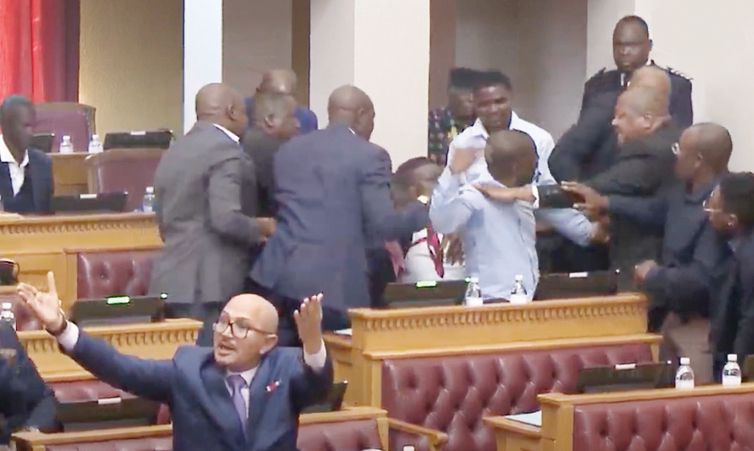
There is something deeply troubling about watching a Parliament descend into disorder.
Not because parliamentary politics should be quiet, polite or without confrontation. Quite the opposite. A healthy parliament should be noisy. It should contain disagreement, anger, passion and competing visions of the country.
But there is a difference between vigorous parliamentary politics and parliamentary dysfunction.
The recent scenes in Namibia’s National Assembly should therefore provoke a question much larger than who shouted at whom, who insulted whom or which political faction won the day’s confrontation.
The real question is: What do we believe parliament is for?
That question matters because parliament is one of the great institutional achievements of civilisation. It represents the idea that the affairs of a country should not be determined solely by a monarch, president, government or ruling party, but should be subjected to public argument and scrutiny by representatives of the people.
The institution did not emerge fully formed.
The British parliament, from which much of the Westminster parliamentary tradition inherited by Namibia ultimately derives, evolved over centuries out of struggles between monarchs, aristocrats and increasingly representative interests.
The word “parliament” itself came into use in England in the 13th century to describe an enlarged meeting of the King’s council.
The story is particularly instructive.
In 1215, King John was forced to accept Magna Carta, establishing in writing the principle that the king and his government were not above the law. It also established the principle that taxation required consent.
Then came Simon de Montfort’s parliament of 1265.
It was revolutionary because representatives of towns and counties were brought together to discuss matters of national concern. Knights representing counties and burgesses representing towns sat alongside the traditional political establishment. It is regarded as an important forerunner of the modern representative parliament.
In other words, parliament was born out of a simple but profound proposition:
The government must listen to the governed.
Parliament became progressively more powerful precisely because it provided a mechanism through which the grievances, demands and interests of society could reach the centre of power.
The history of Westminster is therefore also the history of Britain learning to argue with itself.
The famous “Good Parliament” of 1376, for instance, saw the Commons challenge corruption and fraud among royal officials and employ impeachment against the King’s advisers.
That is the point our new generation of Namibian parliamentarians seems in danger of missing.
Parliament is not primarily a stage on which politicians demonstrate how powerful they are.
It is the place where power is interrogated.
The finest parliamentary traditions of Britain produced politicians who understood that words could be weapons, but also instruments of accountability.
Edmund Burke, speaking to the electors of Bristol in 1774, articulated perhaps the most famous principle of representative democracy: a representative does not simply obey the instructions of his constituents; he owes them his judgment.
That distinction is fundamental.
An MP is not merely a messenger carrying whatever political emotion happens to be circulating outside parliament into the chamber. He or she is elected to exercise judgment on behalf of the country.
British parliamentary history is filled with politicians who understood this.
William Pitt the Younger was only 24 when he became prime minister, yet his parliamentary career demonstrated the importance of mastering policy, argument and the mechanics of government.
Benjamin Disraeli understood parliamentary politics as both combat and theatre. His famous observation that “with words we govern men” captured something essential about Westminster: political leadership depends not only on numbers but on the ability to persuade.
And then there was Winston Churchill.
Churchill’s parliamentary career was defined by conflict, opposition and sometimes spectacular political misjudgment.
But his greatest parliamentary contribution came from his willingness to stand against the prevailing mood when he believed the country was heading in the wrong direction.
His words during Britain’s darkest hours became part of the country’s political mythology because parliament gave him the platform to make an argument to the nation.
That is what parliament at its best does.
It allows the country to hear itself thinking.
The government explains itself.
The opposition challenges it.
Backbenchers raise concerns from their constituencies.
Ministers are forced to defend decisions.
Experts are summoned.
Budgets are interrogated.
Legislation is examined.
Public grievances become political questions.
And through all of this, the nation gets a sense of where it stands.
This is why parliamentary debate matters even when no vote is immediately taken.
A parliamentary question can expose an administrative failure.
A speech can reveal an emerging social crisis.
An opposition member can identify something the government has overlooked.
A government backbencher can tell ministers what their own officials may be reluctant to say.
That is the pulse of a country.
Parliament should therefore be one of Namibia’s greatest instruments of national intelligence.
Yet too often we appear to be reducing it to political spectacle.
There is nothing wrong with politicians being theatrical. Parliament has always had theatre. There is nothing wrong with sharp exchanges. Westminster has produced some of the most devastating political insults in history.
The problem begins when the performance replaces the purpose.
When members are more interested in being seen than in being heard, when insults substitute for arguments, when procedural rules become weapons rather than safeguards, and when parliamentary time is consumed by personal rivalries instead of national problems, the institution begins to lose its meaning.
Namibia has enormous questions before it.
Unemployment.
Housing.
Land.
Education.
Healthcare.
Youth unemployment.
Economic diversification.
Corruption.
Regional inequality.
The cost of living.
The management of natural resources.
Industrialisation.
These are questions worthy of a parliament.
The Namibian people do not need 104 representatives merely occupying seats. They need 104 representatives thinking.
The new generation of parliamentarians should therefore be encouraged to study parliament itself.
Read Hansard.
Read Burke.
Read the history of Westminster.
Study how parliamentary committees work.
Watch how serious legislators interrogate ministers.
Learn the rules of procedure.
Learn the difference between a point of order and a political argument.
Learn when to speak, and, perhaps more importantly, when not to speak.
Because parliament is not strengthened by the number of times an MP appears on social media.
It is strengthened by the quality of the questions asked, the legislation scrutinised, the budgets challenged and the arguments advanced.
There is also an important lesson in the British experience: Parliament did not become powerful because British politicians were inherently superior to everyone else.
It became powerful through institutional evolution.
Rules developed.
Conventions developed.
Procedures developed.
Accountability mechanisms developed.
The institution learned from its crises.
Namibia is still a relatively young democracy. Our Parliament therefore has every right to develop its own character and traditions.
But we should not confuse youth with an excuse for incompetence.
The National Assembly is an August House because of the constitutional responsibility entrusted to it, not because its members are personally august.
The institution derives its dignity from the people.
Every time a parliamentarian rises to speak, there should be an awareness that millions of Namibians are effectively speaking through that representative.
That should inspire humility.
It should also inspire seriousness.
The battle for the soul of Namibia’s parliament is therefore not between one political party and another.
It is not between the government and the opposition.
It is between parliament as an institution of democratic accountability and parliament as political entertainment.
The former strengthens Namibia.
The latter diminishes it.
Our parliament should be the place where the government feels the pressure of the people, where opposition parties sharpen the national debate, and where competing political ideas are tested against evidence, reason and the national interest.
It should be where Namibia hears its own conscience.
The British parliament took centuries to evolve into the institution the world recognises today. Namibia does not have centuries to waste.
We have urgent problems.
We need parliamentarians who understand that their greatest power is not the ability to shout down another member.
It is the ability to ask the question nobody else wants answered.
That is the purpose of parliament.
And that is the battle we should be fighting: not for who dominates the chamber, but for whether the chamber itself still matters.