The public reprimand of a senior health official by Health Minister Dr Esperance Luvindao over a leaking toilet at Katjinakatji Clinic may have been intended to demonstrate accountability. But there is a difference between holding people accountable and humiliating them in public. Namibia needs the former, not political theatre masquerading as leadership.
There is no question that a leaking toilet in a health facility is unacceptable. Clean, functional sanitation is fundamental to patient dignity, infection prevention and the delivery of quality healthcare. Those responsible for maintaining public facilities must answer for their failures. However, the manner in which leaders exercise authority matters just as much as the message they seek to communicate.
Looking at the demeanour and expressions of the officials in the video, one cannot escape the impression that the professionals involved felt belittled. Public humiliation is not a management strategy, nor is it evidence of effective leadership.
One must ask: what if the President adopted the same approach towards her ministers? What if, during a Cabinet meeting or a public engagement, she chose to reprimand ministers on camera for every visible failure in their respective portfolios? Would that improve governance? Would it produce better policy, stronger institutions or more effective public servants? Or would it simply create an atmosphere of fear, defensiveness and resentment?
Leadership is not about demonstrating who has the loudest voice or the greatest authority in the room. It is about creating an environment in which people are expected to perform, are equipped to deliver and are held accountable when they fail.
More importantly, the Nurses Union has raised issues that deserve considerably more attention than the viral video.
Medicine shortages, vacant nursing positions, deteriorating infrastructure, inadequate budgets and security failures at public health facilities are not isolated inconveniences. They are systemic problems affecting the lives and dignity of ordinary Namibians. Patients are being forced to purchase medicines from private pharmacies they can barely afford. Healthcare professionals are expected to deliver services under increasingly difficult conditions. Some facilities have not kept pace with population growth.
These are the failures that demand ministerial urgency.
If the regional director says the toilet problem was reported but could not be resolved because of budgetary constraints, the minister’s responsibility is to establish whether that explanation is legitimate, identify where the system failed and ensure that corrective action follows. If there was negligence, disciplinary procedures must apply. If the problem is inadequate funding, the ministry must confront that reality.
Scolding an official on camera does neither.
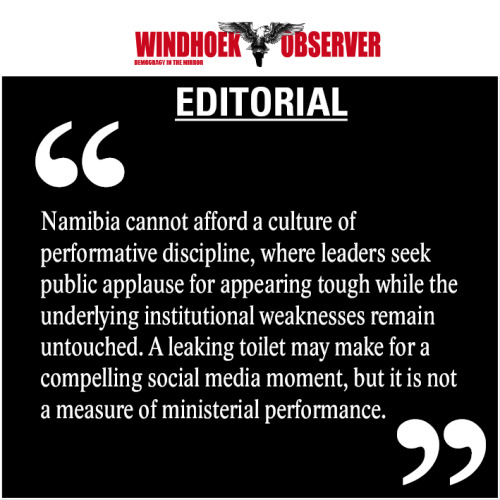
Namibia cannot afford a culture of performative discipline, where leaders seek public applause for appearing tough while the underlying institutional weaknesses remain untouched. A leaking toilet may make for a compelling social media moment, but it is not a measure of ministerial performance.
We need ministers who can listen, investigate, mobilise resources, make difficult decisions and deliver measurable improvements. We need public servants who understand that accountability is non-negotiable, but who are also given the resources and institutional support to do their jobs.
The ultimate test of Dr Luvindao’s leadership will not be how effectively she reprimands a regional director. It will be whether, under her stewardship, patients find medicines on hospital shelves, nurses are adequately deployed and clinics have the infrastructure necessary to provide decent healthcare.
Namibia has had enough of political performances. We need results. And results require leadership, not humiliation.