
CHAMWE KAIRA
The FNB House Price Index Report has identified slow land servicing and limited availability of developable residential plots as major constraints on the property market.
National residential plot transactions declined by 15.5% on a 12-month moving average basis, an improvement from the 26.7% contraction recorded in the previous quarter.
Plot sales fell by 14.9% in the central region, 26% in the north and 30.8% along the coast. The southern region recorded an increase of 105.3%, although the report attributes the sharp movement to the region’s small market base.
Despite declining transactions, land prices increased across all four regions. The cost of land per square metre rose by 8.5% in the central region to N$1 003, while northern land prices increased by 18% to N$855.
Coastal land prices climbed by 18.2% to N$742 per square metre, while the southern region recorded the steepest increase of 53.8%, taking prices to N$673 per square metre.
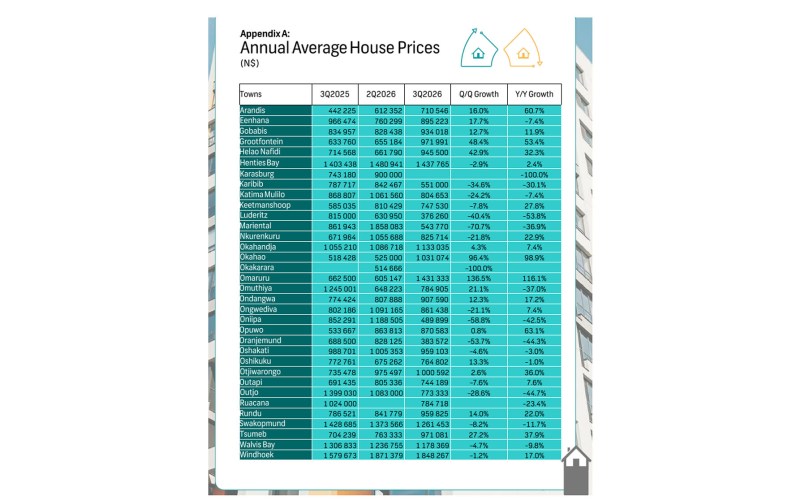
Namibia’s house prices continued to rise in the third quarter of 2026 as shortages of serviced residential land and high construction costs constrained supply, while property sales declined amid weakening household affordability.
The central region recorded the strongest house price growth, with average prices increasing by 11.4% to N$1.936 million.
Windhoek remained the most expensive town, with an average house price of N$1.848 million.
In the coastal region, house price growth slowed to 3.7%, with the regional average reaching N$1.532 million.
The northern region recorded a recovery, with prices increasing by 1.6% to an average of N$991 000.
The southern region remained under pressure, recording a 3.4% decline in average house prices to N$892 000.
Despite rising prices, national property sales volumes contracted by 3% during the quarter, reflecting affordability constraints among prospective buyers.
The small housing segment, comprising properties valued between N$500 000 and N$1.5 million, experienced the largest decline, with transaction volumes falling by 8.5%.
Although the higher-value property segments recorded substantial percentage increases in sales, activity remained limited. Only five luxury properties and 47 large properties were sold during the quarter.
The report links the pressure on household affordability to high inflation and declining disposable income, which have made it increasingly difficult for lower- and middle-income households to enter the property market.
Mortgage credit growth edged up to 2.8% in August 2026, although borrowing activity remained subdued.