Namibia’s independence in 1990 was not merely the transfer of political power from one administration to another. It was a promise. A promise of freedom, dignity, equality, opportunity, justice and a better life for all Namibians. More than three decades later, it is legitimate, and indeed necessary, to ask whether that promise is being fulfilled.
Veteran journalist Chris Jacobie raises precisely this question in his recent interview on the Windhoek Observer’s Catalyst Podcast. His reflections, informed by his experience of Namibia before and after independence, provide an opportunity to confront an uncomfortable but important national conversation: Is our democracy delivering what it was meant to deliver?
There is no denying that Namibia has made significant strides since independence. We have maintained constitutional democracy, held regular elections, enjoyed relative political stability and established institutions that are fundamental to democratic governance. These achievements should neither be dismissed nor taken for granted, particularly against the background of our liberation history and the instability experienced elsewhere on the continent.
But democracy must be measured by more than elections, political freedom and the peaceful transfer of authority. It must be measured by the quality of life of ordinary citizens, the accountability of those in power, the independence of institutions and whether economic opportunities are accessible beyond a politically connected or privileged few.
This is where the national conversation becomes less comfortable.
Poverty, unemployment, inequality and the concentration of economic opportunity remain stubborn features of our society. Young Namibians, many of whom were born after independence, are increasingly questioning whether the freedom inherited from the liberation generation has translated into meaningful economic freedom. For them, independence is not a historical event to celebrate alone. It must offer a tangible prospect of a better future.
More concerning is the persistence of corruption and the apparent culture of impunity that sometimes accompanies it. The Fishrot scandal demonstrated how public resources and national assets could allegedly be manipulated for private benefit. It also exposed weaknesses in oversight and accountability. Such scandals do more than cost the country money; they erode public confidence in institutions and undermine the very principles upon which democracy rests.
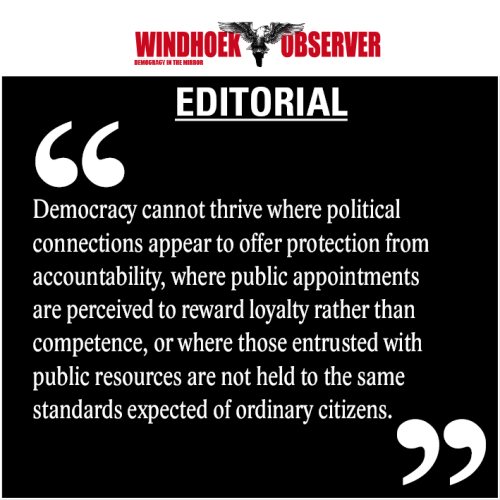
Democracy cannot thrive where political connections appear to offer protection from accountability, where public appointments are perceived to reward loyalty rather than competence, or where those entrusted with public resources are not held to the same standards expected of ordinary citizens.
The responsibility does not rest exclusively with the government of the day. Successive administrations, political parties, Parliament, the judiciary, oversight institutions, the private sector and civil society all have a role in determining the quality of our democracy. Equally, citizens must resist the temptation to confuse political loyalty with patriotism. Supporting a government does not mean surrendering the right to question it.
President Netumbo Nandi-Ndaitwah inherited both the achievements and shortcomings of previous administrations. Her government has an opportunity to demonstrate that democracy is not simply about maintaining political power, but about using that power to improve people’s lives. Listening to citizens is important, but the ultimate test will be whether their concerns translate into measurable action.
We should also be careful not to romanticise the past or diminish the sacrifices made to secure independence. The liberation struggle was fought for a future in which Namibians would enjoy freedom, dignity and equal opportunity. Those ideals remain relevant and deserve to be defended.
Jacobie’s reflections should therefore not be dismissed as nostalgia or criticism for its own sake. They invite us to examine the distance between the promises of independence and the realities of contemporary Namibia.
Ultimately, democracy is not a trophy that a country wins once and keeps forever. It is a continuous social contract between citizens and those entrusted with governing them.
The question is no longer simply whether Namibia is democratic. It is whether our democracy is delivering. And that is a question every government must be prepared to answer.