There is something fundamentally healthy about citizens questioning those entrusted with managing their towns. When residents hold their local authority leaders accountable, they are exercising a democratic right that should be welcomed, not treated as hostility or an inconvenience.
The unfolding dispute in Okahandja over the renewal of municipal CEO Alphons Tjitombo’s contract raises an important question: what does accountability mean in local government, and to whom are municipal leaders ultimately answerable?
Activist Paulus Haindere captured the frustration of many residents when he said: “We don’t hate the man. We hate his incompetence.” Whether one agrees with his assessment or not, the sentiment deserves to be heard.
Residents are raising legitimate questions about access to residential land, recurring water interruptions, electricity outages, sanitation, roads and waste management. These are not extravagant demands. They are the basic responsibilities of a local authority.
For a pensioner without proper sanitation, a family waiting years for a residential plot or a household repeatedly left without water, municipal performance is not measured by boardroom presentations or annual reports. It is measured by the quality of everyday life.
The municipality has presented its own record, pointing to the construction of a fire station, an SME market, a mini police station, infrastructure improvements and the acquisition of vehicles and equipment. These projects should be acknowledged. However, the existence of projects does not automatically answer whether the municipality has met the broader needs of its residents.
Nor should the renewal of a CEO’s contract be a routine administrative exercise. Five years in office should provide sufficient evidence to assess performance. What targets were set? Which were achieved? How much residential land was made available, particularly to lower-income households? How has service delivery improved? What happened to municipal funds returned to Treasury while communities continued to experience shortages?
Minister James Sankwasa should explain the basis on which the renewal was approved. The public deserves transparency about the performance criteria applied and the reasons behind the decision.
Equally concerning are questions surrounding the alleged refusal to accept land applications submitted with the assistance of community activist Johannes /Gerub /Gâseb. If approximately 190 applications were received and stamped, residents deserve clarity about their status. The municipality is entitled to insist on proper procedures, but those procedures must never become unnecessary barriers to citizens exercising their right to apply for land.
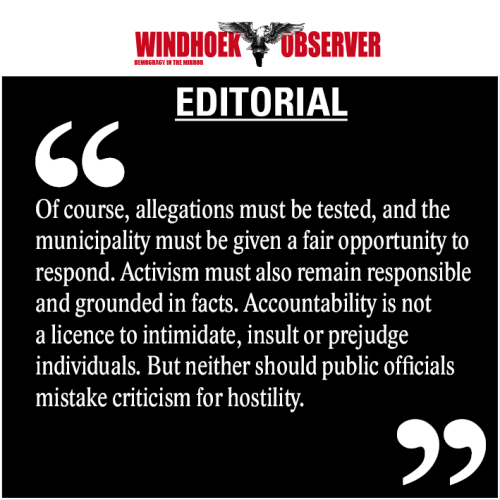
Of course, allegations must be tested, and the municipality must be given a fair opportunity to respond. Activism must also remain responsible and grounded in facts. Accountability is not a licence to intimidate, insult or prejudge individuals.
But neither should public officials mistake criticism for hostility.
A municipality does not belong to its CEO, its management or even its councillors. It belongs to the people who live there, pay rates and taxes, and depend on its services.
The residents of Okahandja are entitled to ask difficult questions. They are entitled to demand answers and measurable improvements. They are entitled to expect leadership that listens.
Indeed, if residents are holding their town leaders accountable, those leaders ought to listen.
The next five years should not be about defending a contract renewal. They should be about demonstrating, through measurable improvements, that the confidence placed in the CEO was justified.
Public office is a responsibility, not a privilege. And accountability is not an act of disrespect. It is the foundation of democratic leadership.