Minister of Justice and Labour Relations Fillemon Wise Immanuel is right to argue that democracy means little if ordinary citizens cannot access justice. His warning that democracy risks becoming an empty promise when citizens cannot exercise their rights speaks directly to one of the most important challenges facing Namibia.
Our Constitution guarantees equality before the law, human dignity, freedom and fundamental rights. These are not privileges reserved for the wealthy, politically connected or those who can afford expensive legal representation. They are guarantees that must translate into tangible improvements in the everyday lives of ordinary Namibians.
Unfortunately, there remains a considerable gap between these constitutional promises and the reality experienced by many citizens.
For too many Namibians, access to justice is constrained by the cost of legal representation, lengthy court processes, geographical barriers and inadequate access to legal assistance. Cases drag on for years, legal costs remain prohibitive and people in rural communities often face additional obstacles in accessing justice services.
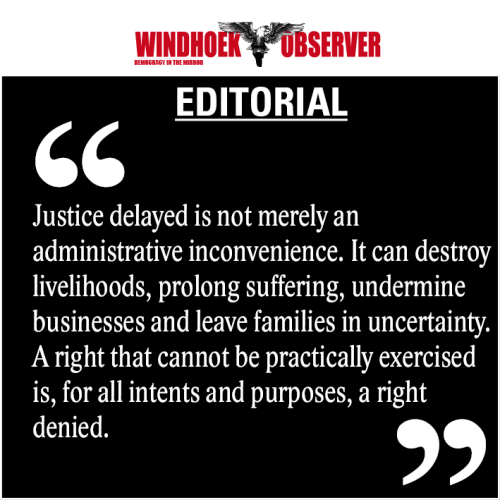
Justice delayed is not merely an administrative inconvenience. It can destroy livelihoods, prolong suffering, undermine businesses and leave families in uncertainty. A right that cannot be practically exercised is, for all intents and purposes, a right denied.
This is why Immanuel’s call for people-centred justice must move beyond conference speeches and declarations of intent. It must become a programme of measurable institutional reform.
The performance of a justice system should not be measured simply by the number of laws passed, court buildings constructed or cases registered. It should be measured by how efficiently disputes are resolved, how fairly citizens are treated and whether people have confidence that the law applies equally to everyone.
The minister’s observation that justice must not depend on socio-economic status or who one knows deserves particular attention. Perceptions that wealth, influence or political connections can determine outcomes are corrosive to public confidence. Equality before the law must be evident in practice, not merely proclaimed in principle.
This also requires an uncompromising commitment to institutional accountability. Public power must be exercised within the law, and those entrusted with administering justice must themselves be accountable. Independence of the judiciary, professionalism in the prosecution service and responsible conduct by law enforcement agencies are indispensable to a functioning democracy.
Government must therefore confront the practical shortcomings within the justice system. Court backlogs must be reduced through better case management, adequate judicial capacity and the effective use of technology. Legal aid must be strengthened so that indigent citizens are not denied representation because they cannot afford it. Justice services must also become more accessible to rural communities.
Furthermore, the police, prosecution services, correctional facilities, judiciary and Ministry of Justice must operate as parts of a coordinated system. Inefficiency at one point in the chain compromises the entire process.
Importantly, these reforms must be accompanied by measurable targets, transparent reporting and regular assessments of institutional performance. Citizens deserve to know whether court backlogs are declining, cases are being finalised faster and access to legal assistance is improving. Accountability without measurable performance is little more than rhetoric.
There is also a compelling economic argument. Investors, entrepreneurs and businesses require predictable laws, independent institutions and efficient dispute-resolution mechanisms. A justice system that commands public confidence strengthens economic participation, protects property rights and creates an environment conducive to investment and enterprise.
Immanuel’s emphasis on cooperation between Namibia and South Africa is equally relevant. However, bilateral agreements and regional commitments will only have meaning if they produce practical benefits for citizens.
Our liberation struggle secured political freedom. Our Constitution established the promise of equality, dignity and justice. The responsibility of this generation is to ensure that these promises are not confined to constitutional preambles, court judgments and ministerial speeches.
Ultimately, a democracy is only as strong as the confidence its citizens have in its institutions. That confidence is earned through fairness, efficiency, transparency and accountability.
Justice must not simply exist in law. It must be accessible, affordable, timely and experienced by every Namibian.