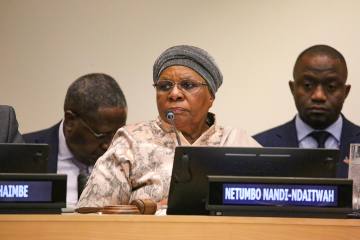
Allexer Namundjembo
Prime Minister Elijah Ngurare has defended the Petroleum (Exploration and Production) Amendment Bill, saying the proposed reforms are necessary to safeguard Namibia’s emerging oil and gas industry and ensure the country’s petroleum resources are managed in the national interest.
Contributing to the debate in the National Assembly on Tuesday, Ngurare urged lawmakers to put aside political differences and support the legislation, drawing parallels with the passage of the original Petroleum (Exploration and Production) Act in 1991.
Recalling discussions with ambassador Heiki Ausiku, a member of the first National Assembly, Ngurare said that lawmakers from across the political spectrum had unanimously supported the legislation despite significant political differences.
“National interest weighed heavier than political differences,” Ngurare said. “The same national interest should unite us today.”
He said he had expected the debate on the amendment bill to focus on how Namibia’s newly discovered petroleum resources could benefit citizens and how the country could learn from international examples of resource governance.
Instead, he argued, much of the discussion had centred on criticism of the proposal to place the Upstream Petroleum Unit under the Presidency.
“We have not, with few exceptions, heard concerns from the other side of the House that in terms of natural resources beneficiation, how best Namibians should benefit from these petroleum resources,” he said.
Ngurare rejected suggestions that the proposed governance model would weaken accountability or transparency, arguing that the Presidency would remain subject to parliamentary oversight through the minister in the Presidency.
“The Amendment Bill does not remove oversight; it institutionalises it,” he said.
He maintained that oil and gas resources require strategic leadership at the highest level of government, particularly as Namibia prepares for commercial production.
“Oil and gas are our new precious petroleum resources that can make or break this country,” he said.
“These amendments seek to bring about a robust, modern and transparent legal framework that can guide our upstream petroleum sector responsibly and efficiently.”
According to Ngurare, the proposed structure would improve coordination, accelerate evidence-based decision-making, and reduce bureaucratic delays in a highly technical industry.
He also dismissed concerns that transferring certain powers to the Presidency would expose the Head of State to undue legal risk, arguing that Namibia’s Constitution already provides for executive authority while preserving judicial oversight and parliamentary accountability.
Ngurare further pointed to provisions in the bill requiring annual reporting to Parliament on petroleum royalty remissions, deferrals, and refunds as evidence of the government’s commitment to transparency.
“The President represents the collective sovereign will of the Namibian people. Therefore, vesting final authority in the Presidency elevates petroleum governance from narrow bureaucratic control to a matter of national strategic importance and economic liberation,” he said.
Swapo Party Member of Parliament Jonas Justina urged lawmakers not to lose sight of the interests of ordinary workers as Namibia develops its petroleum sector.
Justina said the country’s oil discoveries in the Orange Basin presented enormous opportunities but warned that economic transformation would be meaningless if workers were excluded from the benefits.
“Development that excludes workers is not progress, and resource wealth that fails to deliver decent work, skills, and safety is not transformation,” she said.
She noted that the upstream petroleum industry remains highly specialised, with many technical positions still occupied by expatriates due to shortages of local expertise and training opportunities.
“Namibians are largely confined to support roles, which, while important, do not build core expertise or long-term career growth,” Justina said.
According to her, the sector faces two major challenges being a shortage of specialised skills and inadequate labour protections for workers operating in high-risk environments.
“Petroleum operations are high-risk, yet Namibia’s labour frameworks are not fully equipped for offshore conditions, exposing workers to safety and welfare risks,” she said.
Although she welcomed efforts to modernise governance and improve coordination through the Presidency and the proposed Upstream Petroleum Unit, Justina argued that stronger labour provisions should be built into the regulatory framework.
“Oil and gas development without labour justice is not development,” she said.
Justina called for enforceable measures to promote local employment, equal pay for equal work, freedom of association, worker safety, and mandatory skills transfer programmes.
“Petroleum wealth must uplift Namibian people, especially the working class, through decent jobs, fair pay, safe conditions, and real skills transfer,” she said.
She further proposed that the Upstream Petroleum Unit work with relevant ministries to develop and enforce regulations aimed at protecting workers and building local capacity within the sector.
The amendment bill comes as the country seeks to position itself as a future oil-producing nation following major offshore discoveries in the Orange Basin by international energy companies.
Government officials have indicated that the reforms are intended to modernise the country’s petroleum governance framework and prepare the sector for commercial production, which industry projections suggest could begin around 2032.
The bill proposes the establishment of an Upstream Petroleum Unit in the Office of the President and transfers several regulatory and licensing functions currently exercised through the ministry of industries, mines and energy.
The proposal has generated significant debate, with supporters arguing it will improve coordination and efficiency, while critics contend it centralises too much authority in the Presidency and could weaken existing checks and balances.
The current debate follows months of public discussion after the amendment bill was first tabled in Parliament.
Opposition parties, including the Independent Patriots for Change, have previously argued that petroleum governance should remain under ministerial control to preserve constitutional accountability.
Government officials, however, have maintained that the reforms are necessary to strengthen oversight, streamline decision-making, and ensure Namibia is institutionally prepared for the development of its petroleum resources.
Industry stakeholders have also weighed in, with some investors and analysts supporting the creation of a specialised upstream regulator to manage the growing complexity of the sector as exploration activity accelerates offshore.