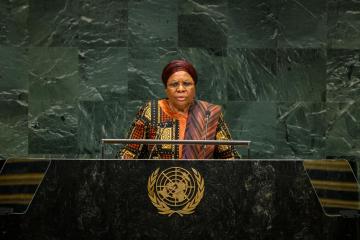
Patience Makwele
President Netumbo Nandi-Ndaitwah says Namibia remains committed to securing a resolution on reparations for the genocide committed against the Ovaherero and Nama people during German colonial rule, insisting that justice and reconciliation can only be achieved through truth, acknowledgement and sustained dialogue.
Addressing the High-Level Consultative Conference on the Next Steps for United Nations Resolution A/RES/80/250 on the Transatlantic Slave Trade in Accra, Ghana on Thursday, Nandi-Ndaitwah said Namibia’s pursuit of restorative justice forms part of a broader African effort to confront the enduring effects of slavery, colonialism and historical injustices.
She said Namibia’s engagement with Germany stems from a unanimous motion adopted by Parliament in 2006 on genocide, apology and reparations, which directed the government to pursue the matter with Berlin.
She said the two governments have been engaged in discussions over the past nine years, with affected communities actively involved in the process, resulting in a joint draft declaration following several rounds of talks in Windhoek and Berlin.
“Justice is rarely a straight road. It is often slow and uncomfortable. We remain engaged as a solution has to be found,” she said.
Nandi-Ndaitwah acknowledged that the negotiations have not always been easy and called for patience, resilience and an unwavering commitment to dialogue.
“For Namibia, this discussion is deeply personal,” the President said.
She said the effects of slavery and colonialism continue to shape lives through inequality, poverty and lost opportunities, adding that genuine reconciliation can only be built on truth, acknowledgement and mutual respect.
Political analyst Alex Murangi said the President’s remarks highlighted Namibia’s determination to keep the issue of restorative justice on the international agenda.
“The issue of restorative justice is not merely about the past. It is about recognition, historical accountability and the long-term socio-economic consequences that communities continue to experience today,” he said.
Murangi said the President’s remarks would resonate with many descendants of genocide victims who continue to seek acknowledgement and justice.
“For affected communities, this is not an abstract historical debate. It is a lived reality. Families still carry the trauma and pain of what happened to their ancestors and many believe the process of healing remains incomplete,” he said.
Historian, commentator and researcher Dr. Rudzo Kevin Moyo said Namibia’s participation in the conference demonstrated that discussions around the transatlantic slave trade and colonial-era atrocities are increasingly interconnected.

“These conversations are about restoring dignity and ensuring historical injustices are not forgotten. They also provide an opportunity for Africa and the diaspora to collectively examine the legacies of slavery, colonialism and genocide and their continuing impact on societies today,” he said.
Nandi-Ndaitwah also highlighted Namibia’s efforts to address historical injustices, including Parliament’s decision to declare 28 May as Genocide Remembrance Day and a public holiday.
Her remarks come less than three months after the United Nations General Assembly, on 25 March 2026, adopted a landmark resolution spearheaded by Ghana declaring the transatlantic slave trade and racialised enslavement as the gravest crime against humanity.
The President said Africa’s pursuit of restorative justice is not driven by bitterness but by a desire to heal unresolved wounds.
“Africa is not seeking to reopen old wounds. Africa is seeking to heal wounds that were never healed,” she said.
The President further called for greater unity among African countries and stronger engagement with the African diaspora, saying the continent’s collective future depends on solidarity and a shared commitment to justice.
“History has brought us to this moment. The question before us is whether we have the courage, readiness and unity to finish the work that previous generations began. I believe we do,” she said.