Sostenus Wilherm
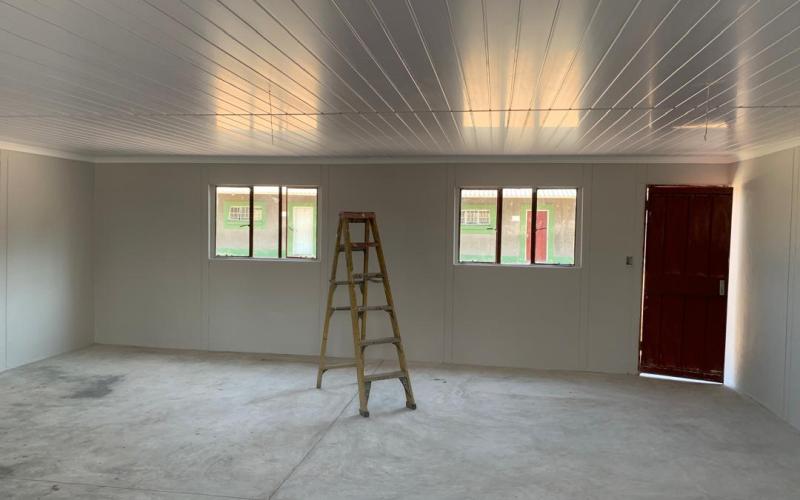
The Revolutionary Union has completed two classrooms at Limbadungila Combined School in the Ohangwena Region after finding learners being taught in makeshift structures built from sticks, with rainwater entering the classrooms and electricity connected to the unsafe buildings.
The project started in 2025, has seen the union spend between N$300 000 and N$350 000 on the construction of the two classrooms, which are now fully completed and awaiting an official handover date.
The project covered construction work, roofing, plastering, painting, ceilings and electricity and is expected to benefit between 70 and 80 learners.
Revolutionary Union central secretary Julius Natangwe told the Windhoek Observer that the union became concerned after visiting the school and witnessing the conditions under which learners were receiving lessons.

“Those kids were just being taught under, you know, it’s not even wooden, it’s just sticks,” Natangwe said.
He explained that the structures were made from sticks collected from the bush and covered with zinc roofing, leaving learners exposed to rain.
“If you check on social media, you’ll see the videos of those classrooms. That’s exactly what we found there. It’s a confusing environment for kids to be taught under, not to be taught in,” he said.
Natangwe said the situation was particularly concerning because electricity had also been connected to the makeshift structures.
“We were unlucky that day because when we visited, we found it raining. So, the water is just falling there, and the electricity was connected there. Anything, any type of development, it’s just dangerous,” he said.
According to Natangwe, the union first identified the school in 2025 after researching the conditions through social media before visiting the area.
The union then began mobilising resources to address the situation.
Natangwe said the union could not disclose the specific source of its funding but explained that the project was supported through engagement with corporate stakeholders.
“We are a direct union, of course we negotiate, we negotiate, and we also address issues of corporate social responsibilities with our stakeholders. So, the resources were raised through a corporate partner,” he said.
He added that the union also uses stakeholder engagement and lobbying to secure support for community projects, arguing that businesses have a responsibility to contribute to communities where they operate.
Natangwe said Limbadungila was prioritised because of the severity of the conditions facing learners there, particularly amid concerns about inequalities between rural communities.
“We prioritize that school, because we saw the need for that one,” he said.
He acknowledged that there are other schools across the country facing similar challenges, but said limited resources prevent the union from addressing all the needs at once.
“We would want to be all over the place, but unfortunately, with limited resources, we can not,” he said.
Natangwe urged businesses operating in different regions to identify challenges within their communities and contribute towards addressing them.
“If businesses in !Kharas identify problems in !Kharas, Zambezi in Zambezi and Ohangwena in Ohangwena, we will have all these problems addressed, or at least all of them, but at least the majority of them addressed,” Natangwe said.
He said businesses should not wait for national organisations to identify every community problem but should take responsibility for challenges affecting people in the areas where they operate.
Natangwe also linked the call for community support to the issue of menstrual hygiene, saying girls in some communities continue to miss school because they cannot afford sanitary pads.
“If we have kids that are unable to go to school in the region, as soon as you go to school, it is going to reach out to us. These kids can not go to school because they do not necessarily pay what they can afford. Why don’t we, the business communities in those areas, assist?” he asked.
He said sanitary products should also be part of community support initiatives.
“A pack of pads is just N$9.00,” Natangwe said, questioning how girls could still be missing school because of their menstrual cycles despite women holding several senior positions in the country.
“It is very interesting that in the Namibian way, the President is a woman, the Vice President is a woman, the Speaker of National Assembly is (a)woman, the Inspector General is a woman, the Prosecutor General is a woman, the minister of health woman… and we still have a girl child who is unable to attend classes because she doesn’t have sanitary pads,” he said.
Natangwe said the union would continue supporting education, sport, sanitation and other community initiatives where resources allow, while calling on companies and individuals to contribute to improving conditions in underserved communities.
“Let us brighten our small corners, and eventually we will have a brighter Namibia,” he said.