Shafa Kaulinge
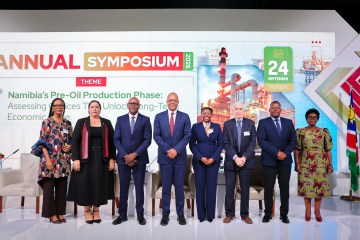
At the opening of the Namibia International Energy Conference (NIEC) 2026, an AI-generated video projected a future Namibia of modern ports, integrated energy infrastructure, industrial corridors, and logistics networks, a nation visibly in command of its own developmental trajectory.
The room responded with genuine emotion. That reaction is worth taking seriously, not dismissing. In development studies, the gap between a country’s imagined future and its material present is often the very thing that mobilises the institutional will required to close it.
What the room felt was not naïve optimism. It was recognition of latent capacity: the Namibia that already exists in potential, organised, productive, and industrially credible, waiting on the right sequencing of policy, investment, and execution.
The organisers of the NIEC’s eighth edition deserve credit for this. The conference has evolved from a sectoral energy platform into something closer to a national strategy forum, a space where Namibia is annually confronted with the scale of its opportunity, and with the institutional seriousness required to convert opportunity into outcome.
The Singapore comparison, read correctly
Around the same period, revisiting The Singapore Story: Memoirs of Lee Kuan Yew offers a useful comparative lens, not as a template, but as a case study in what political economists call developmental statecraft: the deliberate, state-led coordination of institutions, human capital, and capital investment toward a coherent national project.
Singapore’s transformation from a resource-poor port city into a global hub of finance, logistics, manufacturing, and governance is frequently cited in comparative development literature, alongside South Korea, Taiwan, and more recently Rwanda and Mauritius, as evidence that resource endowment is not deterministic. Institutions and execution capacity matter at least as much as geology.
But comparative development economics also insists on a discipline that popular commentary often skips: initial conditions matter.
Singapore’s trajectory began from a specific set of structural advantages, including a strategic entrepôt location on one of the world’s busiest trade routes, a relatively compact and administratively manageable population, and a colonial-era institutional inheritance oriented toward commerce and trade infrastructure.
Namibia’s structural starting point is different, and understanding that difference is not an excuse. It is analytically necessary.
Namibia’s economic geography was shaped by German colonial extraction, South African occupation, apartheid-era spatial and racial planning, land dispossession, and a migrant-labour system engineered to move value out of the territory rather than build productive capacity within it.
This is what economic historians describe as an extractive institutional legacy, an economy architected for resource export rather than domestic industrial linkage.
Treating Singapore as a direct benchmark, without accounting for this divergence in starting conditions, risks converting a legitimate development question into an unfair moral judgement, one where African nations are measured against outcomes produced by fundamentally different historical structures, and found wanting by design.
History explains. It does not excuse
This is the analytical balance worth holding: structural history explains constraint, but it does not excuse present-day execution. Namibia’s colonial and apartheid past accounts for much of the country’s institutional and infrastructural starting point. It does not account for what happens next.
And what happens next is genuinely encouraging, if approached with clarity. Namibia is not short of strategic vision. Vision 2030, the Harambee Prosperity Plans, the National Development Plans, and now a wave of oil, gas, green hydrogen, and critical minerals frameworks all demonstrate a functioning planning apparatus.
The country’s constraint is not imagination. It is what public administration scholars call the implementation gap, the distance between policy design and delivery capacity.
This gap is closeable. It is a known problem in development economics, and there is a well-documented playbook for closing it: sequenced local-content policy, deliberate technical and vocational skills pipelines tied to specific industrial timelines, transparent sovereign wealth and revenue-management institutions modelled on best-practice examples like Botswana’s Pula Fund or Norway’s Government Pension Fund, and strong, independent regulatory oversight of extractive-sector contracts.
From discovery to development: The real test ahead
Namibia now stands at a genuinely favourable inflection point. Offshore oil and gas discoveries, green hydrogen potential, critical minerals, uranium, fisheries, and emerging logistics corridors give the country more optionality than it has had at any point since independence.
The socio-economic literature on resource-led development is clear that the determining variable is not the resource itself, but the linkage strategy built around it.
Discovery becomes development only through deliberate local content requirements and enforceable technology-transfer clauses.
Extraction becomes industrialisation only when supply chains such as fabrication, welding, marine services, and engineering are built domestically rather than imported wholesale.
Royalties become transformation only when revenue is channelled into human capital and productive infrastructure rather than consumption or patronage.
Namibia has real, usable precedent to draw on here, including its own diamond beneficiation experience and regional examples from Botswana’s mineral-revenue management. The institutional muscle memory already exists, and it needs to be extended deliberately into the hydrocarbons and green-hydrogen sectors.
Patriotism as institutional behaviour
There is also a socio-cultural dimension that development economics increasingly takes seriously: what some scholars term civic capital, the degree of trust, ethical restraint, and shared national purpose that allows institutions to function as designed rather than being captured by narrower interests.
This is not an abstract or sentimental variable. It shows up empirically in cross-country studies as a strong predictor of whether resource revenue translates into broad-based development or narrow enrichment.
Practically, this means Namibia’s local-content and transformation agenda succeeds only if it is structural rather than symbolic, building productive capacity across firms, technical colleges, and supply chains, rather than simply inserting individuals into existing arrangements.
The distinction development economists draw is between inclusion, meaning a few new participants in old structures, and transformation, meaning new structures that expand who can produce, own, and compete.
A grounded, positive outlook
None of this is cause for pessimism. It is the opposite. Namibia enters this resource cycle with advantages many first-generation resource economies lacked: a functioning multiparty democracy, a relatively strong rule-of-law tradition by regional standards, an established sovereign wealth fund architecture already under discussion, a young and increasingly technically trained population, and, crucially, the benefit of hindsight from both African and global resource-development experience.
Namibia does not have to learn these lessons the hard way. It can study Botswana’s diamond governance, Ghana’s oil-sector local content framework, and Norway’s revenue management, and adapt what works to its own institutional context.
The NIEC video’s invitation to dare to dream is a legitimate starting point, not a naïve one. The harder and more hopeful task ahead is execution, and execution is a solvable, learnable, institutional capacity, not a fixed national trait.
Namibia does not need to become the Singapore of Africa. It needs to become a disciplined, confident version of itself: a country that acknowledges its structural wounds without being governed by them, that converts resource wealth into skills, industry, and dignity, and that treats this decade’s resource boom as the foundation for the next century’s institutional maturity.
The more useful question, then, is not whether Namibia can replicate Singapore. It is whether Namibia is ready to build, deliberately, transparently, and patiently, the institutions that turn today’s opportunity into tomorrow’s shared prosperity. Every indication suggests it is closer to that readiness than the pessimists assume.