From Pohamba to Geingob and now Nandi-Ndaitwah, successive presidents have warned about red tape, stalled projects and weak implementation. The near-loss of a N$41.1 billion Dangote investment raises fresh questions about why bureaucratic delays persist and what they are costing Namibia’s economy.
Elvis Mboya
President Netumbo Nandi-Ndaitwah’s revelation that Namibia came close to losing a multibillion-dollar investment because of bureaucratic delays has brought renewed attention to a problem that has confronted successive administrations for nearly two decades.
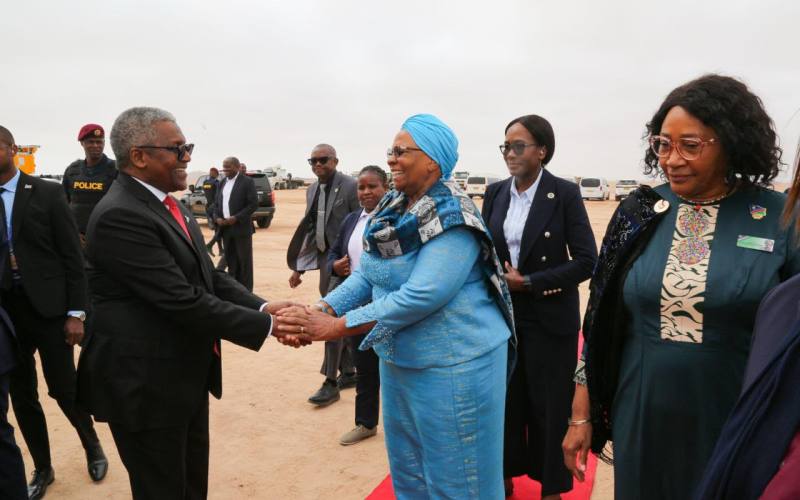
At the launch of the Dangote Namibia Tank Farm and Regional Pipeline Project at Farm 58, outside Walvis Bay, on Wednesday, 4 November 2026, the President disclosed that she had personally intervened to prevent Nigerian industrialist Aliko Dangote from abandoning the investment after his team became frustrated with the pace of government processes.
The project, valued at approximately US$2.5 billion (N$41.1 billion), is among the major energy infrastructure investments planned for Namibia.
Its near-loss raises a fundamental question about the country’s investment environment: why must major investors encounter administrative obstacles before their projects can move forward?
“I apologise for the delays and frustrations you have experienced. We could have lost this project had there not been direct communication between you and me,” Nandi-Ndaitwah told Dangote.
She further disclosed: “When the team was becoming frustrated, I had to call Mr Dangote and plead with him to hold on and make it work.”
The President said she had placed the project directly under the Office of the President, directing National Planning Commission Director General Ambassador Kaire Mbuende to oversee implementation and keep her informed of progress.
Her intervention was informed by previous experiences with investors while serving as minister of international relations and trade.
“However, they became frustrated by our bureaucratic systems, and we lost very important projects,” she said.
One such project was a proposed shipyard in Namibia.
According to the President, the investors were serious and wanted to proceed but eventually withdrew.
“After four years, they had to withdraw,” she said.
The President did not identify the investors or disclose the proposed shipyard’s investment value.
Nevertheless, her account illustrates the potential economic consequences of prolonged administrative processes.
A problem inherited across presidencies
Nandi-Ndaitwah’s criticism is not the first time a Namibian president has publicly challenged the civil service over bureaucratic inefficiencies and slow implementation.
In June 2006, former President Hifikepunye Pohamba took senior government officials to task over bureaucratic delays affecting capital projects.
Pohamba warned that funds allocated to development projects were going unused and being returned to the Treasury because of poor implementation.
He urged government managers to achieve at least 70% implementation of government programmes and projects, warning that managers would be held directly accountable for delivery.
“Managers will thus be held directly accountable for the implementation of programmes and projects,” Pohamba said.
He also raised concerns about government service providers waiting up to three months to receive payment for work already completed, warning that such delays were damaging relationships with service partners and sometimes resulting in the suspension of essential services.
His message was that administrative procedures should facilitate development rather than obstruct it.
Twelve years later, in February 2018, former President Hage Geingob raised similar concerns, this time explicitly linking bureaucratic bottlenecks to Namibia’s investment climate and international competitiveness.
Addressing the first Cabinet meeting of that year, Geingob said inefficiencies, bureaucratic bottlenecks and the slow pace of reforms were contributing to the country’s declining standing in global competitiveness rankings.
“Our investment climate has been perceived to be not conducive due to a lack of implementation of agreed-upon reforms. This has become an impediment to investment and economic growth,” Geingob said.
He directed then Prime Minister Saara Kuugongelwa-Amadhila to expedite reforms and conduct a bureaucratic bottleneck audit to decongest government systems and institutions.
The concerns extended to business registration and the processes investors encountered when establishing enterprises in Namibia.
Geingob’s administration had identified improving competitiveness and positioning Namibia as an investment destination as important priorities under the Harambee Prosperity Plan.
Yet, eight years after those warnings, Nandi-Ndaitwah has found herself confronting similar frustrations, with the Dangote project requiring direct presidential intervention.
The numbers behind the delays
The problem is also reflected in independent assessments of public project implementation.
The African Development Bank’s Namibia Country Portfolio Performance Review 2025, published in February 2026, identified procurement and implementation delays among the challenges affecting development projects.
The report found that the period between project approval and the first disbursement of funds had increased from 10.4 months to 13.6 months, mainly because of prolonged procurement processes and additional clearance requirements from the Office of the Attorney General.
It also identified lengthy bid evaluations, procurement capacity constraints and delays in contract clearance as challenges affecting implementation.
The Bank further reported that only 38% of targeted outcomes and 33% of planned outputs under Namibia’s 2020–2024 Country Strategy Paper had been achieved.
It attributed the underperformance partly to projects that remained incomplete and others that did not materialise following changes in government priorities.
These findings provide a broader institutional perspective on the concerns raised by successive presidents. They demonstrate that delays are not confined to private investment negotiations but also affect publicly financed development programmes.
However, the AfDB report also recorded improvements in portfolio performance, with the proportion of red-flagged projects falling from 46% to 33% between the July 2024 performance review and the March 2025 review.
This suggests that progress is possible, although significant implementation challenges remain.
What Namibia stands to lose
For an economy seeking diversification, industrialisation and employment creation, delays in investment implementation carry consequences beyond the immediate projects.
When investors withdraw, the country loses potential capital, employment opportunities, business contracts, tax revenues and opportunities for skills transfer.
The Dangote investment illustrates the scale of what is at stake.
The project includes a proposed 600-million-litre fuel storage facility and a regional pipeline network of approximately 1 700 kilometres, potentially connecting Namibia with Botswana, Zambia, Zimbabwe and the Democratic Republic of Congo.
According to Reuters, the project is expected to take between 18 and 20 months to complete.
Its strategic importance lies in strengthening petroleum storage and regional fuel distribution while positioning Walvis Bay as a regional energy and logistics hub.
The President has said the project should prioritise Namibians, followed by other Africans, in its execution, while providing opportunities for employment and skills development.
However, the investment also raises an important institutional question: if a project of this magnitude requires the President’s personal intervention to keep it on track, what happens to smaller investors without access to the highest office?
Beyond presidential interventions
Nandi-Ndaitwah has called on the ministry of industries, mines and energy, the ministry of works and transport, ministry of finance, the National Planning Commission and Namport to work closely with Dangote Industries Limited.
She has declared the investment a presidential project until completion.
But the broader challenge is ensuring that administrative efficiency becomes an institutional practice rather than depending on individual presidential intervention.
Pohamba called for accountability in 2006. Geingob demanded reforms and the removal of bureaucratic bottlenecks in 2018.
Nandi-Ndaitwah is now confronting the consequences of delays through a major investment that she says could have been lost.
The recurring warnings raise questions about the effectiveness of reforms, coordination between government institutions and accountability for projects that remain stalled despite investment commitments.
Namibia needs predictable approval processes, competent project management, timely procurement decisions and clear accountability across public institutions.
Investors should be able to navigate government systems without waiting years for decisions or relying on personal intervention from the President.
Ultimately, attracting investment is only one part of economic development. The ability to facilitate, retain and implement those investments is equally important.
Nandi-Ndaitwah’s warning about the relationship between bureaucratic delays and poverty was particularly pointed.
“If we move slowly, our people will continue to languish in poverty,” she said.
Her closing message at the Dangote launch was a challenge to government institutions and project implementers alike: “With those words, I say that today we have spoken, and now we must act.”