Sostenus Wilherm
Namibia has launched its Third Nationally Determined Contribution (NDC 3.0), setting an estimated US$14.07 billion which is about N$241.52 billion price tag on the country’s climate ambitions.
The country warns that the real test will be turning plans into projects and measurable results.
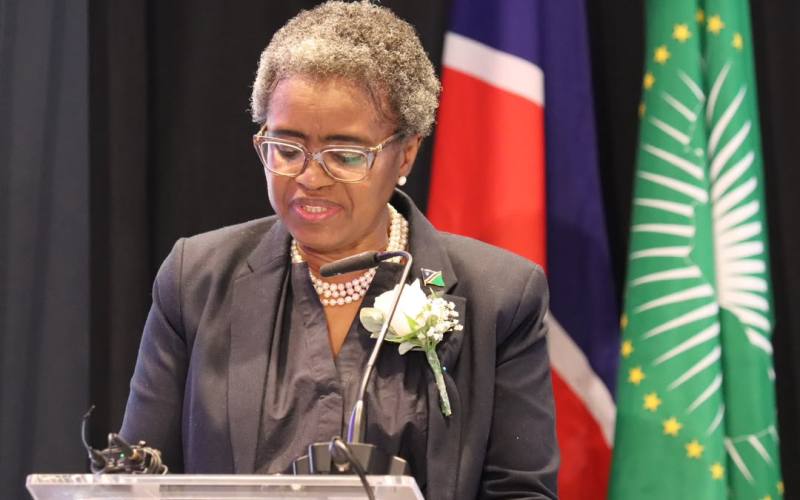
Environment, forestry and tourism minister Indileni Daniel launched NDC 3.0 in Windhoek on Friday, saying Namibia could no longer afford to treat climate action as a long term policy exercise while communities were already experiencing drought, floods, water scarcity, extreme heat and land degradation.
“Today, we are not simply launching another climate document. We are launching Namibia’s climate implementation agenda,” Daniel said.
NDC 3.0 identifies 26 mitigation measures and 106 actions to be implemented by 2035 across energy, agriculture, forestry and other land use, industrial processes and waste.
The plan also places adaptation at the centre of Namibia’s climate response, with nine priority areas, 46 measures and 110 actions covering agriculture and food security, water resources, biodiversity, fisheries, health, infrastructure, coastal zones, urban settlements and broader resilience.
Daniel said the plan must ultimately be judged by whether it improves the lives of Namibians.
“Ultimately, the success of NDC 3.0 must be measured by one simple question: Has it improved the lives and livelihoods of Namibians?” she said.
The minister said Namibia requires approximately US$14.07 billion to implement NDC 3.0, with US$6.42 billion earmarked for mitigation and US$7.65 billion for adaptation.
Only about 12% of the required funding is unconditional, while the remaining 88% depends on international climate finance, technology transfer and capacity-building support.
Daniel said the country must now focus on converting its climate priorities into credible programmes and bankable projects capable of attracting both domestic and international investment.
“Our task now is therefore to move beyond talking about climate finance to mobilising climate finance,” she said.
She stressed that the conditional portion of the funding should not be interpreted as optional, but rather as an indication of what Namibia could achieve if international support matches its climate ambitions.
UNDP resident representative to Namibia Amanda Serumaga echoed the call for implementation, saying the value of NDC 3.0 would ultimately be determined by what happens on the ground.
“The cost of action is significant. The cost of inaction is higher,” Serumaga said.
She said climate action needed to be translated into practical benefits for different sectors of society, including water security and productive land for farmers, investment opportunities and efficient energy for businesses, and stronger livelihoods and food security for communities.
Serumaga said climate priorities must also be reflected in Namibia’s national budget and sector plans.
“Climate priorities that are not reflected in public expenditure and investment decisions will remain aspirations rather than implementation,” she said.
Daniel said climate action would require a whole-of-government and whole-of-society approach, rather than being left to the environment ministry alone.
She said ministries responsible for finance, energy, agriculture, fisheries, water, health, transport, urban development, gender and social protection, together with regional and local authorities, all have responsibilities under NDC 3.0.
The minister also linked the climate plan to Namibia’s natural-resource ambitions, including oil and gas development, saying climate action and economic development should not be treated as opposing objectives.
“Where petroleum development proceeds, it must comply with Namibia’s environmental and petroleum laws, while promoting cleaner technologies, operational efficiency, methane management, robust monitoring and transparent emissions reporting,” Daniel said.
At the same time, she called for continued investment in renewable energy, green hydrogen, energy efficiency and low-carbon industrialisation.
Daniel said accountability would be critical, with the government expected to track implementation, financing and results.
“Because ambition without implementation remains a promise, and a promise must ultimately be measured by results,” she said.
She called on development partners to help mobilise finance, technology and capacity, and urging the private sector to view NDC 3.0 as an investment and innovation opportunity.