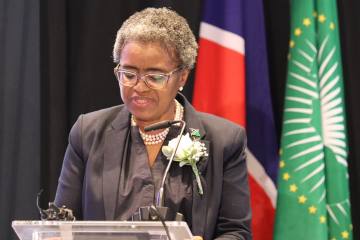
Patience Makwele
Health minister Esperance Luvindao has admitted that State hospitals cannot always attend to Motor Vehicle Accident (MVA) Fund patients because of limited clinical expertise, theatre space and intensive care beds.
Luvindao made the admission in the National Assembly while responding to questions from member of parliament Fenny Nanyeni, who questioned why accident victims covered by the MVA are sometimes referred to or admitted to private hospitals instead of being treated at State facilities.
“Due to limited capacity, State facilities are not always able to attend to all MVA Fund patients,” Luvindao said.
Nanyeni questioned whether the MVA Fund, which is financed through a fuel levy, should put more resources into strengthening public hospitals and establishing trauma centres rather than relying on private facilities to treat road accident victims.
She also asked whether the referral of MVA patients to private hospitals was a result of capacity limitations at State facilities or a policy decision by the Fund.
Luvindao said the fund has invested in public health facilities for close to two decades and continues to work with the ministry of health and social services to strengthen public healthcare.
Among the investments she listed were the renovation of the Emergency Unit at Intermediate Hospital Katutura, medical equipment for Intermediate Hospital Oshakati and a Lodox full-body low-dose X-ray machine at Katutura.
She said the MVA is also consulting the ministry on the renovation of theatres and ICUs at Windhoek Central Hospital and Intermediate Hospital Katutura.
Despite these investments, however, Luvindao acknowledged that State facilities remain unable to accommodate every MVA patient.
She said the limitations include the availability of certain clinical expertise, timely access to theatre space when other surgeries are taking place and limited ICU beds.
“State facilities are not always able to attend to all MVA Fund patients because of limited clinical expertise, theatre space and intensive care beds,” Luvindao said.
The minister said this means the decision on where an MVA patient receives treatment is not based simply on whether the patient is covered by the Fund.
Instead, the fund uses clinical guidelines and considers the severity of the injuries, the capacity of available hospitals, the location of the accident and the availability of appropriate medical personnel.
The proximity of suitable medical care is also considered because reaching appropriate treatment during the “golden hour” can affect the chances of a positive outcome, Luvindao said.
According to Luvindao, the issue is particularly important for patients requiring emergency surgery or intensive care, where delays in accessing the appropriate facility can have serious consequences.
Luvindao said that once critical interventions have been performed, patients can be transferred back to State facilities where appropriate.
“When appropriate, the fund transfers patients back to State health facilities when the critical interventions identified to render life-saving aid have been performed,” she said.
She added that the fund maintains communication with ministry officials at various health centres to facilitate such transfers.
Nanyeni’s questions also put the spotlight on the role of the fund’s fuel levy in strengthening the public health system.
Rather than simply paying for individual patients after crashes, she questioned whether the resources generated through the fund could be used more extensively to improve the facilities where accident victims are expected to receive emergency treatment.
Luvindao said the fund’s investments in public facilities are aimed at capacity building, infrastructure development and strengthening emergency response capabilities.
The minister also disclosed that the planned Windhoek trauma centre remains at an “infant stage” of establishment.
She said land acquisition had been finalised through the City of Windhoek, with the necessary paperwork expected to be completed early in the next financial year.
The development is intended to provide dedicated trauma capacity in the capital, where State hospitals currently have to balance road-crash injuries with other emergency and surgical cases.
The capacity issue comes against a wider expansion of public intensive care services.
The government’s 2026/27–2028/29 expenditure framework says Namibia had fewer than 40 public ICU beds before the Covid-19 pandemic, with capacity subsequently expanded by 55 beds to 97.
The government says it is also working to establish modern ICU facilities at district hospitals across all 14 regions.
Trauma demand remains significant outside Windhoek as well.
Onandjokwe Intermediate Hospital was reported in August to handle an average of 91 bone and joint injury cases a month, including serious trauma cases requiring surgery.
The MVA Fund recently donated a C-arm X-ray machine worth about N$4 million to the hospital to strengthen orthopaedic and trauma care.
For Luvindao, however, the immediate issue remains ensuring that patients reach facilities capable of providing the care they need.
“When appropriate, the fund transfers patients back to State health facilities when the critical interventions identified to render life-saving aid have been performed,” she said.