The launch of Namibia’s first state-owned air ambulance service represents an important step towards addressing one of the country’s longstanding healthcare challenges: the difficulty of accessing emergency medical care across vast distances and often isolated communities. In a country where geography can determine whether a patient reaches specialised medical attention in time, the ability to transport critically ill patients by air is a welcome development.
The Windhoek Observer believes this initiative deserves support. However, its significance must be measured against the practical realities of Namibia’s public healthcare system, where inadequate infrastructure, shortages of medical personnel and unreliable emergency transportation continue to affect thousands of citizens.
Health Minister Esperance Luvindao was therefore right to clarify that the service will not evacuate every patient. Aeromedical transportation is a specialised and costly intervention that must be reserved for circumstances where the patient’s clinical condition warrants it and road transportation presents unacceptable risks or delays.
Patients requiring urgent neurosurgical, cardiac, trauma and obstetric interventions, as well as those needing specialised medical monitoring during transportation, are among those who could benefit. Such prioritisation is both medically responsible and fiscally necessary.
Public resources are finite, and government has an obligation to ensure that expensive services are deployed where they can achieve the greatest clinical benefit. However, the criteria governing access must be transparent, consistently applied and understood by hospitals, medical personnel and the public. The emergency call centre being activated to coordinate referrals and dispatch services must operate efficiently. It must not become another bureaucratic obstacle between a critically ill patient and potentially life-saving assistance.
There is also a broader question that government must confront. An air ambulance, however sophisticated, cannot compensate for weaknesses in the country’s ordinary emergency medical services.
For many Namibians, particularly those in rural communities, the immediate problem is not the absence of an aircraft but the absence of a functioning road ambulance, adequate medical equipment or sufficiently staffed health facilities. Patients can still spend hours waiting for transportation, while families struggle to access basic emergency assistance.
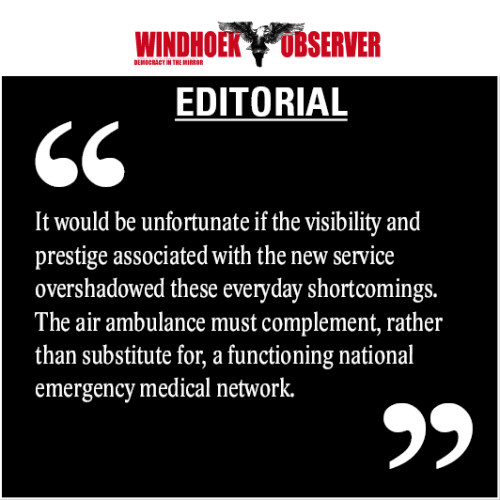
It would be unfortunate if the visibility and prestige associated with the new service overshadowed these everyday shortcomings. The air ambulance must complement, rather than substitute for, a functioning national emergency medical network.
In this regard, the ministry’s intention to establish a dedicated directorate for emergency services is particularly important. Namibia needs an integrated system connecting clinics, district and regional hospitals, national referral facilities, ground ambulances and aeromedical services. Each component must operate within clearly defined protocols, with effective communication and accountability.
The involvement of the Namibian Police Force, the Namibia Defence Force and Government Air Transport Services is encouraging. It demonstrates that government institutions can pool resources and expertise towards a common national objective. That cooperation must, however, extend beyond the launch and translate into sustained operational coordination.
There are equally important financial considerations. Operating a Learjet 31A as a flying intensive care unit requires substantial investment in maintenance, fuel, specialised medical equipment, personnel and training. The government must demonstrate that it has developed a sustainable funding model capable of keeping the service operational over the long term.
Vice President Lucia Witbooi appropriately cautioned that the launch represents only the beginning. This is an important observation. Government projects are frequently celebrated at inauguration, only for operational challenges, inadequate maintenance and funding constraints to undermine their effectiveness later. This initiative must not follow that pattern.
The Namibia Civil Aviation Authority must also maintain rigorous safety oversight. The certification process is a necessary foundation, but continued compliance, regular inspections and operational discipline will be essential.
Ultimately, the success of this service should not be determined by the aircraft acquired, the launch ceremony or the number of kilometres flown. It should be measured by lives saved, response times improved and patients successfully transferred to facilities capable of treating them.
Government deserves credit for recognising the importance of aeromedical emergency services and taking steps to establish them. But the larger responsibility is to strengthen the entire emergency healthcare system, including the less visible but equally essential network of ground ambulances and adequately equipped hospitals.
Namibia needs an emergency medical system that serves citizens wherever they live, not merely those fortunate enough to qualify for an aircraft.
An air ambulance can bring specialised care closer to those who need it. The real test is whether government can build and sustain a system that ensures no Namibian is left waiting for help simply because of where they live.