Patience Makwele
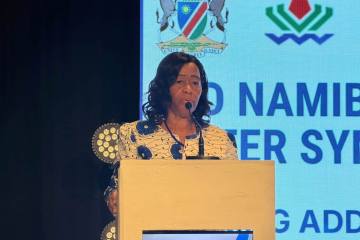
Home affairs, immigration, safety and security minister Lucia Iipumbu has warned correctional officers against corruption, abuse of authority and other forms of misconduct, saying such behaviour undermines public confidence in the Namibian Correctional Service (NCS).
Addressing the graduation ceremony of 296 newly trained correctional officers at Rietfontein in the Otjozondjupa Region on Tuesday, Iipumbu said incidents of absenteeism, insubordination, corruption, substance abuse and criminal conduct continued to undermine the reputation of the service.
She warned both the newly recruited officers and serving members that disciplinary standards must be upheld, regardless of their position.
“The uniform you wear symbolises public trust, authority, responsibility, and sacrifice. Every action you take, whether on duty or off duty, reflects upon both yourself and the institution you represent,” she said.
Iipumbu said officers who deliberately violated established rules and regulations must be prepared to face the consequences of their actions.
“This ministry will not tolerate indiscipline, condone misconduct, or interfere with lawful disciplinary processes,” she said.
She urged officers to conduct themselves professionally, comply with service regulations and perform their duties with integrity.
The minister also cautioned officers against allowing inmates to compromise their professional judgement through gifts, favours, friendships or other forms of influence.
She urged them not to disclose personal information to inmates, accept gifts or favours, or enter into relationships that could compromise their impartiality.
“Always remember that your greatest asset as a correctional officer is your integrity. Once integrity is lost, trust is lost, and without trust, effective correctional management becomes impossible,” she said.
The warning comes against the backdrop of disciplinary concerns within the service. The Anti-Corruption Commission’s 2022/23 report recorded 331 disciplinary cases initiated by the NCS.
Fourteen officers were discharged, while three were demoted during the reporting period.
The Ombudsman’s 2022 annual report also recorded 253 complaints against the correctional service.
These included complaints relating to alleged assaults by officers, medical care, remission and parole, as well as conditions of detention.
Among the complaints were 15 allegations of assaults by correctional officers at Evaristus Shikongo Correctional Facility in July 2022.
The complaints were reportedly submitted to Tsumeb Police Station. The Ombudsman was informed in February 2023 that no action had been taken at that stage.
Section 50 of the Correctional Service Act of 2012 also provides for disciplinary offences involving correctional officers.
These include assaulting inmates, neglect of duty, unauthorised absence, accepting gifts or money from inmates and engaging in relationships with inmates.
Iipumbu further warned officers against financial irresponsibility, saying excessive debt and poor financial planning could expose public servants to corruption and exploitation.
She encouraged the graduates to live within their means, save consistently and avoid unnecessary debt.
The minister also urged officers to prioritise their mental health, noting that correctional work could be stressful and emotionally demanding.
“There should be no stigma attached to seeking professional assistance when faced with personal or occupational challenges,” she said.
Meanwhile, NCS Commissioner-General Raphael Hamunyela said the recruitment of people from different professional backgrounds was intended to equip the service with specialised skills needed to fulfil its mandate.
He said the graduates included people with backgrounds in healthcare, psychology, law, social work, theology, education, agriculture, artisan trades, sport and music.
Hamunyela said the training was conducted in line with the United Nations Standard Minimum Rules for the Treatment of Prisoners, also known as the Nelson Mandela Rules.
Graduate representative Roux-Che Mulike who spoke at the event said the three-month programme had brought together trainees from different regions, cultures and professional backgrounds.
“From strangers, we became a team,” she said, describing the training as a period that tested their physical endurance, mental resilience and ability to work together.
The 296 graduates, comprising 190 men and 106 women, completed a three-month Basic Orientation Training Course that began on 1 August 2026.
The intake initially had 310 trainees, but 14 did not complete the programme.
Six were dismissed for violating college orders, two withdrew voluntarily, one could not continue due to pregnancy, two failed security clearance and three former correctional officers could not proceed with the course.