Falling allocations, rising raw-fish imports and pressure on processing capacity expose the economic consequences of Namibia’s changing fisheries landscape.
Elvis Mboya
President Netumbo Nandi-Ndaitwah’s announcement that Namibia intends to end individual fishing quotas has reopened debate over ownership, sustainability and the economic structure of an industry generating billions in export earnings and supporting thousands of jobs.
Addressing residents at a town hall meeting at Mondesa Multi-Purpose Hall in Swakopmund on Friday, 6 November, the President said declining fish stocks and the sale of beneficiaries’ interests had made the current allocation system unsustainable.
“We are now with not enough fish to give the quotas, and the quota cannot belong to individuals. We are now bShe accused some beneficiaries of selling their interests, allowing control to return to established fishing companies. “What they did is, they sold this industry, and it went back to where we thought we didn’t wringing that to an end,” she said.
ant it to go back,” she said.
The proposed shift towards allocating quotas directly to industry operators could reshape access to marine resources. However, the government has yet to publish the framework or clarify the future of existing rights holders.
A multibillion-dollar industry under pressure
Namibia’s fishing industry generated N$13.8 billion in export earnings in 2024, down from N$14.1 billion in 2023, according to Fisheries Minister Inge Zaamwani-Kamwi.
Its GDP contribution fell from 4.5% to 4.1%, while the government collected N$278 million through quota fees, levies, licence fees and penalties.
Questioning the public return from exploiting a national resource, Zaamwani-Kamwi said: “If you look at the total turnover of the industry in 2024 of N$14 billion and the owner of the resource is getting less than N$300 million, this is a point of reflection for us.”
She said the government needed to increase value addition and the returns flowing to the Namibian public.
National accounts estimates put fishing and aquaculture gross value added at approximately N$6.52 billion in 2024, measuring economic value generated after intermediate production costs.
The sector had 235 commercial fishing vessels and 30 onshore processing facilities, producing 39 value-added fish products. More than 19 000 people were employed in 2024, with women accounting for a substantial share of the onshore workforce.
Beyond exports, fishing supports employment in Walvis Bay and Lüderitz and sustains transport, cold storage, packaging and logistics businesses.
Falling quotas, declining catches
The pressure is reflected in allocations for key commercial species.
Cabinet approved a hake total allowable catch (TAC) of 116 000 tonnes for 2026/27, down from 133 000 tonnes, a 12.8% reduction.
The 2026 horse mackerel TAC was set at 197 000 tonnes, down 5% from 208 000 tonnes in 2025.
The government has attributed the reductions to precautionary, science-based management.
Namibia Statistics Agency figures show quota-species landings fell 20.8% in the fourth quarter of 2025, from 67 382 tonnes a year earlier to 53 392 tonnes.
Hake landings declined from 40 005 tonnes in the third quarter to 18 436 tonnes in the fourth. Horse mackerel accounted for 30 896 tonnes of fourth-quarter landings.
Matti Amukwa, chairperson of the Namibia Hake Association and the Confederation of Namibian Fishing Associations, told local media that the latest hake reduction could put up to 1 500 jobs at risk.
“The reduction of 12.8% (17 000) is equivalent to the entire annual throughput of a major shore-based processor, effectively placing up to 1 500 jobs at immediate risk,” he said.
The figure represents potential exposure, not confirmed job losses. Amukwa added that “data-driven science must determine harvest thresholds to protect the long-term health of our fish stocks”, while calling for greater predictability in allocations.
Processing capacity versus fish availability
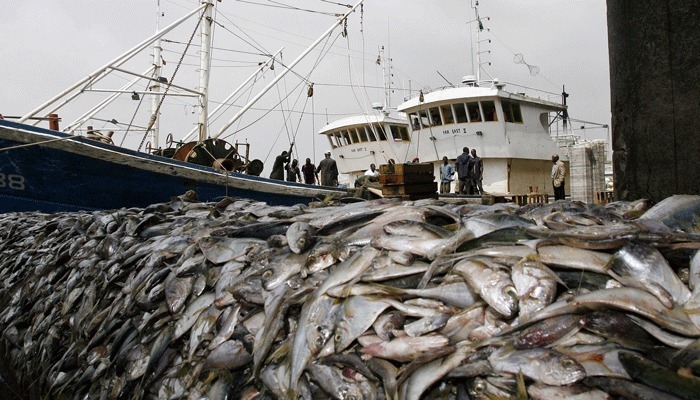
Namibia’s growing processing infrastructure faces a supply constraint since local allocations are increasingly insufficient to keep some factories operating at full capacity.
Reports in local media indicated that fish imports reached almost N$140 million in the fourth quarter of 2025, approximately 40% above the corresponding period of 2024. South Africa supplied 50.1%, Spain 21.7%, with hake the main product sourced.
Merlus Management chairperson Stanley Katzao said: “The country’s hake fishing processing capacity is substantially larger than the TAC and quotas allocated annually.”
He said factories were importing unprocessed hake to sustain production, employment and market supply, with high local quota prices adding to the pressure.
Amukwa confirmed that imported hake from South Africa and South America was processed locally into fillets, portions and moulded loins for re-export.
“The main reason is that our TAC has gone down, but our workforce is still there, so companies are not retrenching,” he said.
“To maintain that workforce, we bring in raw material because we are short of local hake.”
The government is seeking to deepen domestic processing through its wet-fish landing policy.
In her April 2026 State of the Nation Address, the President said monkfish was being processed entirely onshore, while hake processing stood at 80%, with a target of 100%.
For the 2026/27 hake season, the allocation split was changed from 70:30 to 90% wet-landed and 10% freezer-landed fish.
The policy aims to encourage investment, local processing and employment, but depends on sufficient fish supplies.
Export markets and regional opportunity
Spain remains an important destination and distribution hub for Namibian hake, alongside France and Italy.
African markets are significant for horse mackerel and other frozen products, particularly Zambia, South Africa and the Democratic Republic of Congo.
Namibia Statistics Agency figures show fish and related product exports reached N$2.9 billion in the fourth quarter of 2025, up from N$2.6 billion a year earlier.
Spain accounted for 32.3%, Zambia 26.7% and South Africa 9.2%.
Lower hake allocations also affect the Fisheries Observer Agency, which depends heavily on the sector for revenue.
Chief executive Stanley Ndara said: “Hake accounts for about 45% of our projected annual income, followed by horse mackerel. The projected loss is about N$2.6 million, equivalent to one month’s net salary bill for the FOA.”
The agency employs 117 fisheries observers, most deployed on hake vessels. Reduced funding could affect monitoring and compliance.
Who benefits from the resource?
The proposed quota reset raises a central economic question: how can Namibia distribute access to a finite public resource while protecting investment, employment and national returns?
The individual quota system was intended to broaden Namibian participation in an industry historically dominated by established and foreign operators.
However, concerns persist over beneficiaries selling their interests to larger companies, undermining the intended empowerment objectives.
The government has reported 462 active fishing-right holders, with a significant number of rights approaching expiry. Their review offers an opportunity to reassess ownership, performance, compliance and economic benefits.
A new system will need safeguards against concentration of marine resources while providing certainty to companies that have invested in vessels, processing facilities, workers and export markets.
Increasing allocations to sustain factories cannot replace scientific evidence of stock recovery. Equally, reducing quotas without a transition strategy risks undermining investment and employment.
The challenge is to ensure that Namibia’s marine resources generate greater domestic value, sustain jobs, strengthen local processing and deliver a fair return to the public.
With N$13.8 billion in annual export earnings at stake, the proposed reforms will test Namibia’s ability to balance conservation, economic empowerment and the competitiveness of one of its most important export industries.