From ancient copper traders to offshore diamonds and uranium that powers the world, Namibia’s mining story is one of resilience, wealth and unfinished ambition.
Long before Namibia became known as one of Africa’s most stable mining jurisdictions, before giant haul trucks carved through open pits or ships vacuumed diamonds from the Atlantic seabed, the country’s mineral wealth was already shaping the lives of its people.
For centuries, indigenous communities extracted copper, iron, salt and ochre from the land. Copper from the Tsumeb region was fashioned into tools and ornaments, iron ore became weapons and agricultural implements, while salt was traded across southern Africa as a prized commodity.
Long before international mining companies arrived, Namibia’s first miners were already proving that the country’s greatest treasure lay beneath its soil.
Today, mining remains the backbone of the Namibian economy. The sector contributes approximately 13–14% of the country’s Gross Domestic Product (GDP), generates more than 60% of export earnings in many years, attracts billions of dollars in foreign direct investment and supports tens of thousands of direct and indirect jobs.
It has built towns, financed public services and positioned Namibia as one of the world’s leading producers of diamonds and uranium.
Yet, more than a century after the first industrial mines opened, an important question remains unanswered: has Namibia truly captured the full value of its extraordinary mineral wealth?
A country forged by minerals
Few countries can claim that their modern identity has been so profoundly shaped by geology.
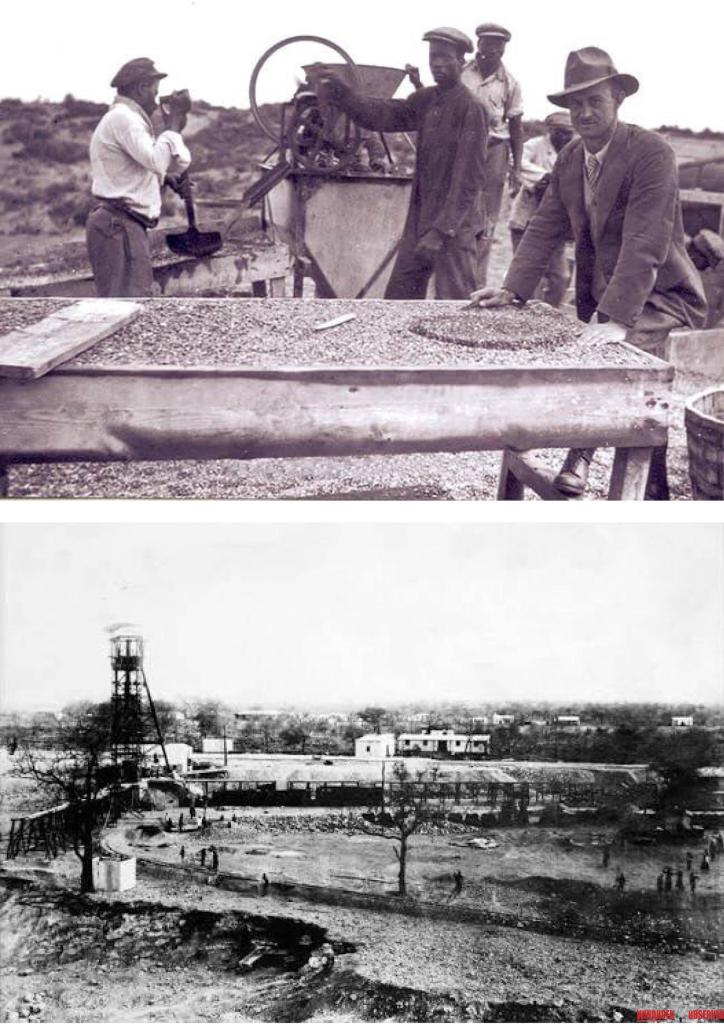
The story begins in earnest during Germany’s colonial administration of German South West Africa between 1884 and 1915. Prospectors quickly realised that beneath Namibia’s harsh and seemingly unforgiving landscape lay extraordinary mineral riches.
Among the earliest discoveries was the legendary Tsumeb Mine, which would become one of the richest polymetallic ore bodies ever discovered anywhere in the world.
Unlike conventional copper mines, Tsumeb produced astonishing concentrations of copper alongside lead, zinc, silver, germanium and dozens of rare minerals. Scientists have identified more than 240 different mineral species at the mine, with many first discovered there.
Tsumeb rapidly evolved into one of southern Africa’s premier mining towns.
Railways were constructed to transport ore to ports, engineering expertise flowed into the country, and supporting industries developed around the mine. It became a symbol of industrial progress long before Namibia itself existed as an independent nation.
Then came the discovery that would forever change Namibia’s fortunes.
When diamonds changed everything
In 1908, railway worker Zacharias Lewala reportedly picked up a glittering stone near Lüderitz while working alongside German railway inspector August Stauch.
It was a diamond.
That single discovery triggered one of the greatest diamond rushes in history.
Within months, prospectors descended upon the Namib Desert. Entire settlements sprang from the sand almost overnight. Among them was Kolmanskop, once one of Africa’s wealthiest towns.
The town became an oasis of luxury in the desert.
Residents enjoyed electricity before Berlin itself had universal electrification. There was an ice factory, hospital, casino, ballroom, school, bakery and even the first X-ray machine in southern Africa, installed not for medicine, but to prevent workers from stealing diamonds.
Such was the extraordinary wealth generated by Namibia’s diamond fields.
Germany soon declared a vast restricted diamond zone known as the Sperrgebiet, an area that remains tightly controlled today.
As richer deposits were discovered further south, Kolmanskop declined, eventually becoming one of the world’s most photographed ghost towns, slowly reclaimed by drifting desert sands.
It remains a powerful reminder of both the prosperity and impermanence of mining booms.
South African rule and industrial expansion
Following Germany’s defeat in the First World War, South Africa assumed administration of the territory.
Mining expanded dramatically.
Diamond production became increasingly mechanised, while offshore exploration revealed that enormous quantities of diamonds had been washed into the Atlantic Ocean over millions of years.
Those discoveries laid the foundation for what is today regarded as the world’s most advanced marine diamond mining industry.
Today, Namibia extracts more diamonds from the ocean floor than any other country on Earth.
Using sophisticated vessels equipped with remotely operated crawler systems, diamonds are recovered from depths exceeding 100 metres beneath the Atlantic.
It is mining unlike anywhere else in the world.
Perhaps even more significant was another discovery made decades later.
The uranium revolution
In the early 1970s, the development of the Rössing Uranium Mine near Swakopmund transformed Namibia into one of the world’s leading uranium producers.
At the time, global demand for nuclear fuel was rising rapidly.
Rössing became one of the largest open-pit uranium mines ever constructed and soon established itself as a cornerstone of Namibia’s export economy.
Today, uranium remains one of Namibia’s most strategically important commodities.
Alongside Rössing, operations such as the Husab Mine, operated by Swakop Uranium, and the Langer Heinrich Mine, operated by Paladin Energy, consistently place Namibia among the world’s top uranium-producing nations.
As countries seek cleaner alternatives to coal-fired electricity, nuclear energy has regained international attention.
This has renewed investor interest in Namibia’s uranium reserves.
Ironically, while Namibia generates relatively little electricity from nuclear power itself, the uranium mined from its deserts helps power cities across Europe and Asia.
Mining after independence
When Namibia achieved independence in 1990, the mining industry remained central to the economy.
The challenge facing the new government was balancing foreign investment with national ownership, environmental responsibility and inclusive economic development.
The solution was not nationalisation but partnership.
Government retained significant interests in strategic operations, most notably through Namdeb, the joint venture with De Beers that manages the country’s diamond resources.
This model has allowed Namibia to remain attractive to international investors while ensuring that mining revenues contribute directly to national development.
Over the past three decades, successive governments have strengthened mining legislation, improved regulatory certainty and encouraged exploration.
The result has been continued investment across diamonds, uranium, gold, zinc, copper and increasingly, critical minerals essential for the global energy transition.
Exploration activity has intensified in recent years, particularly as demand grows for minerals required in electric vehicles, renewable energy technologies and battery storage.
Lithium, graphite, rare earth elements, cobalt and vanadium are all attracting investor interest.
For Namibia, this could represent the beginning of an entirely new mining era.
But it also raises an old question.
Will the country once again export mostly raw materials?
Or will it finally move further up the value chain?
That question may determine whether Namibia merely remains a successful mining nationor becomes a truly industrialised economy.
From Digging Minerals to Building Wealth
If the first century of mining in Namibia was about discovering extraordinary mineral wealth, the next century will be judged on something entirely different: how much of that wealth remains in Namibia.
For decades, economists have described mining as both a blessing and a paradox. It generates foreign exchange, creates jobs and attracts investment, yet its benefits can be fleeting if countries simply export raw materials while importing finished products at many times the value.
Namibia is hardly alone in facing this dilemma. Across Africa, nations rich in natural resources have often struggled to convert mineral wealth into broad-based industrialisation.
The challenge is no longer finding minerals. It is finding ways to extract more value from them before they leave the country’s borders.
Learning from Botswana
Perhaps the most frequently cited comparison is Botswana.
Like Namibia, Botswana is sparsely populated, politically stable and heavily dependent on mining. Both countries built their post-independence economies on diamonds.
Yet Botswana has, over the years, managed to capture significantly more value from its diamond industry.
The decision by De Beers to relocate much of its diamond sorting, aggregation and sales operations from London to Gaborone fundamentally changed Botswana’s economic landscape.
Thousands of skilled jobs were created, while local expertise in valuation, grading, cutting and polishing steadily expanded.
The ripple effects extended well beyond mining. Financial services, logistics, aviation, hospitality and professional services all benefited from the influx of international buyers who regularly travelled to Botswana for diamond auctions.
Namibia has made important progress of its own. Diamond cutting and polishing factories have operated locally for years, and the government has consistently promoted local beneficiation. However, the scale has remained relatively modest compared to Botswana’s transformation.
The lesson is not that Namibia should imitate Botswana in every respect. Rather, it demonstrates that minerals can become the foundation for a diversified economy if governments and industry deliberately build value chains around them.
The world’s underwater diamond capital
One area where Namibia stands entirely alone is marine diamond mining.
While most people imagine miners descending underground or digging vast open pits, Namibia’s diamonds increasingly come from beneath the Atlantic Ocean.
Specialised mining vessels, equipped with sophisticated crawler systems and recovery plants, carefully vacuum diamond-bearing gravel from the seabed before processing it onboard.
The technology is among the most advanced in global mining and represents decades of engineering innovation.
These marine diamonds are renowned for their exceptional quality. Because they have been naturally polished by millions of years of ocean currents, Namibian diamonds consistently command premium prices on international markets.
The country’s reputation is built not on producing the greatest number of diamonds, but among the finest.
That distinction matters.
In luxury markets, quality often outweighs quantity.
Uranium and the global energy transition
If diamonds built Namibia’s past, uranium may well define much of its future.
As governments around the world pursue lower-carbon energy systems, nuclear power has regained prominence.
More than 30 countries are actively expanding or planning new nuclear generation capacity, while small modular reactors promise to reshape electricity production over the coming decades.
That places Namibia in an enviable position.
The country’s uranium reserves rank among the world’s largest, and mines such as Rössing, Husab and Langer Heinrich are strategically important suppliers to international energy markets.
Unlike fossil fuels, uranium is increasingly viewed by many governments as part of the solution to climate change.
Demand is therefore expected to remain robust for decades.
For Namibia, the opportunity extends beyond mining itself.
It includes research partnerships, technical training, specialised engineering services and potentially developing regional expertise in nuclear-related industries.
Gold’s quiet rise
While diamonds and uranium dominate headlines, gold has quietly become one of Namibia’s fastest-growing mining sectors.
The success of the Otjikoto Mine demonstrated that Namibia possesses commercially viable gold deposits capable of attracting international investment.
Exploration has since accelerated, with projects such as Twin Hills promising to extend the country’s gold production for decades.
Gold also offers an important advantage.
Unlike some commodities whose prices fluctuate with industrial demand, gold often performs strongly during periods of economic uncertainty.
That provides Namibia with valuable diversification within its mining portfolio.
Critical minerals, the next frontier
Perhaps the most exciting chapter of Namibia’s mining story has yet to be written.
The global transition toward electric vehicles, renewable energy and battery storage has triggered unprecedented demand for so-called critical minerals.
Lithium powers rechargeable batteries.
Graphite forms battery anodes.
Rare earth elements are essential for wind turbines, electric motors and advanced electronics.
Vanadium is increasingly important for large-scale energy storage.
Cobalt remains crucial in many battery technologies.
Namibia possesses geological potential for many of these minerals.
International exploration companies have taken notice.
If developed responsibly, critical minerals could become the twenty-first century equivalent of the country’s historic diamond discoveries.
The difference is that the world now needs these minerals not simply for economic growth, but for the transition to cleaner energy.
Oil should complement mining, not replace it
Recent offshore oil discoveries have understandably generated enormous excitement.
The prospect of Namibia becoming an oil-producing nation has captured global attention and attracted some of the world’s largest energy companies.
Yet mining should not be overshadowed.
Unlike oil, Namibia’s mining industry has been built over more than a century. It possesses established infrastructure, experienced professionals, strong regulatory institutions and international credibility.
Rather than viewing oil as a replacement for mining, policymakers should see the two industries as complementary.
Together, they could transform Namibia into one of Africa’s foremost natural resource economies.
However, history offers an important warning.
Countries blessed with abundant natural resources sometimes fall victim to the so-called “resource curse”, overdependence on commodity exports, weak economic diversification and growing inequality.
Avoiding that fate will require disciplined governance, transparent institutions and long-term investment in education, infrastructure and innovation.
Beyond extraction
Mining today bears little resemblance to the industry of a century ago.
Automation, artificial intelligence, remote sensing, drone technology and sophisticated geological modelling are transforming how minerals are discovered and extracted.
Future mines will require fewer manual labourers but far more engineers, software specialists, environmental scientists and data analysts.
That presents both an opportunity and a challenge.
Namibia’s universities and technical institutions must ensure they produce graduates equipped for this technological revolution.
Equally important is ensuring that mining companies continue investing in local supplier development.
Every truck maintained locally, every engineering contract awarded to Namibian firms and every technology startup supporting mining operations keeps more value circulating within the domestic economy.
Mining should not be viewed simply as an employer.
It should be an ecosystem.
Responsible mining in an age of sustainability
Modern investors increasingly judge mining companies not only by production figures but also by environmental, social and governance (ESG) standards.
Water management has become particularly important in Namibia’s arid environment.
Uranium mines around the Erongo Region depend on careful water conservation, desalination technology and environmental monitoring to minimise their impact.
Mine rehabilitation has likewise become an essential component of responsible resource development.
Communities increasingly expect that once mining ends, landscapes will be restored and alternative economic opportunities created.
This is no longer optional.
It is central to maintaining the industry’s social licence to operate.
The unfinished journey
Mining has given Namibia much.
It financed railways that connected distant communities. It built ports that linked the country to global markets.
It created towns such as Tsumeb, Arandis, Rosh Pinah and Oranjemund. It generated export earnings that funded schools, hospitals and public infrastructure.
Yet history also reminds us that extraordinary mineral wealth does not automatically produce extraordinary national prosperity.
That depends on the choices countries make.
The next chapter of Namibia’s mining story will not be written solely in underground tunnels or open pits. It will be written in laboratories, classrooms, boardrooms and factories.
It will depend on whether young Namibians become geologists, metallurgists, software engineers and entrepreneurs rather than merely employees in extractive industries.
It will depend on whether more minerals are processed locally, whether communities benefit directly from mining activity and whether resource revenues are invested wisely for future generations.
Beneath Namibia’s vast deserts lies one of the richest geological endowments on Earth.
But the country’s greatest resource has never been uranium, diamonds, copper or gold.
It is the wisdom to transform finite mineral wealth into lasting national prosperity.
If the first century of mining unearthed Namibia’s riches, the next century must ensure those riches build a nation that prospers long after the last mine has closed.