Patience Makwele
Health minister Esperance Luvindao has clarified that Namibia’s newly launched state-owned air ambulance service will not evacuate every patient.
She said access will be determined by the severity of medical conditions and whether road transportation poses a clinical risk.
She made the clarification on Wednesday during the official launch of the country’s first state-owned air ambulance service in Windhoek, which is intended to improve access to emergency medical care for patients in remote communities.
Luvindao said the service would specifically target patients whose clinical conditions and transfer circumstances justify aeromedical transportation.
“Not every single patient that’s qualified. We are guided by strategic policy documents that allow us to ensure that we spend government resources efficiently and effectively,” she said.
She outlined several categories of patients who may qualify, including those requiring urgent specialist interventions unavailable at referring hospitals, where ground transportation is not clinically appropriate.
Critically ill or injured patients for whom road transfers would create unacceptable clinical risks or delays will also be considered.
Other qualifying cases include patients requiring time-critical neurosurgical, cardiac, trauma and obstetric care, as well as those needing specialised monitoring and retrieval capabilities available through the aeromedical team.
To manage access to the service, Luvindao said the ministry had repurposed and activated an emergency call centre that will serve as the central coordination, communication, referral verification and dispatch point.
The centre will assess requests for aeromedical services to ensure that patients with justified medical needs are evacuated and transferred promptly.
The minister said the air ambulance would form part of the ministry’s broader plans to strengthen emergency medical services, including better coordination of emergency teams and ensuring that ambulances across the country remain operational.
The ministry ultimately aims to establish a dedicated directorate responsible for coordinating emergency services, standardising operations and addressing challenges such as non-functional ambulances at hospitals.
Vice President Lucia Witbooi, who officially inaugurated the service, said the initiative was aimed at reducing the impact of Namibia’s vast geography and long distances between remote communities and referral hospitals on access to emergency healthcare.
“When a critical injury occurs, or a medical complication arises in a far remote corner of our beautiful country, time is the absolute boundary between life and death,” she said.
Witbooi said journeys that could take hours by road would, in some cases, be reduced to minutes or a few hours by air, allowing patients to reach specialised care sooner.
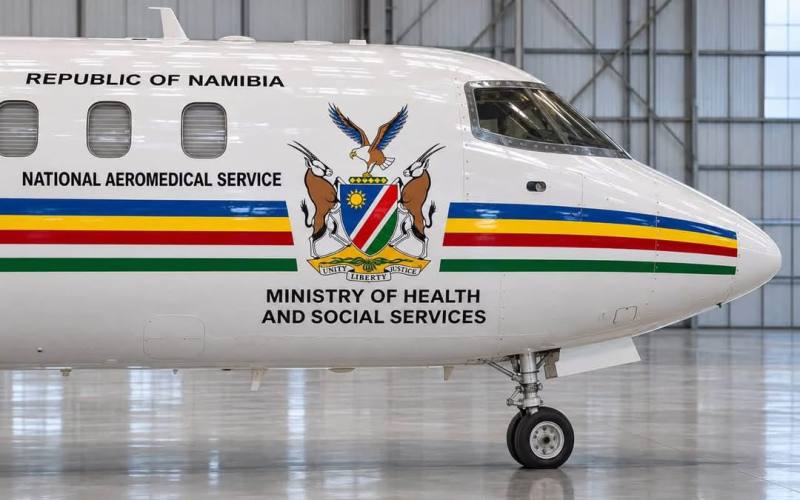
The service includes a Learjet 31A configured as an air ambulance, which Witbooi described as an intensive care unit in the sky.
It will also include helicopter evacuation services through strategic collaboration with the Namibian Police Force (NamPol) and the Namibia Defence Force (NDF) to respond to localised emergencies where necessary.
The package further includes dedicated pilots provided by Government Air Transport Services, specialised emergency medical personnel and emergency service centres at national referral hospitals to facilitate patient handovers.
The Namibia Civil Aviation Authority (NCAA), Executive Director of Civil Aviation, Toska Sam, said the authority began a five-phase certification process in February 2026 to approve the first state-owned air ambulance service.
The process involved documentation reviews, operational assessments and a demonstration flight conducted on 3 October using the Learjet 31A, registration V5-NAG.
Sam said the aircraft underwent evaluations covering operational quality assurance, safety management and emergency response procedures before the operating certificate was issued to Government Air Transport Services.
She said the authority would continue monitoring the service through regulatory oversight, surveillance and periodic inspections to ensure compliance with aviation safety requirements.
Works and transport minister Veiko Nekundi said the initiative had received unanimous Cabinet approval, with no objections raised when it was presented for consideration.
He also credited the ministry of finance for approving the transfer of the aircraft assets from the ministry of works and transport to the ministry of health and social services within seven days of the request, in terms of section 18 of the State Finance Act.
Nekundi said the public ambulance task force, comprising several government ministries and institutions, had played an important role in bringing the initiative to fruition.
He said the task force would continue addressing outstanding implementation matters, coordinating institutional contributions and ensuring the service progresses towards long-term stability.
Witbooi cautioned that the launch marked only the beginning of the initiative, warning that its long-term success would depend on sustained funding, aircraft maintenance, specialised medical equipment, personnel training and operational readiness.
She called on the health ministry and other stakeholders to ensure that the service operates with professionalism, compassion and accountability.
“The real work, and the tangible impact we seek to achieve, lies in ensuring that this service operates efficiently, safely and sustainably for decades to come,” she said.
She added that the initiative’s success should ultimately be measured by the lives saved, injuries prevented and hope restored to families requiring emergency medical assistance.