There is something deeply troubling about the latest legal dispute engulfing TransNamib, and it goes beyond the allegations against one executive or the legality of a N$500 000 forensic investigation.
It goes to the heart of corporate governance at a state-owned enterprise: who is actually in charge?
The High Court will determine whether TransNamib’s appointment of Specialised Investigation Consultancy Services (SICS) was lawful and whether the resulting forensic report can properly be relied upon in disciplinary proceedings against executive Alynsia Platt.
Those are important questions.
But there is another question, perhaps even more fundamental, that should concern government, TransNamib’s board and every Namibian taxpayer: why was the company’s board apparently not consulted before chief executive officer Desmond van Jaarsveld decided to oppose a High Court application in the name of the company?
According to Works and Transport Minister Veikko Nekundi, the answer is straightforward: the board was not consulted and did not approve the decision.
That is a serious governance concern.
A board is not an ornamental body whose members are expected to sit quietly while management makes consequential decisions on behalf of the institution. Its purpose is to provide oversight, strategic direction and accountability.
And TransNamib is not an ordinary private company.
It is a strategic state-owned enterprise entrusted with public assets, public money and a mandate central to Namibia’s economic infrastructure. Decisions taken in its name therefore carry consequences beyond the personalities involved.
The matter becomes particularly uncomfortable because board chairperson Esther McLeod says she was unaware of Platt’s court challenge. Nekundi has gone further, confirming that the board was not consulted and had given no approval for opposing the application.
If that account is correct, the obvious question is: on whose authority was the decision made?
Van Jaarsveld may well have statutory or delegated authority to act for TransNamib in litigation. That is ultimately a matter for the relevant legal framework and, if necessary, the courts.
But legal authority and sound corporate governance are not necessarily the same thing.
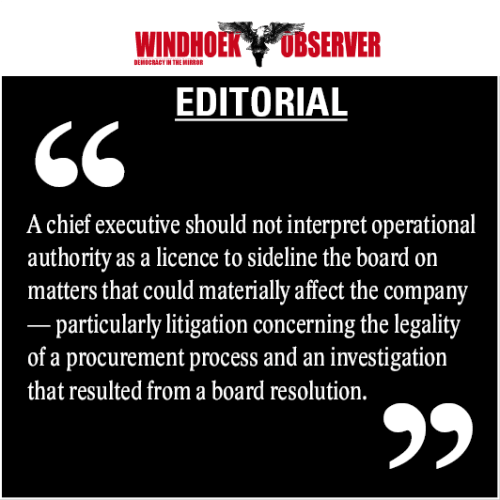
A chief executive should not interpret operational authority as a licence to sideline the board on matters that could materially affect the company — particularly litigation concerning the legality of a procurement process and an investigation that resulted from a board resolution.
The chronology contained in the court papers raises another legitimate concern.
According to the documents, SICS signed a Statement of Work on 21 July 2025, submitted an interim report in September and completed its final report in December 2025.
Yet the formal Notice of Award of the N$500 000 procurement contract was only issued in April 2026.
That chronology demands explanation.
Van Jaarsveld argues that the April 2026 notice was a subsequent notification contemplated by the Public Procurement Act. He disputes the contention that the procurement was unlawful and maintains that even if irregularities occurred, they would not automatically invalidate the investigation, its findings or the disciplinary proceedings against Platt.
Those are legitimate legal arguments. TransNamib is entitled to defend itself.
But the public is equally entitled to ask whether procurement law was followed and, if so, why the formal award appears to have followed the completion of the investigation.
This newspaper is not declaring SICS’s appointment unlawful. Nor are we declaring Platt innocent of the allegations contained in the disciplinary charges. Those matters remain subject to due process.
But neither should the public be expected to accept an unusual procurement chronology without scrutiny.
The investigation concerns alleged irregularities involving the lease and disposal of two TransNamib properties, as well as alleged undisclosed private business interests. Its findings subsequently became the basis for eight disciplinary charges against Platt.
When a forensic investigation becomes the foundation for disciplinary action against a senior executive, the integrity of the process that produced that investigation matters.
If the procurement was lawful, TransNamib should be able to demonstrate that clearly.
If it was irregular, the company should confront that reality and determine what consequences follow.
And if the investigation remains legally usable despite any procurement irregularity, that should be established through due process rather than managerial assertion.
There is, however, a larger issue that cannot be ignored.
Namibia cannot continue preaching good corporate governance in its state-owned enterprises while tolerating structures in which boards are informed after consequential decisions have already been taken.
Government has spent years demanding better performance, stronger accountability and greater professionalism from SOEs. Those demands are justified. But accountability must run in both directions.
Boards must hold executives accountable.
Executives must respect boards.
Ministers must respect the independence of boards while ensuring that boards perform their statutory responsibilities.
And boards themselves must be sufficiently assertive to exercise oversight rather than merely rubber-stamp decisions after the fact.
Nekundi’s warning that Van Jaarsveld could personally be held accountable for legal costs if the court rules against TransNamib is therefore significant.
If public resources were committed to litigation without proper institutional authority, the matter cannot simply disappear into the general cost of doing business.
Someone must answer.
The High Court will decide the legal questions. It should be allowed to do so without political interference or public pressure.
But government should not wait for the judgment before examining the governance questions.
The real scandal would not be whether one side wins or loses this court application.
The real scandal would be if a state-owned company has reached a point where its board can be bypassed on consequential litigation and everyone simply carries on as though nothing happened.
TransNamib belongs to Namibia.
Its assets belong to the people.
Its board has a fiduciary responsibility.
Its executives have authority, but that authority must have boundaries.
And when those boundaries are unclear, the answer cannot be to shrug.
It must be to ask the most basic question of corporate governance:
Who is really in charge?