Staff Reporter
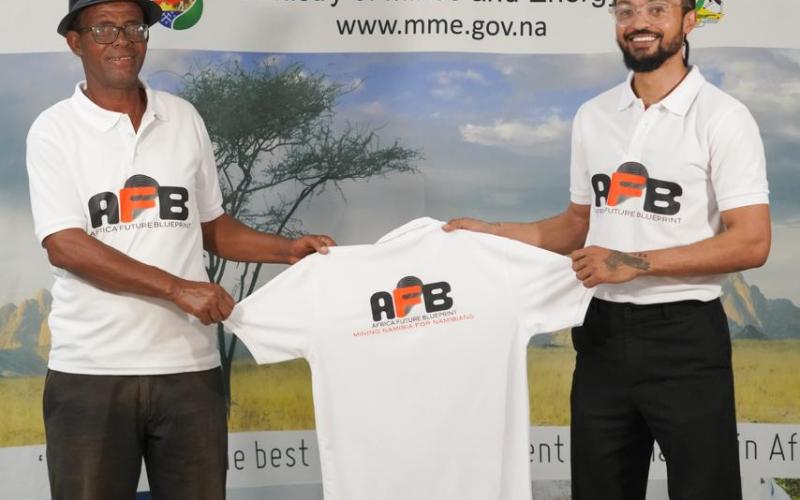
AFRICA Future Blueprint Exploration (AFB) has signed agreements covering approximately 100 mining claims in the Kunene region as it prepares to consolidate the assets and develop them into commercially viable mining projects.
The company, founded by Namibian entrepreneur Ennio Hamutenya, is preparing to begin exploration across the claims to establish their mineral potential, with interests spanning uranium, rare earth elements, gold, copper and silver.
The initiative is aimed at helping small-scale miners who hold mineral rights but lack the financial resources, machinery and technical expertise to develop their claims independently.
AFB plans to bring together claim owners, financiers, technical operators, service providers and mineral buyers to support exploration and mining activities.
Hamutenya said many small-scale miners struggled to develop their claims because of limited access to funding, equipment, regulatory support and markets for their minerals.
As a result, some were left with little negotiating power and sold unprocessed ore below its potential market value because they needed immediate income.
“Mining cannot be measured only by what is taken out of the ground or by the revenue recorded by a company,” Hamutenya said.
“We must also ask what the miner receives, what remains in Namibia, and what changes for the people living in the communities where mining takes place. Our principle is simple: Mining Namibia for Namibians.”
Under the proposed model, AFB intends to provide exploration and operational funding, machinery and technical expertise, while assisting claim owners with Environmental Clearance Certificate processes and other regulatory requirements.
The company also plans to facilitate access to mineral processing and trading opportunities, allowing miners to benefit from the value created beyond the initial sale of unprocessed ore.
AFB says it is working to consolidate suitable claims and develop partnerships that allow original claim owners to remain economically involved as projects grow.
Rather than receiving once-off payments and losing any further interest in the projects, participating miners are expected to retain a stake in their long-term development.
The company’s longer-term ambition is to develop the projects to a stage where they could potentially pursue listings on recognised international stock exchanges, subject to their performance, market conditions and applicable regulatory requirements.
Community development
AFB also intends to allocate between 10% and 15% of relevant project value or proceeds towards community development, depending on the structure and feasibility of individual projects.
Hamutenya said the company would work with traditional authorities and communities to identify development priorities, including access to water, infrastructure, education and other locally identified needs.
He said mining companies should be accountable for what they contribute to communities surrounding their operations, particularly where residents continue to lack basic services despite living close to valuable mineral resources.
AFB wants community development to form part of its mining model from the beginning rather than being treated as an obligation after mining activities have generated revenue.
Hamutenya also called on local mining entrepreneurs to establish partnerships that protect small-scale claim owners instead of taking advantage of their financial circumstances.
“This cannot be done by AFB alone. We need more Namibian entrepreneurs to work together, build credible projects and make sure that small miners receive the value they deserve. We also need to challenge ourselves as businesspeople: what are we leaving behind in the communities where we operate?” he said.
Expansion plans
AFB has invited small-scale miners and mining claim owners in the Kunene region with prospective ground or mineral opportunities to approach the company for possible partnerships.
The company is seeking claim owners who need exploration, technical, financial, regulatory or operational assistance.
It has also called for cooperation between government, traditional authorities, local entrepreneurs, claim owners and investors to address obstacles facing small-scale mining.
AFB intends to demonstrate its model in Namibia over the next two to three years before exploring opportunities to introduce a similar approach in other African countries.
Hamutenya said the initiative was intended to change how mineral resources benefit local communities and the people who hold the rights to them.
“We have to change the conversation around mining. It is not enough to say that Namibia is rich in minerals. We must show how that wealth improves the lives of Namibians, especially the small miners and communities closest to the resources. That is what Mining Namibia for Namibians means,” he said.