There is something profoundly disturbing about the description of a town where smoking crack cocaine has allegedly become as commonplace as eating sweets. If the account of a recovering addict in Rehoboth is even remotely representative of the reality on the ground, Namibia is facing a drug crisis that can no longer be treated as a routine policing matter.
The revelations about Rehoboth should alarm every parent, community leader, law enforcement agency and policymaker. They point to a disturbing ecosystem in which drugs are not merely being sold and consumed but are allegedly sustaining networks of dealers, customers and suppliers, with addiction becoming normalised in parts of the community.
The repeated arrests of suspected dealers, including Naomi Fisch, may make headlines, but they also raise a more uncomfortable question: what happens after the police make an arrest? Who takes over the market? Who supplies the drugs? Who protects the trade? And why does the business appear attractive enough for new players to enter it?
These are questions that cannot be answered by counting arrests alone.
The account presented by Daniel, a recovering addict and former gang member, deserves serious attention. His estimate of 5 000 addicts in Rehoboth has not been independently verified and must be treated with caution. Nevertheless, his description of how individuals allegedly move from street-level selling to establishing their own operations provides a disturbing insight into the mechanics of an illicit economy.
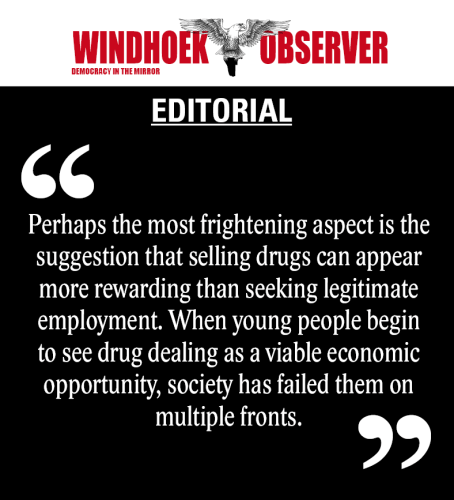
Perhaps the most frightening aspect is the suggestion that selling drugs can appear more rewarding than seeking legitimate employment. When young people begin to see drug dealing as a viable economic opportunity, society has failed them on multiple fronts.
But unemployment cannot become an excuse for criminality. Nor should difficult childhoods, broken family relationships or social rejection be used to romanticise those who profit from other people’s addiction. Drug dealers are not entrepreneurs in any legitimate sense. They are participants in an economy that destroys families, steals futures and places enormous pressure on already stretched public health and security services.
There is also a social dimension that deserves greater attention. Daniel’s account suggests that the drug trade offers some individuals money, recognition, influence and a sense of belonging. This is particularly troubling because it points to a deeper breakdown in the social fabric. When criminal networks provide the identity, acceptance and economic opportunity that legitimate institutions fail to offer, the consequences extend far beyond drug consumption.
The police must therefore look beyond individual suspects. If there are interconnected networks operating in Rehoboth, investigations must follow the money, identify suppliers, establish distribution channels and determine whether anyone is facilitating or protecting the trade. Allegations of organised cooperation and protection must be investigated, not simply repeated.
Equally, the Ministry of Health, local authorities, schools, churches and community organisations must confront the demand side of this crisis. Addiction is not defeated through arrests alone. Rehabilitation, prevention, counselling and reintegration must become central components of the response.
Rehoboth should be a warning to the rest of Namibia. No community is immune, and no town can police its way out of an addiction crisis without addressing the conditions that sustain it.
We cannot afford to wait until an entire generation has been lost before recognising the scale of the problem.
The question is no longer whether Rehoboth has a drug problem. It is whether those entrusted with protecting the community have the courage, resources and determination to dismantle the business behind it.
Arresting dealers is necessary. Breaking the market is imperative. Saving the addicts is non-negotiable.