Desmarius Hansen
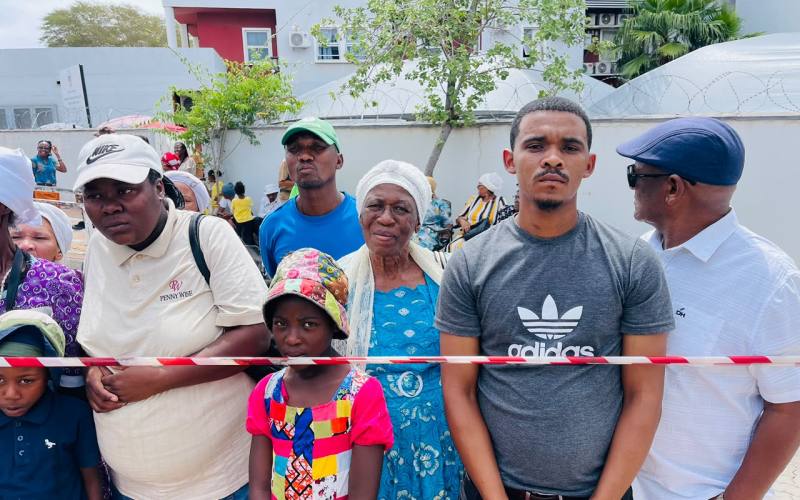
Agriculture, fisheries, water and land reform minister Inge Zaamwani-Kamwi has committed to providing the /Khomanin traditional community with feedback on its land demands by Thursday at 11:00, following a protest at the ministry’s offices in Windhoek.
The community had been seeking an audience with the minister over a submission mass in February requesting, among other things, the acquisition of five farms during the current financial year.

The community had initially expected feedback at 15:45 on Tuesday, but was left waiting while ministry officials attempted to establish contact with the minister.
Community members insisted on meeting her directly, with one saying they had been trying to reach her since February.
“We were adamant to see the honourable minister today. We have been trying to get a hold of her since February this year. We are just asking that the minister at least sacrifice her lunch hour,” a community representative said.
Zaamwani-Kamwi eventually arrived, explaining that she had been informed about the petition and the planned peaceful demonstration and had delegated her executive director to receive the documents from the community.
She acknowledged receiving the community’s communication following a meeting on 13 February, saying it had been referred to the relevant department for consideration and preparation of a response.
“I have now received a draft response. I’m looking at it before I sign it,” she said.
The minister said she expected to send the response by Wednesday or Thursday, eventually committing to provide feedback by Thursday morning at 11:00 after requesting an additional 24 hours.
The February submission was compiled by a 10-member committee representing various /Khomanin community groups, associations and activists, including the Landless /Khomanin People’s Association and the Ancestral Land Foundation.
In the letter, the community describes land as central to its identity, spirituality, culture and survival, arguing that poverty reduction and food security cannot be achieved without access to land.
It further claims that the /Khomanin are among the communities that suffered historical dispossession, alleging that their ancestral land in the Khomas region was taken during German colonial rule and continued under South African administration.
The community says it has remained landless on much of its ancestral territory despite Namibia’s independence in 1990.
The five-farm request also comes amid concerns over the allocation of land through the Land Acquisition and Development Fund.
Community representatives questioned why returnees from Botswana had benefited from the allocation of six farms while the /Khomanin continued to seek access to land.
The latest protest follows earlier demonstrations and disputes over land allocation, the traditional authority and the removal of Chief Julianne Qawanas.
“We removed her traditionally, yes, but we also want her to be decertified for government contractual purposes.” /Khomanin Association chairlady, Verona !Kharuxas previously told urban and rural development minister James Sankwasa.
The community has said it will continue pursuing its demands for land and accountability from the government.
Zaamwani-Kamwi’s promised response on Thursday is expected to clarify the ministry’s position on the issues raised in the February submission.