Namibia has four years left to achieve the United Nations Sustainable Development Goals (SDGs) for 2030. Yet, as the country approaches this deadline, the latest figures suggest that the challenge is not simply a question of implementation, but also whether government has the information necessary to measure progress and make informed decisions.
Prime Minister Elijah Ngurare was therefore right to warn that Namibia cannot continue with business as usual. However, the warning must translate into more than another declaration of intent. It must be followed by measurable action, clear accountability and a willingness to confront uncomfortable realities.
The launch of the 2025 SDG Indicator Framework and Portal is a welcome development. Namibia can currently report on 176 of the 248 indicators assessed, representing 71% reporting capacity. While this is an improvement from 66% in 2019, the fact that 72 indicators remain without reporting coverage is concerning.
Good governance and effective development planning depend on reliable, current and accessible information. Without it, government risks designing interventions that do not address the actual needs of communities or accurately measuring whether public spending is producing meaningful results.
But there is an important distinction between measuring development and achieving it. A country can improve its statistical reporting capacity without necessarily improving the lives of its citizens.
Namibia’s development challenges are well documented. Approximately 40% of households lack adequate sanitation, unemployment stands at 36.9%, and poverty remains widespread. Young people and women continue to bear a disproportionate share of the economic burden.
These are not merely statistics. They represent households struggling to make ends meet, young people unable to find employment, communities without adequate sanitation and families uncertain about their next meal.
The international assessment placing Namibia 100th out of 169 countries, with a score of 67.1, should serve as a reminder of the distance between our development ambitions and our actual performance.
The updated framework and online portal could help close the information gap, but only if government institutions take ownership of the process. Ministries, agencies and regional authorities must regularly update their data, explain poor performance and demonstrate how identified shortcomings are being addressed.
There is also a need to ensure that information is disaggregated. National averages can conceal significant inequalities between urban and rural communities, regions, genders and income groups. Development planning must recognise these differences rather than assume that progress in one part of the country represents progress everywhere.
Furthermore, the Sixth National Development Plan must become the practical instrument through which Namibia accelerates its SDG commitments. Its priorities of wealth creation, employment and greater equality are appropriate, but they require implementation discipline, adequate funding and effective coordination across government.
The private sector, civil society and local communities must also be part of this effort. Government cannot shoulder the entire development burden, but it must provide the leadership, policy certainty and institutional accountability necessary to mobilise wider participation.
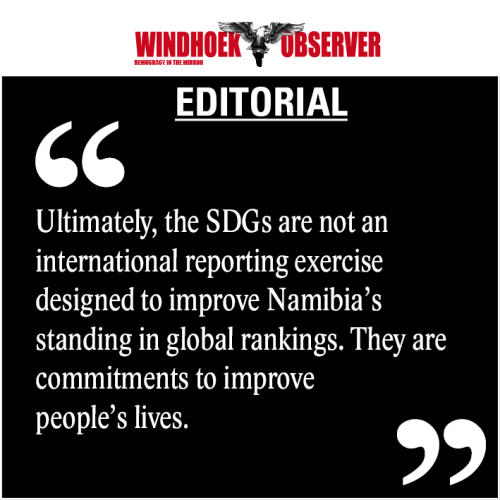
Ultimately, the SDGs are not an international reporting exercise designed to improve Namibia’s standing in global rankings. They are commitments to improve people’s lives.
The new framework gives Namibia a better opportunity to understand where it stands. The more important question is whether government will use that information to change course where necessary.
Four years is a relatively short period in development planning. It is, however, enough time to make meaningful progress if priorities are clear and implementation is taken seriously.
Namibia does not need another set of ambitious promises. It needs measurable results that citizens can see and experience.