The Namibia Airports Company’s declaration of its first dividend in 20 years is more than a financial milestone. It is an encouraging signal that, with the right leadership, accountability and commercial discipline, Namibia’s state-owned enterprises can become productive national assets rather than permanent burdens on the public purse.
The decision to pay N$7.7 million to the government, following a reported net profit of N$23 million, deserves recognition. It is particularly significant given NAC’s history and the challenges that have confronted the company over the years. For an enterprise that has spent much of its existence under the weight of operational, financial and governance concerns, returning to a position where it can reward its shareholder is an achievement worth acknowledging.
It is also a reminder that the debate about Namibia’s state-owned enterprises must move beyond the familiar narrative of losses, bailouts, mismanagement and political interference. While these concerns remain legitimate and must never be dismissed, they should not become an excuse for accepting mediocrity as an inevitable feature of public ownership.
NAC has demonstrated that a different outcome is possible.
The N$7.7 million dividend, declared at the company’s annual general meeting on 30 October, represents approximately one-third of its reported net profit. This is an important development, not simply because of the amount involved, but because of what it says about the company’s capacity to generate a surplus while meeting its operational responsibilities.
For government, every additional revenue stream matters. Namibia faces considerable demands on its national budget, from infrastructure development and education to healthcare, housing and social protection. Revenue generated by commercially viable public enterprises can help ease some of this pressure.
Minister of Works and Transport Veikko Nekundi was therefore right to welcome the dividend as evidence that state-owned enterprises can fulfil their mandates, operate commercially and contribute to government revenue rather than depend exclusively on Treasury support.
That is precisely the culture Namibia needs to cultivate across its public enterprise sector.
For too long, the performance of many state-owned enterprises has raised difficult questions about whether public ownership is translating into public value. Taxpayers have had to contend with institutions that struggle to meet their financial obligations, deliver adequate services or justify the resources allocated to them. In some instances, government has been forced to intervene repeatedly to keep essential entities afloat.
This is neither sustainable nor acceptable.
State-owned enterprises were established to serve strategic national interests, provide essential services and, where commercially viable, generate returns for their shareholder. They are not intended to become institutional extensions of the national budget, insulated from the consequences of poor performance.
The NAC milestone should therefore be viewed as an example of what is possible when commercial responsibility becomes an organisational priority.
However, celebrating this achievement must not mean overlooking the work that remains. One dividend does not erase two decades without a payout, nor does it automatically resolve the structural and operational challenges that have historically affected the company. NAC must demonstrate that this performance is sustainable and that the dividend represents the beginning of a more consistent record of financial discipline.
The company occupies a particularly important position in Namibia’s economic infrastructure. Airports are not merely transportation facilities. They are gateways through which tourists, investors, business travellers and international partners encounter the country. Their efficiency, safety, reliability and service standards influence perceptions of Namibia as an investment and tourism destination.
As Namibia seeks to position itself as an emerging destination for energy investment, mining, tourism and international business, the importance of a capable and commercially sustainable airports operator cannot be overstated.
The country’s ambitions in oil and gas, green hydrogen, logistics and regional trade will require infrastructure that can support increased economic activity. Airports must be part of that equation.
NAC therefore has a responsibility that extends beyond its balance sheet. It must continue investing in infrastructure, improving passenger experiences, maintaining international safety standards and ensuring that Namibia’s airports remain competitive with those in the region.
Profitability should strengthen this mandate, not compromise it.
The declaration of a dividend also brings into focus the responsibility of government as shareholder. A financially successful public enterprise requires an enabling environment in which professional management can make commercially sound decisions without unnecessary political interference. Boards must be appointed on merit, management must be held accountable, and performance must be measured against clear and transparent objectives.
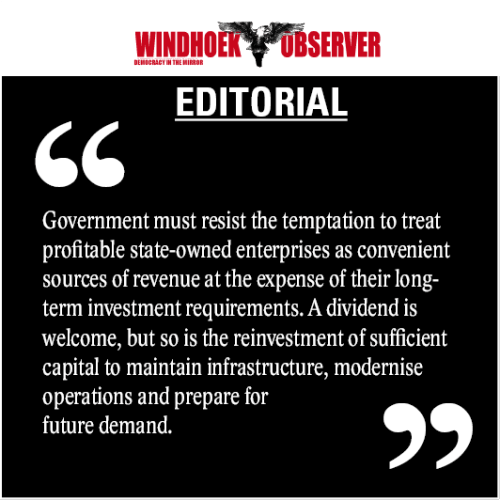
Government must resist the temptation to treat profitable state-owned enterprises as convenient sources of revenue at the expense of their long-term investment requirements. A dividend is welcome, but so is the reinvestment of sufficient capital to maintain infrastructure, modernise operations and prepare for future demand.
There must be a sensible balance between shareholder returns and the sustainability of the enterprise.
Equally, NAC should make financial performance and corporate governance central to its institutional culture. Transparency, prudent expenditure, effective procurement and accountability must become permanent features of its operations, rather than occasional responses to public scrutiny.
The achievement should also encourage other state-owned enterprises to examine their own operating models. Namibia does not need every public enterprise to generate dividends, particularly where its primary responsibility is providing an essential public service. But every entity must demonstrate value for money, operational efficiency and a clear commitment to serving the national interest.
Commercial discipline and public service are not mutually exclusive.
Indeed, the strongest public enterprises understand that financial sustainability is what enables them to fulfil their mandates over the long term.
NAC’s first dividend in two decades may not transform Namibia’s public enterprise landscape overnight. Nor should N$7.7 million be mistaken for a solution to the country’s broader fiscal challenges. But milestones matter, particularly in institutions where the public has become accustomed to disappointing news.
It is important to recognise progress when it happens, just as it is important to demand accountability when institutions fall short.
The message from NAC should be clear: public ownership need not mean poor performance, and a government enterprise can be both commercially responsible and nationally relevant.
Namibia needs more of this.
The real test now is whether NAC can turn this milestone into a lasting culture of excellence, profitability and responsible public service. The first dividend in 20 years is a good beginning. The country should expect many more.