President Netumbo Nandi-Ndaitwah’s presence in Moscow this week is an important reminder of the enduring political relationship between Namibia and Russia. The two countries share a history forged during Namibia’s liberation struggle, when the Soviet Union provided political, diplomatic and material support to the liberation movement.
That history matters. It should neither be forgotten nor diminished.
But history alone cannot build an economy.
As the President participates in the Russia–Africa Summit, Namibia should use the occasion to ask a practical question: how can a longstanding political friendship be converted into a stronger economic partnership that delivers tangible benefits to Namibians?
The latest figures from the Institute for Public Policy Research’s Namibia Quarterly Economic Review provide a sobering starting point.
Namibia exported goods worth only N$65.3 million to Russia in 2025, down from N$100.1 million in 2024. Russia accounted for a mere 0.07 percent of Namibia’s total goods exports, ranking just 33rd among the country’s export destinations.
That is remarkably small for a country with which Namibia enjoys such longstanding political ties.
More revealing is the narrow composition of Namibia’s exports. Crustaceans accounted for N$44.1 million, while fruit and nuts contributed N$18.4 million. Together, those two categories represented almost 96 percent of Namibia’s exports to Russia.
On the other side of the equation, Namibia imported N$791.8 million worth of goods from Russia in 2025, up from N$480 million in 2024.
Wheat accounted for N$575.1 million and fertilisers for N$196.7 million, representing more than 97 percent of imports from Russia.
There is nothing inherently wrong with this imbalance. Countries trade according to their respective needs and competitive advantages. For Namibia, access to wheat and fertiliser is important, particularly in the context of food security and agricultural production.
But the figures expose a wider weakness.
For all the political warmth between Windhoek and Moscow, the economic relationship remains shallow and highly concentrated.
That should not be viewed as a failure of diplomacy. Rather, it should be viewed as an opportunity.
Namibia is entering a period in which it needs substantial capital, markets, technology and expertise. The country is seeking to develop its oil and gas resources, expand green hydrogen, grow its mining industry, strengthen agriculture, improve infrastructure and diversify tourism.
Russia, like every other major economic power, should be asked what it can contribute to these ambitions.
The answer cannot simply be political solidarity.
Nor should Namibia approach Russia through the prism of the increasingly polarised geopolitical competition between Moscow and the West. Namibia has no reason to choose between Russia, the United States, Europe, China, India or other international partners.
Our foreign policy should be guided by one overriding consideration: what serves Namibia’s national interest?
That means welcoming Russian investment where it meets Namibia’s laws, environmental standards and development objectives, while applying exactly the same standards to investors from everywhere else.
The proposed Rosatom uranium project near Leonardville demonstrates why this principle matters.
Russian investment in uranium could potentially bring capital, employment, infrastructure, skills and revenue. Those are legitimate benefits that Namibia should examine seriously.
But the concerns surrounding the Stampriet Aquifer must also be taken seriously.
Namibia is one of the driest countries in the world. Water security is therefore not a peripheral environmental concern. It is a national strategic issue. Any development that could affect an important underground water resource must be subjected to rigorous scientific assessment and transparent regulatory processes.
Political friendship cannot substitute for environmental safeguards.
Nor should environmental concerns automatically become an argument against Russian investment. The correct approach is evidence, transparency and adherence to Namibia’s laws.
There may also be opportunities in tourism.
Russian tourist arrivals increased from 3,501 in 2024 to 8,727 in 2025. While still a relatively small market, the growth suggests potential. Namibia’s extraordinary landscapes, wildlife and tourism infrastructure could appeal to a much larger Russian market if connectivity, marketing and travel arrangements are properly developed.
But again, the challenge is turning potential into business.
The same applies to agriculture, education, science, technology and trade. Namibia should be identifying specific sectors in which Russian capabilities and capital can complement Namibian opportunities.
This is where the President’s visit becomes important.
Summits often produce declarations, communiqués and expressions of friendship. Those are useful, but they should not be the end of the process.
Namibia needs concrete agreements, investment commitments, market access and partnerships that can be measured.
The country has had decades of political solidarity with Russia. What it needs now is a new generation of economic solidarity.
That does not mean abandoning the principles that have historically guided Namibia’s foreign policy. It means adapting them to the economic realities of an independent Namibia.
The Soviet Union supported Namibia when the country was fighting for political freedom. Today, Namibia’s challenge is different. It is fighting poverty, unemployment, inequality and economic dependence. It needs investment and productive capacity. It needs markets for Namibian goods. It needs technology and skills. It needs an economy capable of creating opportunities for its young people.
Russia can be part of that story.
But it cannot be assumed that political friendship automatically produces economic benefit.
The IPPR figures make that abundantly clear.
The task before President Nandi-Ndaitwah is therefore not to prove that Namibia is a friend of Russia. That friendship is already well established.
The task is to determine what that friendship can produce.
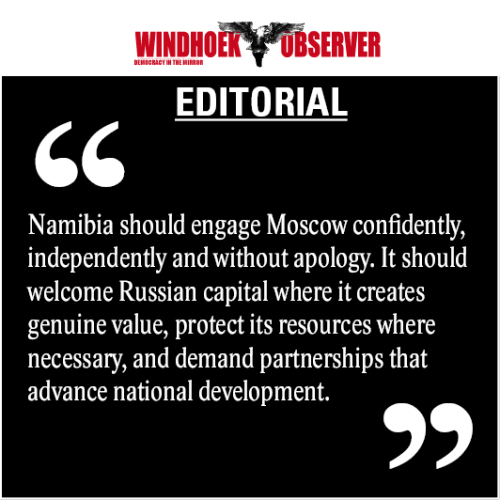
Namibia should engage Moscow confidently, independently and without apology. It should welcome Russian capital where it creates genuine value, protect its resources where necessary, and demand partnerships that advance national development.
Namibia does not need more symbolism from its international friendships. It needs results.
If Russia wants a deeper economic relationship with Namibia, Moscow should be prepared to demonstrate what it can bring to the table.
And Namibia should be equally clear about what it expects in return.