There was a time when Namibia mattered enormously to the United Nations.
Not because we were a large country. Not because we possessed great military or economic power. Not because we had a population large enough to command attention.
We mattered because our very existence as an independent nation had become an international question.
For decades, the question of Namibia was debated in the corridors of the United Nations. The country’s liberation struggle became intertwined with the international campaign against colonialism and apartheid.
The UN General Assembly recognised SWAPO in 1976 as the “sole and authentic representative” of the Namibian people. Security Council Resolution 435, adopted in 1978, provided the internationally accepted framework for Namibia’s transition to independence.
And in 1989, the United Nations Transition Assistance Group was deployed to help supervise the transition, including the country’s first democratic elections.
Namibia became independent on 21 March 1990 and joined the United Nations shortly afterwards, becoming its 160th member.
Our independence was therefore not merely a domestic political achievement.
It was, in the language of the United Nations itself, one of the organisation’s great success stories.
Thirty-five years later, however, a legitimate question must be asked:
What happened to Namibia’s international standing?
Do we still occupy a meaningful place in the rooms where the international agenda is shaped?
Do other countries look to Namibia for leadership on particular questions?
Do we have political champions who can advance Namibian interests when we are not physically sitting at the table?
Or have we become a respectable but relatively quiet member of the international community?
These are uncomfortable questions, but they are necessary ones.
From international cause to international actor
The generation that led Namibia to independence understood something that today’s Namibia sometimes appears to forget: small countries can have influence far greater than their size if they develop the diplomatic capacity, political relationships and moral authority to exercise it.
Theo-Ben Gurirab is perhaps the clearest example.
Before independence, Gurirab spent 14 years as SWAPO’s chief representative at the United Nations.
The UN itself records that under his stewardship, SWAPO moved from being a petitioner on the sidelines of diplomacy to becoming a mainstream participant and negotiator in international affairs.
He later became Namibia’s foreign minister and, remarkably, President of the 54th session of the UN General Assembly.
That is what international influence looks like.
It is not necessarily about having a permanent seat on the Security Council.
It is about having people who understand the international system, know the personalities within it, build relationships and are trusted enough to influence conversations beyond their country’s immediate weight.
Namibia produced such people.
The question is whether we are producing them today.
We should not romanticise the past
There is a danger in looking backwards through rose-coloured glasses.
Namibia’s diplomatic prominence after independence was partly inherited from the liberation struggle itself. The country arrived on the international stage with enormous goodwill.
The story was compelling.
A people colonised for decades had achieved independence through a negotiated settlement. A United Nations mission had helped oversee the transition. The country adopted a democratic Constitution. It became a symbol of peaceful decolonisation.
That was diplomatic capital.
And Namibia used some of it effectively.
In 1999 and 2000, Namibia served on the UN Security Council. During that period it presided over the Council twice.
Theo-Ben Gurirab served as President of the General Assembly. Namibia also participated in important UN and multilateral bodies and conferences.
These were not ceremonial accomplishments.
They placed Namibians in rooms where consequential international decisions were being debated.
But international influence cannot survive indefinitely on historical goodwill.
Countries have to continually earn relevance.
So where are we now?
The answer is more complicated than either “Namibia has lost its influence” or “Namibia remains highly influential.”
There is evidence for both engagement and limitations.
Namibia continues to be an active advocate of multilateralism, African representation and reform of the international system.
President Netumbo Nandi-Ndaitwah has made this particularly visible.
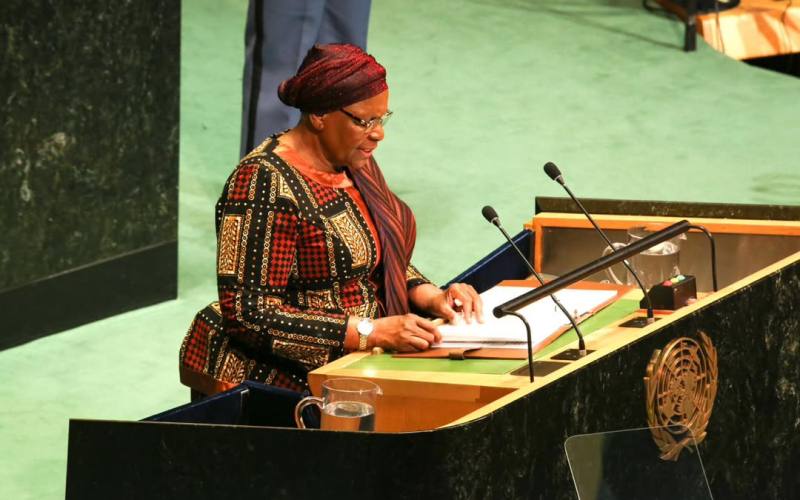
In her September 2026 address to the 81st UN General Assembly, she described Namibia’s independence as having been “born out of international solidarity” and explicitly invoked it as a UN success story.
She argued for reform of the Security Council and stronger African representation in global decision-making.
This is not insignificant.
Indeed, on the margins of the current General Assembly, Nandi-Ndaitwah chaired a high-level panel on water investments for Africa and global cooperation.
The African Union reported that the panel brought together senior African and international figures and focused on investment, infrastructure, finance and Africa’s water challenge.
Namibia has also continued to articulate positions on the reform of global institutions, climate justice, the right to development, the Palestinian question, Western Sahara and other international issues.
The Foreign Affairs ministry has described the country’s diplomacy as contributing to peace, security and prosperity at regional, continental and global levels.
It has also highlighted Namibia’s leadership on the Women, Peace and Security agenda.
So it would be unfair to suggest that Namibia has withdrawn from international affairs.
It has not.
The more interesting question is whether participation is translating into influence.
The difference between being heard and being influential
Every UN member state has a microphone.
Not every country has influence.
A country can make eloquent speeches at the General Assembly, vote on resolutions and issue statements on global crises without significantly affecting what powerful countries eventually do.
Influence requires something more.
It requires coalitions.
It requires diplomatic persistence.
It requires expertise.
It requires strategic relationships.
And sometimes it requires the ability to make one’s national interest relevant to somebody else’s national interest.
This is where Namibia needs to have an honest conversation with itself.
Our diplomatic record shows that we have occupied important international positions. But we have not consistently converted our relatively strong moral reputation into a sustained diplomatic machine capable of advancing Namibian interests across multiple fronts.
Our economy makes this particularly important.
Namibia wants investment in green hydrogen, oil and gas, critical minerals, fisheries, logistics, agriculture and tourism.
It wants preferential market access.
It wants climate finance.
It wants infrastructure investment.
It wants greater value addition to its mineral resources.
It wants international support for adaptation to climate change.
It wants a greater African voice in global institutions.
All of these objectives require diplomacy.
Economic diplomacy cannot simply mean receiving visiting investors in Windhoek.
It means having Namibian diplomats, ministers, business leaders and political figures continuously building relationships in Washington, Brussels, Beijing, New Delhi, London, Tokyo, Riyadh, Pretoria, Addis Ababa and elsewhere.
President Nandi-Ndaitwah herself identified economic diplomacy as central to Namibia’s foreign policy in February 2026.
That is the right direction.
But a policy becomes meaningful only when it produces results.
The “seat in the room” is not necessarily a physical seat
There is another misconception we should challenge.
Namibia does not need to become a permanent member of the UN Security Council to matter.
Africa itself does not currently have a permanent seat.
Namibia’s present challenge is therefore not simply to obtain a seat.
It is to build enough diplomatic influence that its voice matters even when it does not have one.
Namibia has served on the Security Council before, most recently in 1999–2000. Today, it is not a member of the Council.
The current 2026 membership includes African states such as Somalia and the Democratic Republic of Congo, but not Namibia.
Nor is Namibia currently among the members of the UN Human Rights Council for the 2026–2028 term. The 2025 election produced 14 new members, including Angola, Egypt and South Africa from Africa.
These institutional positions matter because they give countries formal opportunities to shape agendas.
But there is a bigger picture.
Namibia is part of the African Union.
It is part of SADC.
It is part of the Non-Aligned Movement.
It has relationships with Europe, China, the United States, Russia, Cuba and other partners.
These networks provide platforms.
The question is how strategically we use them.
Who are Namibia’s international champions?
Historically, we can name them.
Sam Nujoma was an important political symbol of the liberation movement internationally.
Theo-Ben Gurirab was an extraordinary diplomatic operator.
Hidipo Hamutenya, as foreign minister, was an important voice in Namibia’s early diplomatic era.
Hage Geingob developed significant international relationships and was particularly vocal on issues such as economic inequality, multilateralism and Africa’s position in global affairs.
Today, Nandi-Ndaitwah has inherited the country’s foreign-policy leadership and is clearly attempting to assert Namibia’s voice internationally.
Her recent UN engagements demonstrate that she is not treating foreign policy as merely ceremonial. Her interventions have included Security Council reform, the right to development, climate issues, water investment and ocean governance.
Foreign Affairs Minister Selma Ashipala-Musavyi is another important part of that diplomatic architecture.
But a country cannot depend on the President and Foreign Affairs Minister alone.
That is perhaps the bigger issue.
Where is the broader ecosystem of Namibian international champions?
Where are our intellectuals who are regularly invited to international forums?
Where are our diplomats who become recognised authorities on particular global questions?
Where are our business leaders building multinational relationships?
Where are our academics influencing international policy?
Where are our young diplomats being prepared to become the next generation of Gurirabs?
Where are the Namibians who can pick up a telephone in New York, Brussels, Addis Ababa or Beijing and have somebody important answer?
That is what diplomatic capital looks like.
We need to decide what Namibia wants to be known for
Perhaps the most important question is not whether Namibia is influential.
It is what Namibia wants to be influential about.
We cannot be strategically important on every global issue.
But there are areas where Namibia possesses unusual credibility.
Climate change.
Desertification.
Water scarcity.
Ocean governance.
Critical minerals.
Energy transition.
Peaceful conflict resolution.
Women, peace and security.
African development.
Land and natural-resource governance.
Small-state diplomacy.
Namibia’s experience gives it something to say in these debates.
The Benguela Current, for example, gives Namibia a legitimate interest and expertise in ocean governance. Its extreme aridity gives it a natural voice in international discussions about water security.
Its uranium, diamonds and emerging critical-mineral and energy sectors give it a stake in the debate over the energy transition and resource value chains.
These are potential diplomatic assets.
But potential is not influence.
Influence requires investment.
We should stop confusing respect with power
Perhaps Namibia’s international standing can best be described as respected, engaged and potentially influential, but not consistently powerful.
That is not an insult.
It is a description of the position of many small states.
But it should also be a challenge.
Our history gave us an extraordinary diplomatic inheritance.
The United Nations helped bring us to independence. Namibia, in turn, became an important example of what international diplomacy can achieve.
President Nandi-Ndaitwah reminded the world of that history this week.
But perhaps there is a question she should also ask herself, and one that the entire country should ask:
What will Namibia contribute to the international system that future generations will regard as our defining diplomatic achievement?
The next Theo-Ben Gurirab does not necessarily have to become UN General Assembly president.
The next Namibian diplomatic champion may instead be the person who persuades a coalition of countries to rethink how Africa’s minerals are financed.
Or the diplomat who gets water security onto the centre of the global development agenda.
Or the negotiator who secures a new international framework for small, climate-vulnerable states.
Or the Namibian who builds the coalition that finally changes Africa’s representation on the Security Council.
That is the standard against which our international diplomacy should ultimately be measured.
Namibia once had a place in the world’s imagination because the world was helping to solve the Namibian question.
Thirty-five years into independence, we must now become a country capable of helping to solve somebody else’s question.
That is the difference between being a beneficiary of international diplomacy and becoming a shaper of it.
And perhaps that is the real test of whether Namibia still has a proverbial seat in the room.