Patience Makwele
The government wants sport to contribute 3.5% to Namibia’s employment sector under the Sixth National Development Plan (NDP6), up from the 1% contribution recorded during the previous development plan.
Education, innovation, youth, sport, arts and culture Minister Sanet Steenkamp said the target forms part of the government’s push to professionalise sport and create sustainable careers in the sector.
“While we have not yet fully realised that target, our resolve has not wavered, indeed, it has grown,” Steenkamp said.
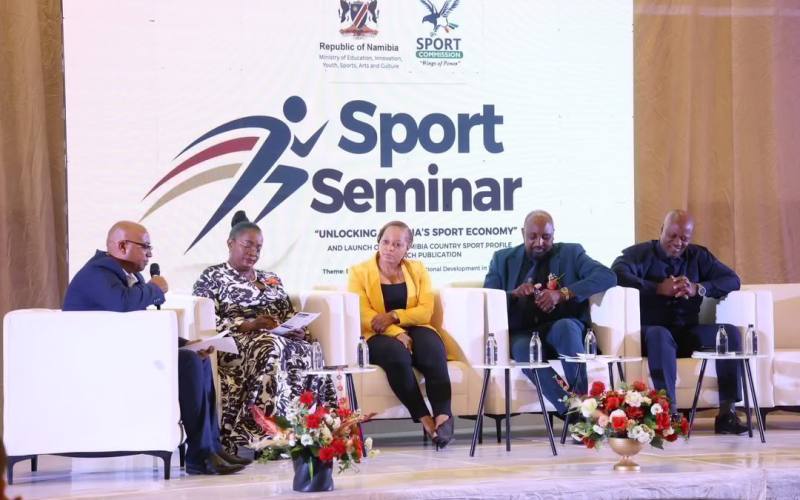
Steenkamp was speaking on Thursday at the Sports Seminar on “Unlocking Namibia’s Sport Economy” and the launch of the Namibia Country Sport Profile at the Mercure Hotel in Windhoek.
The ministry’s executive director, Gerard Vries, said the NDP5 Terminal Review recorded sport’s contribution to employment at 1%, despite the sector’s potential.
He said this potential is particularly significant given that 71% of Namibians are under the age of 35, with the country having a large pool of young people and sporting talent.
Steenkamp said professionalising sport should not only benefit athletes, but also create opportunities for coaches, administrators and others working within the wider sport industry.
“When we speak of professionalising our sport sector, we speak of something deeply human: the dignity of a career,” she said.
For the 2026/27 financial year, the ministry has allocated N$327 million towards the development and promotion of sport.
The allocation includes N$103.4 million for operations and N$223.6 million for development.
Steenkamp said the funding should translate into jobs and sustainable careers.
“This investment must, and will, yield results we can all be proud of: jobs created, careers launched, and lives transformed through sport,” she said.
She said professionalisation would require more than government funding, calling for stronger legislation, inter-ministerial cooperation and greater corporate involvement.
The minister also proposed measures such as athlete development grants, sport venture capital, facility investment funds and tax incentives to attract private investment into sport.
She further called for consideration of a national sport levy and the operationalisation of the Sport Development Fund to support infrastructure and employment creation.
Vries said recent sporting events had shown the economic potential of the sector, citing the ICC U19 Men’s Cricket World Cup, which he said generated an estimated N$380.8 million in economic impact.
Namibia is also set to participate in the Youth Olympics and the AUSC Region 5 Youth Games, while the country will co-host the ICC Men’s Cricket World Cup in October 2027 with South Africa and Zimbabwe.
Steenkamp said major sporting events could help showcase Namibia, develop infrastructure and inspire young people to pursue opportunities in sport.
However, the Country Sport Profile also highlighted challenges including fragmented governance, limited commercialisation, uneven distribution of sporting facilities and outdated legislation.
Namibia’s Sport Policy dates back to 1993, while the Sport Act was enacted in 2003.
Steenkamp said reviewing and amending the legislation would be among the ministry’s priorities as it seeks to modernise the sector.
She said the ministry would also work on clearer roles for stakeholders, stronger governance standards, improved sport data systems and strategies to attract private-sector investment.