Patience Makwele
Three out of four Namibian children are not considered ready for school, according to a national early childhood development (ECD) study cited by Development Workshop Namibia (DWN), raising concerns about the foundations being laid before children enter formal education.
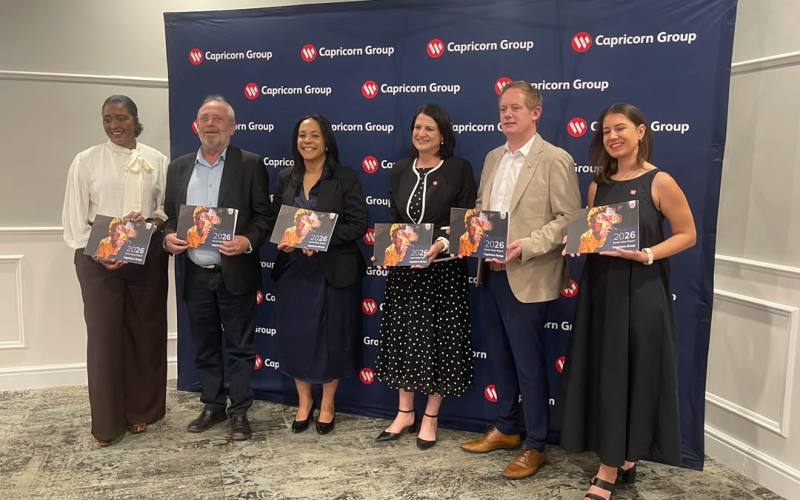
The finding was highlighted by Letta Muleka, Community Outreach and Partnership Coordinator at DWN, during the launch of Capricorn Group’s 2026 Social Value Report in Windhoek on Wednesday.
Muleka said the organisation’s ECD project, which began in 2023, is working to improve the quality of early learning in informal settlements, where centres often operate with limited resources, inadequate infrastructure and educators who lack formal training.
“The reality is that many of these centres are operating in very difficult conditions,” Muleka said.
Some classrooms are built from boards and corrugated iron, while learning spaces can be cramped, with 20 to 30 children sharing small rooms. In some centres, children have limited access to proper toilets, learning materials and play equipment.

The project currently supports 30 ECD centres, 64 teachers and more than 1 042 children. It has helped construct 14 classrooms, 11 playgrounds and four toilets, while also providing learning materials and training for educators.
Muleka said the intervention goes beyond infrastructure. Mentors provide individual support to educators, while the project assists centres with governance, documentation, child-protection policies and administrative systems.
Educators are also being supported to obtain formal ECD qualifications, a critical need as responsibility for ECD shifts from the ministry of gender, poverty eradication and social welfare to the ministry of education, innovation, youth, sport, arts and culture.
Muleka said centres will increasingly need to meet minimum standards to be formally recognised and access future government support.
The KAP study cited by DWN also points to challenges in children’s home environments. It found that 59% of parents reported physically punishing their children.
The study further found that 25% of households reported that a mother drank alcohol and/or smoked tobacco during pregnancy, rising to 33% among rural households.
The findings underline the extent to which children’s development is shaped long before they reach Grade 1.
DWN’s work with Capricorn-funded ECD centres has previously extended to Omaheke, including Gobabis and Witvlei.
Capricorn’s 2025 Social Value Report records support for 23 centres serving about 700 children, with educators receiving training and centres receiving furniture, learning and play materials and infrastructure improvements.
From July 2025, the project shifted its focus to six ECD centres in Hardap, mainly around Rehoboth, showing that the intervention has moved beyond a single-town project.
The wider Capricorn portfolio is also increasingly focused on measuring whether social investment produces lasting outcomes rather than simply tracking money spent.
James Chapman, managing director of Bank Windhoek, said businesses could not separate their prosperity from the wellbeing of the communities in which they operate.
“An institution like a bank cannot prosper whilst society is not doing well,” he said.
Chapman said about 80% of the Capricorn Foundation’s approximately N$14 million allocation for the current financial year had already been committed, with funding increasingly linked to accountability and measurable impact.
That approach is particularly relevant to ECD, where improvements in classrooms or learning materials need to translate into better developmental outcomes for children.
Capricorn has also announced a three-year, N$5 million outcomes fund in partnership with the ducation and the Education Outcomes Fund, expected to reach more than 25,000 children from 2027.
For Muleka, however, the immediate challenge remains ensuring that children in under-resourced communities receive the support they need before they arrive at primary school.
She said further investment was needed in educator qualifications, nutritious feeding programmes, safe and stimulating learning environments and support for parents and caregivers.
“Every investment in early childhood development is really an investment in a child’s potential, a family’s future and the development of a stronger society,” Muleka said.