Staff Writer
President Netumbo Nandi-Ndaitwah says the country must take the issue of the boy child seriously to strengthen social and economic development.
She raised concern over the low number of male graduates at the Namibia University of Science and Technology (Nust).
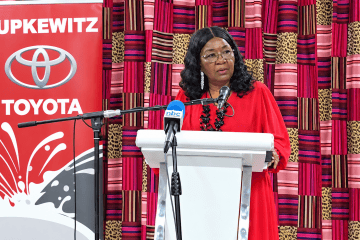
Speaking at the Nust May 2026 graduation ceremony in Windhoek on Friday, Nandi-Ndaitwah said the university’s graduation figures do not reflect the country’s population ratio between men and women.
“In total, 2,962 graduates are being conferred across disciplines, comprising of 1 187 males and 1 775 females,” she said.
The graduating class included 164 master’s degree candidates, made up of 55 males and 109 females, while the 13 doctoral graduates included four males and nine females.
“However, what is disturbing is that those figures do not reflect the female-to-male population ratio of 51.2% and 48.8%, respectively,” Nandi-Ndaitwah said.
“The message is clear: we must take the issue of the boy child seriously if we are to strengthen our social fibre and economic advancement,” she added.
Nandi-Ndaitwah said both men and women must see themselves as equal partners in national development.
“As a person who has advanced equality between men and women, I fully agree with the sentiments of the First Gentleman. We need to liberate the minds of both males and females to see themselves as equal partners in development,” she said.
She described education as central to Namibia’s development agenda and said the government continues to prioritise the sector through policy reforms and budget allocations.
Nandi-Ndaitwah praised Nust for its growth since being upgraded from a polytechnic institution into a university in 2015.
“Nust’s journey deserves special recognition. From its origins as a polytechnic institution to its transformation into a fully fledged university, and now into a globally recognised institution of science and technology, this progress is both remarkable and inspiring,” she said.
She said the institution has expanded its infrastructure, academic programmes and research offerings while contributing to Namibia’s human capital development.
Nandi-Ndaitwah highlighted programmes such as emergency medical care, medical laboratory practitioners and training of trainers in the TVET sector as important contributions to national development.
Nandi-Ndaitwah also urged universities to place greater focus on practical industry exposure.
“I urge all institutions of higher learning not to graduate students equipped only with theoretical classroom knowledge, without first-hand practical exposure to actual industry experience,” she said.
She called on stakeholders to implement the National Policy on Work Integrated Learning and encouraged the private sector to support internship and apprenticeship programmes.
Nandi-Ndaitwah also addressed student mental health, saying academic success should not come at the expense of wellbeing.
“Mental health must never be treated as a matter of shame. Seeking help is not a weakness. It is an act of courage,” she said.
The president acknowledged challenges such as youth unemployment, graduate skills mismatches and limited access to capital.
“Graduates face uncertainties as they transition from academia to the workforce, including difficulties in securing employment and accessing professional networks,” she said.
She encouraged graduates to embrace entrepreneurship, innovation and lifelong learning as technology continues to reshape industries and economies.
“You are entering a world shaped by rapid technological advancement, where innovation, digital transformation, and sustainability are redefining how we live and work,” she said.
Nandi-Ndaitwah urged graduates to use their education to help address poverty, inequality, unemployment, food insecurity and climate change.
“Education, innovation, science, technology, and enterprise are the most effective instruments to fight against those enemies,” she said.
Nandi-Ndaitwah congratulated the graduates and encouraged them to contribute to Namibia’s development.
“Today you carry with you more than a qualification. You carry the hopes and aspirations of a nation,” she said.