Namibia’s trade unions were once at the forefront of the struggle for freedom. Thirty-six years into independence, their silence raises uncomfortable questions.
There was a time when organised labour in Namibia was among the most formidable forces in the country’s political and social landscape.
Trade unions were not merely institutions negotiating wages and working conditions.
They were instruments of resistance, mobilisation and political consciousness, helping to challenge a system that denied the majority of Namibians their dignity and rights.
The December 1971 general strike remains one of the defining moments in this history.
Between 13 000 and 20 000 contract workers participated in an industrial action that shook the apartheid administration and exposed the brutality of the contract labour system.
Workers demonstrated that their collective power could bring an economy to a standstill.
The National Union of Namibian Workers (NUNW), established in 1970, became closely aligned with SWAPO and its liberation struggle.
This relationship was historically understandable. The struggle for workers’ rights was inseparable from the struggle for national liberation.
Indeed, some of Namibia’s strongest and most influential unions emerged under the NUNW umbrella.
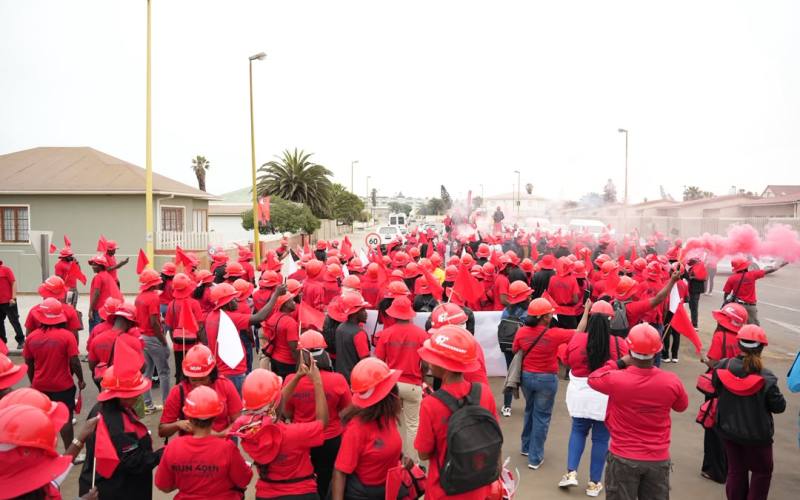
The Mineworkers Union of Namibia (MUN), the Namibia Food and Allied Workers Union (NAFAU) and other affiliates enjoyed considerable grassroots support.
Their strength was rooted in their ability to organise workers and confront employers.
But independence fundamentally changed the relationship between political power and organised labour.
The movement that unions had helped bring to power became the government they were supposed to hold accountable.
This created an uncomfortable contradiction: how does a union remain an independent defender of workers when its political loyalties lie with the governing party?
Over time, that contradiction became increasingly difficult to ignore.
Labour researcher Herbert Jauch was already warning about this problem in 2006.
In a public lecture reported by The Namibian, he argued that the historical relationship between SWAPO and the NUNW contained the seeds of both its creation and its destruction.
He raised concerns about union leaders accepting political appointments and paid positions on company boards, sometimes at the expense of their responsibility to ordinary workers.
Leaders who had once been powerful advocates for reform were increasingly disappearing into political and corporate structures.
This was not simply a question of individual ambition. It pointed to a deeper institutional problem: the gradual erosion of accountability and the independence of organised labour.
The consequences were visible in subsequent internal divisions, leadership disputes and declining influence.
The emergence of alternative federations, including the Trade Union Congress of Namibia (TUCNA) and the Namibia National Labour Organisation (NANLO), also reflected a fragmented labour landscape.
Yet it would be unfair to declare organised labour entirely dead.
Unions outside the NUNW have continued to represent workers, while individual affiliates have periodically demonstrated their ability to mobilise.
The 2006 Ramatex strike, in which workers defied opposition from political and union leadership and successfully pursued their demands, demonstrated that the appetite for collective action had not disappeared.
But isolated victories cannot disguise the broader question of influence.
Namibia faces persistent unemployment, pressure on household incomes, disputes over working conditions and concerns about the distribution of national wealth.
Workers need strong institutions capable of challenging employers, questioning government policy and defending their interests regardless of who occupies the State House.
A trade union cannot become an extension of a political party without compromising its primary responsibility.
Political affiliation is not inherently wrong. The problem arises when political loyalty becomes more important than the interests of members.
The liberation struggle required solidarity between political movements and workers.
The democratic era requires something equally important: independence of thought, institutional accountability and the courage to disagree.
Namibia’s organised labour movement does not need to abandon its history or its political relationships. It needs to rediscover its purpose.
The question is no longer whether unions helped liberate Namibia. Their contribution is well documented.
The question is whether they can still liberate workers from exploitation, insecurity and economic exclusion.
And, perhaps more urgently, when workers look for someone to speak on their behalf, where is the voice of organised labour?