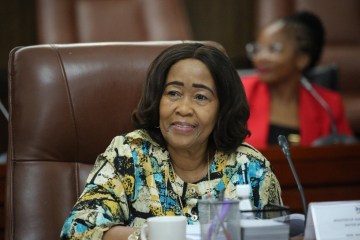
Patience Makwele
President Netumbo Nandi-Ndaitwah has called for mining to contribute more meaningfully to employment creation and economic growth, while industries, mines and energy minister Modestus Amutse has warned companies against using temporary employment and subcontracting arrangements as cheap labour.
Amutse issued the warning while delivering a keynote address on behalf of President Nandi-Ndaitwah at the inaugural Kunene Mining Summit in Opuwo on Thursday.
The warning comes amid the government’s push for the mining sector to create meaningful employment, increase local participation and retain more value from Namibia’s mineral resources.
Amutse said some companies were repeatedly moving workers between contractors instead of creating permanent employment and providing decent working conditions.
“Today it’s company B, tomorrow it’s company C, and another day, and so on and so on. In that process, we are not promoting employment creation at all,” he said.
He urged mining companies to stop the practice, saying temporary workers should not be kept in a cycle of short-term employment simply to reduce labour costs.
“Employment creation must be real employment creation. Not just a talk,” Amutse said.
He also raised concerns about the safety of mining workers, particularly small-scale miners, who he said are sometimes exposed to dust, heavy machinery, harsh conditions and accidents while operating far from medical facilities.
Amutse called for stronger cooperation between employers, unions, labour inspectors and health services to improve occupational safety, emergency response and working conditions.
The minister further raised concerns about local mining rights holders who allegedly lost control of their operations after bringing in investors.
He said the government had observed cases where rights holders could not freely access their own mining sites or did not know what was being extracted from them.
“We hardly know what is being extracted on a daily basis,” Amutse said.
He said investors must also consult affected communities and traditional authorities, stressing that a mining licence does not remove the obligation to engage people whose livelihoods depend on the land.
“Coexistence in our operations in mining must be real and must be beneficial to all,” he said.
In his call to a more valuable Namibia, Amutse called for greater beneficiation and local value addition, saying Namibia should retain more value from its mineral resources instead of relying primarily on extraction and export.
He said the government would move towards measures to promote beneficiation and urged the industry to prepare for increased local processing.
The minister pointed to opportunities in stone cutting, gemstone preparation, equipment repair and, eventually, manufacturing.
He said mining companies must also create opportunities for Namibian businesses and young people to participate in the sector.
“Without local participation, we cannot talk about the value chain,” Amutse said.
He said the government was working with training institutions to identify skills gaps and prepare young Namibians for opportunities in the mining sector.
Amutse also called for financing conditions that would allow young Namibians and small-scale miners to participate meaningfully in exploration and mining.
“A licence is just a paper. It needs to get a value by doing exploration,” he said.
In her keynote address, Nandi-Ndaitwah’s administration was positioned as pursuing productive growth, employment creation and greater value from Namibia’s natural resources under the Sixth National Development Plan.
The address stressed that mineral potential alone does not translate into shared prosperity, with mining dependent on investment, infrastructure, water, electricity, skills, environmental compliance and public confidence.
“An application is not a discovery. A discovery is not a viable mine yet. And the mine is not automatically shared prosperity,” the President stated.
The President’s message also called for collaboration between government, investors, communities and other stakeholders to ensure mining development benefits the wider economy and surrounding communities.
Kunene regional governor Vipuakuje Muharukua said the region’s mineral potential must ultimately translate into jobs and economic opportunities for its residents.
“Kunene region has mineral potential, but potential does not employ anyone by itself,” Muharukua said.
He said mining development could not be planned from geological maps alone, but had to take into account grazing routes, water points, mining claims and young people seeking employment.
“The future of mining in Kunene cannot be designed from a geological map alone,” he said.
The governor called for greater participation by women, young people and local businesses as technicians, suppliers and business owners, saying the summit should produce clear actions and solutions rather than ending with speeches.