Patience Makwele
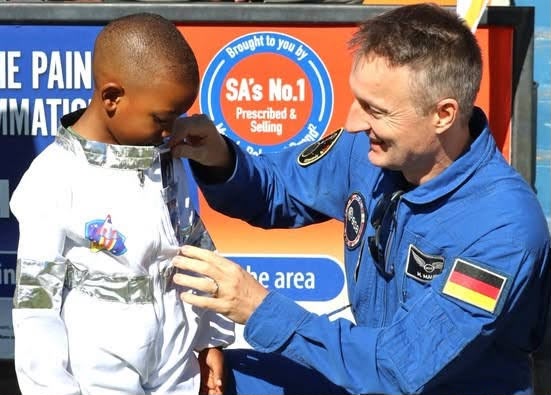
European Space Agency (ESA) astronaut Matthias Maurer has called on Namibia to identify areas where it can contribute to the global space sector instead of waiting to become a space-faring nation.
Maurer said Namibia already has assets that could be useful to international space programmes, including its desert environment, geological expertise, astronomy facilities and young people interested in science and technology.
Speaking in Swakopmund during his visit to Namibia for World Space Week, Maurer said the country could use its experience with harsh desert conditions to help address challenges that will face future lunar missions.
“The moon is a desert. It’s just a little bit harsher desert than the Namib desert because you don’t have any air,” he said.
His comments come as Namibia positions itself to develop a space sector, with the government working on legislation to regulate the industry.
Deputy executive director for research, innovation and training, Lisho Mundia, delivering remarks on behalf of education minister Sanet Steenkamp, said space science and technology could create opportunities in innovation, education, entrepreneurship, job creation and national development.
Mundia said the government was working to create a space sector that would benefit young people, starting with legislation to regulate the industry.
“Space Science is the future and that future begins with you!” Mundia told learners during the opening of World Space Week.
National Commission on Research, Science and Technology (NCRST) chief executive officer Anicia Peters said Namibia already has a place in the international space science community, pointing to the High Energy Stereoscopic System (H.E.S.S.) as an example of the country’s contribution to international research.
“So, as a country, Namibia is very important in the world of space science. We are not just a tiny dot,” Peters said.
Maurer stated Namibia could also further contribute by sharing knowledge on how to manage sand, an issue he encountered during his visit to the Gobabeb Desert Research Station.
He said rocket engines used during lunar landings could blast sand and debris into the air, potentially damaging equipment or a nearby lunar base.
One option would be to land several kilometres away from a base, he said, while another would be to develop a landing pad. Namibia’s experience with roads and desert surfaces could offer ideas for dealing with the problem.
“We could think of such an approach to solidify the sand so that we can actually land without creating a dust storm,” Maurer said.
Lunar dust is also a concern for astronauts because it can affect equipment, spacesuit seals and human health.
Maurer said Namibia’s desert environment could similarly provide lessons for future lunar habitats, including the possibility of using local materials and desert-adapted plants in greenhouse systems.
He specifically mentioned the desert nara plant, a plant native to the Namib, as something that could be investigated for future applications.
Beyond the desert, Maurer said Namibia’s geological expertise could be relevant to the study of lunar resources.
The moon is known to contain water ice and various minerals and metals, while researchers are investigating how such resources could be used to support longer-term human activity.
ESA itself is researching ways to extract oxygen from lunar regolith, while missions are investigating possible water ice deposits near the lunar poles.
Maurer said Namibia should therefore not assume that its contribution would have to begin with a spacecraft or major space mission.
Expertise in Earth observation, data analysis, artificial intelligence and research could provide more accessible entry points.
“You need to bring something to the picnic to be a guest that is welcome. And not everybody should bring the same thing,” he said.
Namibia is already developing astronomy infrastructure that could strengthen its role in international research.
The Africa Millimetre Telescope project, involving Namibian and international research institutions, is being developed in the country and is intended to become part of global radio astronomy efforts.
The German embassy has also positioned Maurer’s visit as an opportunity to strengthen links between Namibian researchers and European scientific institutions, while exposing about 8 000 learners in Windhoek, Swakopmund, Oshakati and Ongwediva to space science.
German embassy deputy head of mission Florian Seitz said international cooperation should ensure that space benefits countries at different levels of scientific and economic development.
“The exploration and use of space shall be carried out for the benefit and in the interest of all countries,” Seitz said.