Patience Makwele
Namibians across the country yesterday marked the Day of the African Child with renewed calls to protect children’s rights and improve access to education, water and sanitation, amid concerns that many young people continue to face abuse, neglect and unequal opportunities.
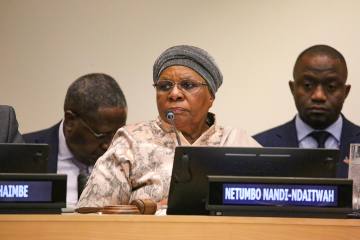
Acknowledging the day, President Netumbo Nandi-Ndaitwah said child abuse, neglect, exploitation and violence remain unacceptable violations of children’s rights.
“As we celebrate the African Child, we must also confront the realities that continue to threaten their wellbeing,” the President said in her message marking the day.
This year’s commemoration was held under the theme, “Ensuring Universal Access to Water, Sanitation and Hygiene for Every Child in Africa,” highlighting the importance of access to clean water and proper sanitation as fundamental rights and essential foundations for health, education, dignity and development.
Nandi-Ndaitwah said the opportunities available to African children today were hard won and should never be taken for granted.
Reflecting on the 50th anniversary of the Soweto Uprising, she said the young people who took to the streets demanding quality education and equal opportunities inspired liberation movements across the continent, including Namibia’s own struggle for independence.
“Their legacy reminds us that the rights and wellbeing of children must remain at the centre of our efforts to build peaceful, inclusive and prosperous societies,” she said.
Education minister Sanet Steenkamp said water, sanitation and hygiene are critical to the dignity, wellbeing and development of every child.
“All our children matter and they all matter equally,” she said.
Steenkamp said the ministry had adopted an integrated approach linking water, sanitation and hygiene initiatives to school feeding programmes and broader efforts aimed at improving children’s health, dignity and educational outcomes.
She said the government was working to upgrade school infrastructure and strengthen sanitation programmes to ensure that children, including those in underserved communities, have access to safe and healthy learning environments.
“We are working extremely hard to ensure that our infrastructure development is upgraded. We are also working very hard to ensure that we have sanitation programmes within our schools and that children from a very young age learn about hygiene and understand its importance,” she said.
The minister urged communities not to lose sight of their collective responsibility towards children.
“May we all remember that we all were once children and that we do not forget what it means to be warm, uplifting and to believe in our children,” she said.
In the Zambezi Region, children’s rights advocate and activist Caroline Namasiku Sitwala said the Day of the African Child should serve as a reminder that children’s rights extend beyond commemorative speeches and require continuous action to address the realities facing young people.
“Many children, particularly girls, continue to face challenges such as poverty, child neglect, early pregnancies, gender-based violence and limited access to basic services. We cannot celebrate our children while some are still exposed to abuse and environments that do not allow them to thrive. Every child deserves to grow up safe, valued and supported by their families, communities and the institutions responsible for protecting them,” she said.
Sitwala said children in rural and underserved communities remain disproportionately affected by inequalities, including inadequate sanitation and limited educational opportunities.
“Fifty years after the Soweto Uprising, our children should not still be struggling for things as basic as safe schools, clean water and equal opportunities. The true way to honour the children of Soweto is by ensuring that no child is left behind because of where they are born or the circumstances they come from,” she said.
Also commenting on the matter, education analyst Alexandrina Thuyeni Hauwanga said the annual commemoration should encourage policymakers and communities to examine whether the education system is adequately meeting children’s needs.
“The African child today faces a different struggle from that of 1976, but it is a struggle nonetheless. There are children who still learn in overcrowded environments, children who walk long distances to school, children who miss classes because of poor sanitation facilities and girls who continue to face barriers that affect their educational outcomes. Access to quality education cannot be separated from the conditions under which children are expected to learn,” she said.
Hauwanga said investment in school infrastructure, water and sanitation facilities, psychosocial support and teacher development remains critical if Namibia is to deliver on its promise to children.
Youth activist Esmeralda Ivy Naruseb said the Day of the African Child should also be a moment of reflection on the education challenges confronting many Namibian families.
“Yesterday, we saw distressed parents in Okahandja standing outside a school because there was reportedly only one classroom available for Grade 1 learners and only 30 spaces for hundreds of children seeking placement. That situation should concern all of us because it speaks directly to whether we are creating enough spaces for our children to access education,” she said.
Naruseb said no parent should be forced to choose between leaving their child at home and paying for private education they cannot afford.
“Education is a right, not a privilege reserved for those who can pay. If communities are growing, then our planning and infrastructure must grow with them. Government, local authorities and communities need urgent and practical solutions, including the construction of additional classrooms and schools in rapidly expanding towns. We cannot celebrate the African Child while children are still queuing for a desk and fighting for a place in the classroom,” she said.
Nandi-Ndaitwah said investing in children is ultimately an investment in Africa’s future, stressing that Namibia’s long-term development depends on empowering young people through education, healthcare and social protection.
She called on parents, communities, educators, faith-based organisations, civil society and government to work together to ensure that every child is valued, protected and given the opportunity to realise their full potential.