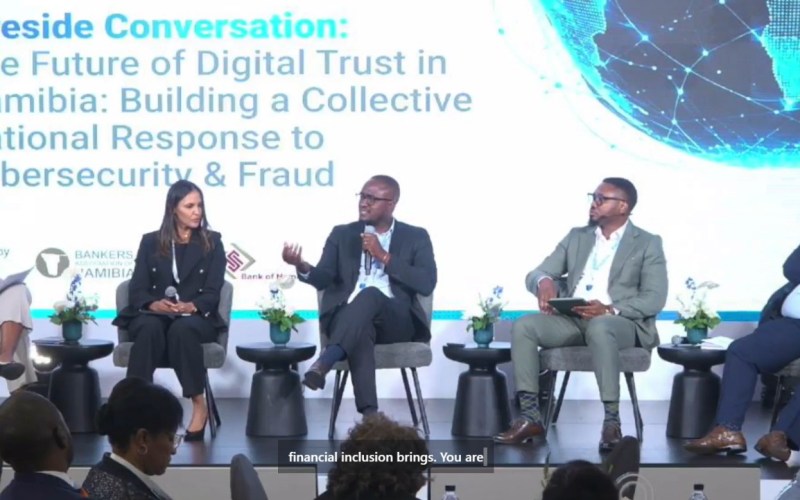
Fraud losses reached N$50.3 million in ten months, raising financial and operational risks as digital payments expand.
Elvis Mboya
Namibia recorded approximately N$50.3 million in reported financial fraud losses between January and October 2026, Bank of Namibia deputy governor Leonie Dunn disclosed at the second Namibia Fraud & Cybersecurity Summit in Windhoek on Tuesday.
Dunn also revealed that victims of electronic funds transfer (EFT) fraud recovered only 34% of their losses during the first half of the year.
She said: “Fraud doesn’t respect institutions. Behind that figure are people and businesses with financial losses whose financial security and confidence had been threatened.”
The summit was hosted by the Bank of Namibia in collaboration with the Bankers’ Association of Namibia (BAN) and the Industry Fraud Working Group under the theme, “Strengthening Trust in a Hyper-Digital Era”.
The latest disclosure comes amid rising payment fraud documented in the Bank of Namibia and NAMFISA October 2026 Financial Stability Report.
The report recorded N$32.45 million in payment fraud losses within the National Payment System during the first half of 2026, an 18.9% increase from N$27.29 million in the corresponding period last year.
EFT fraud accounted for N$21.87 million, increasing 47.3%. Card fraud declined 9.7% to N$10.36 million, while electronic money fraud fell 72.5% to N$229 000.
The report attributed EFT fraud incidents to phishing, vishing and social engineering, where criminals impersonate banking officials and trusted organisations to obtain confidential customer information.
The N$50.3 million figure covers reported fraud across ten months, while N$32.45 million represents National Payment System losses during the first six months.
The figures therefore cover different reporting periods.
Institutional response
The summit brought together representatives from banking, telecommunications, financial regulation, cybersecurity and law enforcement.
The Bank of Namibia’s published programme identified Martha Murorua, BAN chairperson and Nedbank Namibia managing director, alongside Dunn and Dr Pieter Kruger, founding partner of AITech, among the opening-session contributors.
Other speakers included Lehana Nel of the Association of Certified Fraud Examiners Namibia Chapter, Cornelia Shipindo of the Communications Regulatory Authority of Namibia (CRAN), Lara Enslin of TransUnion and Dr Nakarin Amarase of the Bank of Thailand.
Refilwe Matanda of Mastercard Southern Africa addressed consumer protection and digital trust, while Obsidian Shield Cybersecurity specialists Muleka Pandakana Tresor and Marcel Prinzonsky presented a live cyber-enabled fraud demonstration.
A national fraud response panel featured Gerrit Jordaan, Melanie Meiring, Octivius Kahiya of MTC, Josef K. Ihemba of the Ministry of Finance and Ryan Geyser of Bank Windhoek. Uwetha Endjambi of the Bank of Namibia moderated.
A separate cybersecurity panel included Linda Songiso of the central bank, Professor Attlee Gamundani of Namibia University of Science and Technology, Carmen Erasmus of Nedbank Namibia and Thomas Hamata of ISACA Windhoek Chapter.
Regulatory developments
The Bank of Namibia’s report also confirms that revised Operational and Cybersecurity Standards within the National Payment System, known as PSD-12, were gazetted in July 2026.
The standards introduce requirements covering information security, operational resilience, third-party risk management, cloud computing and fraud risk management.
The report further notes that the central bank is developing guidelines for instant payments to support safe and interoperable electronic transactions.
For Namibia’s banking industry, rising fraud losses have implications for technology investment, transaction monitoring, customer verification and operational risk management.
The summit’s discussions placed these challenges within the wider transformation of the country’s digital financial infrastructure.