CHAMWE KAIRA
Standard Bank Namibia’s total funding facility for the Lüderitz 50MW Wind Power Project totals N$2 billion, head of corporate and investment banking, Nelson Lucas revealed to Observer Money on Monday.
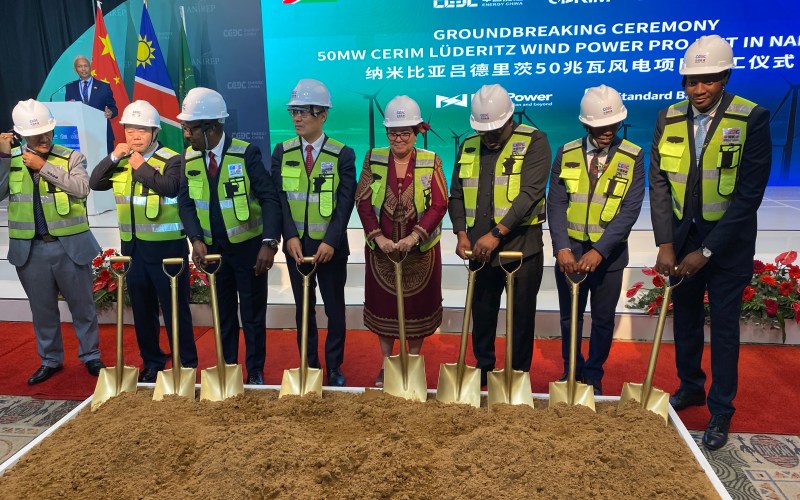
This followed a ground breaking ceremony for the project held in Windhoek and officiated by Vice President Lucia Witbooi.
Lucas said the bank believes energy is a powerful driver for economic development. He said as renewable capacity grows, the country must also grow the broader energy capacity.
He said projects like the Lüderitz 50MW Wind Power Project require strong partnerships between the public and private sectors, local and international investors and industry stakeholders
The renewable energy facility is being developed by CERIM Lüderitz Energy (Pty) Ltd, a joint venture between China Energy International Group and ANIREP.
Representing an investment of US$86.82 million, the wind farm will be located in the Kharas Region, approximately 16.5 kilometres south of Lüderitz.
Once operational, the 50MW plant is projected to generate roughly 253.8 GWh of electricity annually, enough to meet about 6% of Namibia’s total power consumption.
The facility is also expected to offset approximately 150 000 tonnes of carbon dioxide emissions each year.
The project is backed by a 25-year power purchase agreement with Namibia’s national utility, NamPower. Full commissioning of the wind power plant is scheduled for 1 March 2027.
Managing director of ANIREP Limited, Iyaloo ya Nangolo said once completed, it will become Namibia’s largest wind power project, with a capacity of 54.6-megawatt (MW).
The project will comprise seven Goldwind turbines, each with a capacity of 7.8 MW.
Once fully operational, the 50 MW will be injected into the national electricity grid through a 40-kilometre, 132 kilovolt transmission line connecting it to the Namib Substation.
CERIM Lüderitz Energy was established following a NamPower procurement process launched in March 2022 for a 50 MW wind power plant near Lüderitz under a Build-Own-Operate model.
ANIREP, through its subsidiary Zephyrus Energy, holds a 45% stake in CERIM Lüderitz Energy, while China Energy International leads the consortium.
ANIREP said the investment builds on its renewable energy portfolio, which includes the 5 MW Otjiwarongo solar plant developed with CENORED, the 5.73 MW Grootfontein solar plant and the 20 MW Khan Solar project, both developed with NamPower.
The company said the Lüderitz project represents a significant expansion of Namibian participation in large-scale renewable energy infrastructure.
Financing was supported by Standard Bank, RMB, the Development Bank of Namibia, BW and the African Development Bank Group.
Ya Nangolo said electricity generated by the wind farm would cost less than N$1 per kilowatt-hour (kWh), significantly below the estimated cost of electricity produced using diesel generators.
The company estimated that diesel-generated electricity costs between N$7 and N$10 per kWh, based on diesel prices of about N$30 per litre and the efficiency of conventional generators.
The wind project is therefore expected to provide electricity at a substantially lower cost than diesel-based generation and at less than half the cost of imported bulk electricity, according to the managing director.
The project is also expected to contribute to Namibia’s efforts to expand domestic electricity generation and reduce exposure to external energy supply and price shocks.
Jobs and industrial development
ANIREP intends to train Namibians, particularly young people from the region, in the operation and maintenance of the wind turbines over the project’s 25-year lifespan.
Ya Nangolo outlined the potential economic impact of expanding Namibia’s renewable energy capacity to 3 000 MW, supported by battery storage.
Such an expansion, equivalent to approximately 60 projects of the size of the Lüderitz wind farm, could generate an estimated 60 000 construction and engineering jobs, followed by more than 6 000 permanent jobs in operations, maintenance and related industrial infrastructure.
The company said the development of renewable energy capacity could support the growth of Namibia’s green industrial sector, particularly in the south, where emerging energy-intensive industries are expected to require substantial electricity supplies.