Sostenus Wilherm
Minister of environment, forestry and tourism Indileni Daniel has called for greater investment in drought preparedness, warning that Namibia can no longer afford to respond to drought only after disaster has struck.
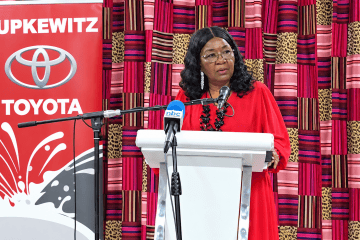
Speaking during the high-level Drought and Water Day segment of the United Nations Convention to Combat Desertification (UNCCD COP17) in Ulaanbaatar, Mongolia, on Tuesday, Daniel said drought must be treated as a development, economic and resilience priority rather than merely an emergency.
“For Namibia, drought is not a distant threat. It is a recurring national reality,” Daniel said.
Namibia is among the driest countries in sub-Saharan Africa and continues to experience rising temperatures, highly variable rainfall and prolonged droughts.
Daniel said these conditions are placing pressure on agricultural production, water security, human health, rural livelihoods and national economic growth.
She said more than one million people can be exposed to food insecurity during severe drought periods, making it necessary for the country to strengthen measures before drought conditions become critical.
“Our experience has taught us an important lesson: we cannot continue responding to drought only after disaster has struck. We must invest before the crisis,” she said.
Daniel said Namibia is strengthening drought preparedness through early-warning systems, contingency planning, sustainable land management, water security measures and ecosystem restoration.
“Namibia is therefore strengthening drought preparedness through early-warning systems, contingency planning, sustainable land management, water security measures and ecosystem restoration,” she said.
She said the country’s Third National Action Programme under the UNCCD, National Drought Policy and Land Degradation Neutrality targets provide important frameworks for strengthening resilience.
The minister also highlighted Namibia’s long-standing efforts to promote stronger international action on drought.
Namibia hosted UNCCD COP11 in 2013, where parties adopted the Namib Declaration, which elevated drought mitigation as a priority.
In 2016, Namibia, together with the African Union and UNCCD, hosted the first African Drought Conference in Windhoek
The conference resulted in the Windhoek Declaration for Enhancing Resilience to Drought and the Strategic Framework for Drought Risk Management and Enhancing Resilience in Africa.
Daniel said the vision of a drought-resilient and prepared Africa is now more urgent as climate pressures intensify.
Namibia is also advancing land restoration through the Great Green Wall Initiative and strengthening resilience across its rangelands.
With about 85% of Namibia’s land consisting of rangelands, Daniel said pastoral communities remain particularly vulnerable to drought and climate shocks.
She stressed that Namibia cannot address the challenge through national interventions alone, calling for greater international cooperation.
“Drought does not respect institutional boundaries, and working in silos will not build the resilience we need; only coordinated and collective action can deliver lasting solutions,” Daniel said.
She called for stronger partnerships, predictable climate finance and increased investment in drought-resilient infrastructure.
Daniel further urged the international community to support innovative risk-financing mechanisms and meaningful private-sector participation in efforts to strengthen drought resilience.
The minister said drought should no longer be viewed simply as an emergency requiring intervention after communities have already suffered losses.
“Our message from Namibia is therefore clear: drought must no longer be managed merely as an emergency. It must be managed as a development, economic and resilience priority,” she said.
She urged COP17 to move from commitments to practical implementation, particularly in strengthening early preparedness, reducing losses and building resilience among vulnerable communities.
“Let COP17 move us decisively from commitments to implementation; from reacting to drought, to preparing for it; from managing losses, to building resilience; and from vulnerability, to a future where our communities, ecosystems and economies can withstand the shocks ahead,” Daniel said.
The minister’s remarks come as countries at COP17 deliberate on measures to combat desertification, land degradation and drought.
For Namibia, the discussions are particularly important given the country’s exposure to water scarcity and climate variability.
Daniel said Namibia remains committed to working with international partners towards a drought-resilient and land-restored future.