Five-year business permits and investment reforms promise greater investor certainty, but local participation and job creation remain central to the debate.
Elvis Mboya
Namibia is strengthening its investment framework through longer business permits, proposed investment legislation and trade reforms aimed at attracting foreign capital and accelerating private-sector growth.
The measures are intended to improve investor confidence, reduce administrative delays and make the country more competitive.
However, the incentives are also fuelling debate over how much of the resulting investment should benefit local businesses, workers and communities.
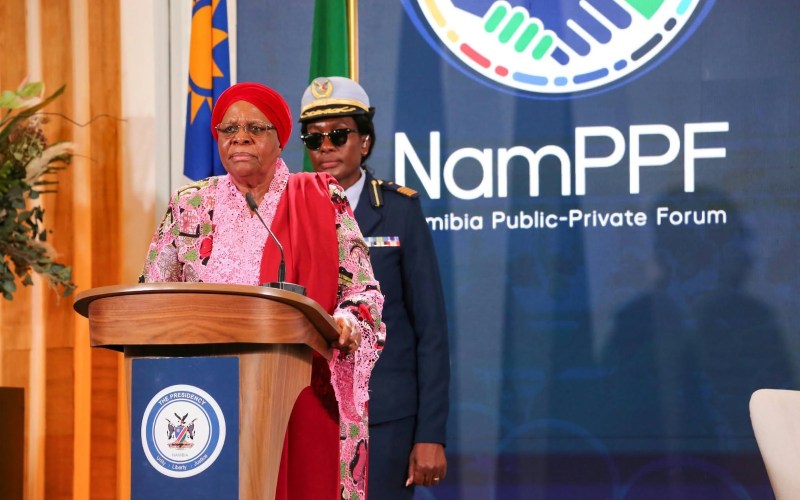
The issue is central to the two-day Namibia Public-Private Sector Forum in Windhoek, which concludes today under the theme From Commitment to Competitiveness: Accelerating Investment, PPPs and Job Creation.
Government targets investor confidence
President Netumbo Nandi-Ndaitwah has called on the government and business to move beyond policy discussions and focus on implementation.
“The NamPPF gives us a common table where we can identify constraints, agree on solutions, and hold ourselves accountable for implementation,” she said.
The President has called for greater local value addition, technology transfer, skills development and participation by Namibian businesses in supply chains.
Her direct engagement with investors at State House is also part of the administration’s efforts to attract capital and address obstacles affecting major projects.
One of the key changes is the five-year Employment Permit for Conducting Business, which was gazetted in July and took effect in September.
The permit allows qualifying investors to obtain authorisation for up to five years, compared with the standard two-year employment permit.
The Investment Promotion and Facilitation Bill, tabled in Parliament on 4 November, is another major component of the reforms.
The proposed legislation seeks to strengthen investment facilitation while providing a framework for regulating investment and local participation in designated economic activities.
The International Trade Management Bill is also intended to strengthen Namibia’s trade framework and support its participation in regional and international markets.
Minister of international relations and trade Selma Ashipala-Musavyi set out the government’s position at the forum.
“A strong investment environment must be one where investors thrive while local enterprises are also able to grow alongside them,” she said.
Her remarks reflect the government’s stated ambition to attract foreign capital while expanding opportunities for domestic businesses.
Investment growth and the jobs gap
The scale of investment entering Namibia underlines the opportunity.
According to the International Labour Organization, Namibia attracted about N$140 billion in foreign direct investment between 2021 and 2025, compared with N$50.5 billion between 2009 and 2020.
The country’s exports also increased from N$68 billion in 2020 to N$125 billion in 2025.
However, unemployment stood at 36.9%, youth unemployment at 44.1%, while 57.7% of the workforce was in informal employment, according to the ILO.
The figures highlight the challenge of translating investment growth into broad-based employment and productive domestic enterprises.
UN Resident Coordinator Hopolang Phororo said the priority was to convert investment potential into productive businesses and jobs.
“The real question is whether we can turn that potential into a growing number of productive enterprises, competitive industries, and quality jobs for Namibians,” she said.
Namibia Employers’ Federation Secretary-General Helene Ochs has also called for investment that supports “economic diversification, competitiveness and decent work”.
“As social partners, we want to be part of shaping that future, not merely consulted after decisions have been made,” she said.
Kandorozu questions foreign permits
The investment incentives and extended business permits have also attracted political criticism.
NUDO member of parliament Vetaruhe Kandorozu has publicly challenged the granting of work permits to foreign nationals, particularly where he believes Namibians can perform the jobs.
In parliament, he called for debate on how work permits and visas are issued to foreign workers.
He cited diamond polishing companies employing foreign nationals in managerial positions despite the availability of experienced Namibians.
He also questioned employment practices in the mining and transport industries, arguing that foreign workers were being recruited for positions that could be filled locally.
Kandorozu has separately called for public action against illegal immigrants and foreign workers, making the issue part of a wider political debate over immigration, employment and local opportunities.
His position raises a question for policymakers: how should Namibia attract investors and the skills they bring while ensuring that foreign recruitment does not displace qualified Namibian workers?
The concern is particularly relevant in capital-intensive sectors such as mining, energy, oil and gas, where investors require specialised skills and technology.
However, local businesses and workers also expect opportunities in construction, logistics, engineering, procurement, maintenance and professional services.
Regulatory certainty and local participation
The proposed investment framework faces scrutiny from other quarters as well.
The Economic Policy Research Association warned that an earlier draft of the Investment Promotion Bill could discourage foreign and domestic capital through excessive regulatory controls.
Senior advocate Raymond Heathcote also raised concerns about the constitutionality and investor protections in the earlier draft.
More recently, Investment Group analysts questioned whether the version now before Parliament provides sufficient protection for investors, including guarantees relating to expropriation, transfer of funds and national treatment.
The International Monetary Fund’s 2026 Article IV assessment also identified regulatory delays as a constraint on private investment.
It found that the share of businesses identifying licensing and permits as an obstacle increased from 38% in 2014 to 56.1% in 2024.
The average share of senior management time spent dealing with government regulations nearly doubled, from 6.6% to 11.4%.
These findings underline the importance of predictable regulations for businesses considering long-term investment.
At the same time, local participation requirements need to reflect the capacity of domestic companies to supply major projects.
From incentives to measurable returns
The economic challenge is to ensure that investment incentives produce measurable returns for Namibia.
Major projects require substantial capital, technology and specialised skills that may not immediately be available locally.
They can also create opportunities for domestic companies through procurement, subcontracting, logistics, processing and other supporting services.
At the forum, President Nandi-Ndaitwah called on the private sector to identify permits that obstruct business and submit recommendations by the end of December.
The exercise is intended to help the government identify regulations that can be streamlined or removed.
A progress report presented at the forum also showed that only three of 17 economic recovery directives were on track, while 58% were stalled.
The report classified the overall economic recovery portfolio as red, pointing to implementation and coordination challenges across government.
For investors, the priority is predictable processes, protection of capital and sustainable returns.
For Namibia, the expected returns include skilled jobs, stronger local suppliers, technology transfer, domestic processing and a wider tax base.
The success of the reforms will ultimately depend on whether the capital attracted translates into productive enterprises, employment and more value retained in the domestic economy.