Allexer Namundjembo
The Namibia Bus and Taxi Association (NABTA) has called for urgent government intervention to address rising road accidents involving public transport vehicles, warning that continued inaction could put more lives at risk.
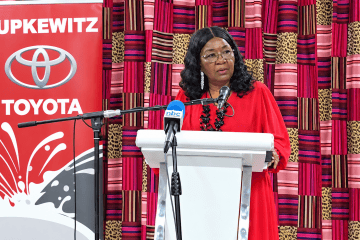
Appearing before the Parliamentary Committee on Transport on Tuesday, NABTA secretary general Pendapala Nakathingo said public transport plays a critical role in Namibia’s daily movement of people, but the sector is facing serious safety challenges.
“Public transport moves over 70% of Namibians daily. Taxis and buses are the backbone of mobility. But with this responsibility comes risk,” NABTA stated in its presentation to Parliament.
The association said accidents involving taxis and buses threaten not only passengers and drivers but also public confidence in the transport sector.
“Every accident is a Namibian life lost, a mother, a student or a breadwinner,” NABTA told lawmakers, stressing the need to shift from responding to accidents after they occur to preventing them through stronger systems.
NABTA identified several factors contributing to road crashes in the public transport sector, including driver fatigue, speeding, reckless driving, substance use, overloading, poor vehicle maintenance and ageing fleets.
The association also pointed to challenges within the transport system itself, including informal operations, limited access to trip data and disorder at taxi ranks.
“‘Bag grabbing’ chaos at ranks leads to rushed driving,” NABTA said, referring to the competition among operators to secure passengers, which it believes encourages unsafe driving behaviour.
Despite these challenges, NABTA said operators have already introduced safety measures through self-regulation.
“NABTA members are not waiting,” the association said, highlighting initiatives such as loading masters at ranks, defensive driving and first aid training, vehicle inspections, disciplinary action against unsafe operators and road safety awareness campaigns.
The association said taxi and bus drivers trained in first aid have become important first responders because they are often among the first people to reach accident scenes.
“Drivers are 24/7 on the road and first on accident scenes to provide first aid before medical rescue arrives,” NABTA stated.
However, the organisation said self-regulation alone cannot solve the country’s road safety challenges and called for stronger systems supported by technology.
NABTA presented its proposed Smart NABTA System (SNS), a digital platform designed to improve accountability, monitoring and safety in public transport.
The system would include driver and vehicle verification linked to the National Traffic Information System (NaTIS), GPS tracking to monitor speeding and driving hours, digital passenger registration for long-distance trips, and electronic dispatch systems to improve order at taxi ranks.
According to NABTA, the system would help authorities identify risky behaviour and respond before accidents occur.
“Self-regulation alone is not enough. We need systems and data,” the association said.
NABTA also proposed the introduction of automatic fire suppression systems and dash cameras, beginning with buses, to improve emergency response and protect passengers.
The association called for a stronger partnership between government and the transport industry, including stricter enforcement against overloading and unroadworthy vehicles, joint operations between NABTA, the ministry of works and transport and law enforcement agencies, and improved infrastructure for taxi ranks and long-distance drivers.
NABTA further recommended incentives for operators investing in safety technology and maintaining roadworthy fleets.
“We ask Parliament to support the adoption of the NABTA System as the national digital platform for public transport regulation and data,” the association said.
The organisation also raised concerns about accidents caused by wild animals entering major roads, particularly along the B1 route, calling for government support for affected victims and improved fencing by farms bordering highways.
NABTA said successful implementation of its proposed measures could significantly improve road safety, predicting better compliance within six months, a possible 20–30% reduction in public transport accidents within 18 months, and a more professional transport sector within five years.
Concluding its presentation, NABTA said the goal was to make public transport safer for all Namibians.
“With the new system and your support, we can move from chaos to order, from reaction to prevention,” the association told Parliament. “Let’s make public transport the safest way to travel in Namibia.”
The presentation was delivered by Nakathingo on behalf of NABTA’s national executive committee, including president Jeffrey Platt, vice president Siremo Sikwaya, chairman Magnus Nangombe and other committee members.
Official statistics from the Motor Vehicle Accident (MVA) Fund show that between 1 January and 21 June 2026, the country recorded 1,333 road crashes, resulting in 2,273 injuries and 229 fatalities.
The figures indicate that while road crashes remain a major national concern, there has been some improvement compared to the same period in 2025.
During the first half of 2025, Namibia recorded 1,500 crashes, 2,486 injuries and 243 fatalities. This represents an 11% decline in crashes, a 9% reduction in injuries and a 6% decrease in fatalities in 2026.
The Khomas Region recorded the highest number of crashes during the period under review, with 493 incidents, followed by the Erongo Region with 171 crashes and the Otjozondjupa Region with 130.