Renthia Kaimbi
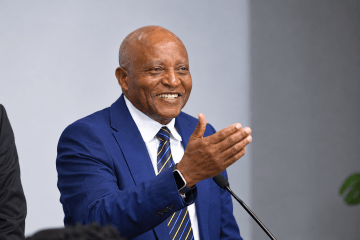
Minister of justice and labour relations, Fillemon Wise Immanuel, has called for justice systems that put people at the centre of service delivery, warning that democracy risks becoming an empty promise when citizens cannot access justice.
Addressing the International Access to Justice Conference in Sun City, South Africa, on 12 November, Immanuel said justice institutions must do more than administer and enforce the law.
They must protect human dignity, make rights accessible and ensure that those entrusted with public power remain accountable.
Speaking under the theme “Strengthening People-Centred Justice Systems: Deepening Democracy”, Immanuel said the relationship between law, democracy, power, institutions, people and justice was central to building stable and democratic societies.
He argued that law provides the foundation for an orderly society, while democracy determines how power is acquired and how those exercising it are held accountable.
Institutions, he said, are the mechanisms through which public services are delivered and justice administered, while people remain the reason these systems exist.
“Power without the restraint of law risks becoming arbitrary. Law without justice risks becoming an instrument of exclusion and inequality. Democracy without access to justice risks becoming an empty promise,” Immanuel said.
He stressed that people-centred justice requires citizens to be treated with equality, fairness, transparency and accountability, regardless of their socio-economic status or personal connections.
“People-centred justice means that justice seekers are treated with equality, fairness, transparency and accountability and are not stratified based on socio-economic status or who knows who,” he said.
Immanuel said access to justice should also create conditions that allow people to pursue happiness and live dignified lives, including the freedom to live without fear, raise children in safety, earn an honest living and enjoy equal opportunities.
He said democracy could only become meaningful when these freedoms were experienced in people’s everyday lives.
The minister also highlighted the historical and constitutional ties between Namibia and South Africa, saying the two countries shared a history shaped by colonialism, racism and apartheid, as well as struggles for freedom, independence and justice.
He said both countries’ constitutions emerged from a determination to establish democratic societies founded on human dignity, equality, freedom, social justice and fundamental rights.
“Their preambles embody a common promise: never again should our people experience oppression, discrimination and the denial of their dignity,” he said.
Immanuel said the shared history placed a common responsibility on both countries to strengthen justice systems and ensure that constitutional promises translated into tangible improvements in people’s lives.
He further called for stronger regional cooperation, pointing to commitments under the African Charter on Human and Peoples’ Rights and the Southern African Development Community (SADC) Protocol on Mutual Legal Assistance in Criminal Matters.
According to Immanuel, cooperation and respect for the rule of law are essential to regional integration and the advancement of the African Union’s Agenda 2063, particularly its vision of an integrated and well-governed continent.
He also linked the commitments to Sustainable Development Goals 16, 10 and 17, which focus on peace, justice and strong institutions, reduced inequalities, and partnerships.
On bilateral relations, Immanuel said Namibia remained committed to strengthening cooperation with South Africa through the Memorandum of Understanding on Cooperation in the Legal Field.
He described the agreement as an important framework for institutional collaboration, bilateral cooperation and the effective administration of justice.
“Our call to action is to translate these commitments into tangible benefits for our people,” he said.
Immanuel challenged the current generation to ensure that the promises made during the liberation struggles and enshrined in the two countries’ constitutions became a lived reality.
“Our liberation struggles secured our political freedom. Our Constitutions promised justice. Our generation must ensure that this promise is lived and experienced by our people in our lifetime,” he said.
He urged delegates to build justice systems that restore dignity, protect rights and ensure that public power remains accountable.
Ultimately, he said, the strength of democracy should not be measured by the authority held by state institutions, but by how effectively they serve, protect and empower citizens.
“The measure of the strength of our democracy is not the power that the institutions have, but the efficiency and effectiveness with which they are serving, protecting and empowering our people,” Immanuel said.
He concluded by emphasising the interconnected future of Namibia and South Africa, saying their shared history and constitutional commitments should guide efforts to ensure that present and future generations experience the justice for which their people sacrificed.