Sostenus Wilherm
Namibia’s commitment to good governance is facing a reality check, with stakeholders in the Omusati Region urged to critically assess the country’s progress in implementing governance reforms rather than simply celebrating achievements.
Omusati governor Immanuel Shikongo has called for an open assessment of Namibia’s implementation of recommendations under the African Peer Review Mechanism (APRM), particularly those addressing youth unemployment, housing, land delivery, rural electrification and decentralisation.
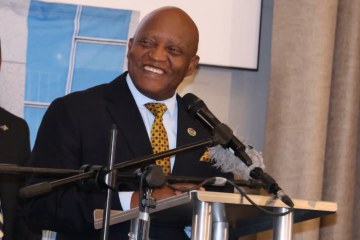
Shikongo made the call on Tuesday in Outapi during a workshop to validate a progress report on the implementation of recommendations contained in Namibia’s Country Review Report.
“We are gathered here today to review and validate the progress made in implementing the recommendations contained in the Country Review Report for Namibia,” Shikongo said.
The Country Review Report was developed in 2021, peer-reviewed by the African Peer Review Forum of Heads of State and Government in February 2022, and officially launched by former President Nangolo Mbumba on 7 March 2024 for implementation.
According to Shikongo, the launch demonstrated Namibia’s commitment to fully implementing the recommendations contained in the report.
Established in 2003, the APRM is an African Union mechanism aimed at promoting good governance across the continent through country self-assessments, the identification of governance gaps and policy interventions.
Namibia acceded to the APRM on 28 January 2017 and has since completed two review reports, with implementation of their recommendations still ongoing.
Shikongo said the recommendations address some of the country’s most persistent challenges.
“These recommendations address long-term national priorities such as youth unemployment, rural electrification, housing, land delivery, decentralization, and other socio-economic challenges,” he said.
Youth unemployment was among the issues highlighted by the governor. Namibia’s Targeted Review Report on Youth Unemployment, undertaken in 2019, examined the underlying causes of persistent unemployment among young people.
Shikongo pointed to the establishment of the National Youth Development Fund during the 2025/2026 financial year as one of the government’s responses to the challenge. He said the Omusati Region has also benefited from the fund.
The validation workshop assessed Namibia’s governance performance across four thematic areas: democracy and political governance, economic governance and management, corporate governance, and socio-economic development.
The democracy and political governance component examines issues including political governance, the rule of law and elections, while economic governance focuses on the management of the country’s economy.
Corporate governance covers the conduct of public and private enterprises, including good corporate citizenship. Socio-economic development focuses on citizens’ welfare, including social protection, education, health, employment and food security.
Shikongo urged stakeholders to ensure that the validation exercise provides an honest assessment of Namibia’s progress.
“I therefore encourage all participants, in the true spirit of nation-building, to engage openly and constructively in validating the Progress Report,” he said.
He said the exercise should not only confirm progress already made, but should also identify governance challenges that may have been left out of the draft report.
“Your contributions are invaluable, not only in confirming the progress already achieved but also in identifying additional governance challenges and development priorities that may not yet be adequately reflected in the draft Progress Report,” Shikongo said.
The workshop brought together regional and local authority councillors, traditional authorities, government ministries, offices and agencies, private institutions, academia, members of the APRM National Governing Council and the media.
The broad participation is intended to ensure that the progress report reflects the experiences and concerns of stakeholders beyond central government.
Shikongo said the APRM recommendations must ultimately translate into policies and practices that improve governance and advance development.
He called on participants to engage freely and constructively, stressing that their input could strengthen governance both in Omusati and nationally.
“Let us engage freely and constructively so that our collective contributions strengthen governance and advance development in the Region in particular and the country in general,” Shikongo said.