- Diamond taxes and royalties are projected to fall to N$414m in 2026/27.
- Deficit projected at 5.5% of GDP
- Ministry of Defence allocated N$200m
- N$535m allocated to PSEMAS
CHAMWE KAIRA
The government has lowered its economic growth forecast for 2026 to 2.3% from 3.1%. At the same time, the government has revised its revenue forecast down by N$1.5 billion.
The additional spending in the midterm budget means the national budget appropriation has increased to N$88.6 billion, from the N$87.9 billion announced in February.
The budget review showed that weaker mining receipts and rising debt-servicing costs are putting pressure on public finances.
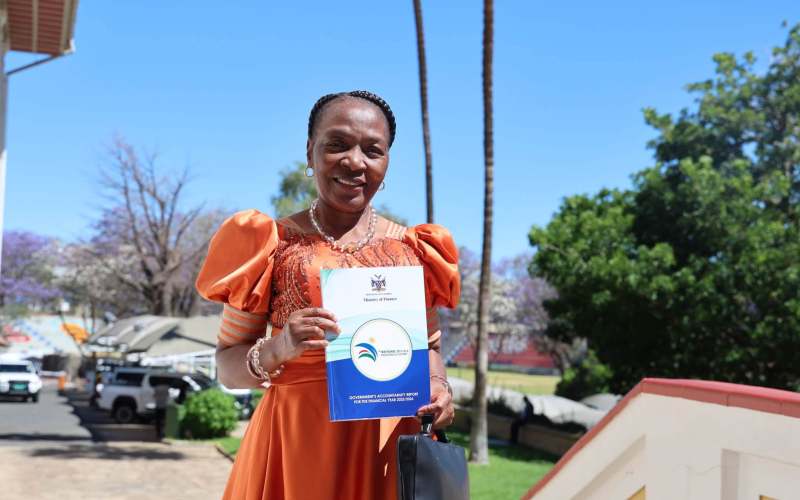
Finance minister Ericah Shafudah announced the revisions in the FY2026/27 Mid-Year Budget Review Statement tabled in the National Assembly on Thursday, 22 October 2026.
The revised growth forecast is above the 1.7% recorded in 2025 but reflects slower-than-expected economic performance during the first half of 2026.
The government now expects the economy to grow by 2.6% in 2027, 3.0% in 2028 and 3.3% in 2029. The projected recovery is expected to be supported by mining projects, strong uranium and gold prices, and improved consumer spending as inflation and interest rates ease.
Shafudah warned that weaker global demand, lower commodity prices, particularly diamonds, high fuel prices, the anticipated El Niño weather phenomenon and the foot-and-mouth disease outbreak remain risks to the outlook.
The government’s revenue forecast for the current financial year has been reduced from N$89.6 billion to N$88.1 billion, mainly because of lower mining receipts, reduced fuel levies and lower administrative fees.
Mining company taxes and royalties have been revised down to N$5.2 billion from N$6.1 billion.
Diamond taxes and royalties, which amounted to N$5.8 billion in 2023/24, are projected to fall to N$414 million in 2026/27.
Non-tax revenue has also been revised down to N$5 billion from N$6.1 billion, mainly due to lower mineral royalties and public enterprise dividends.
As at 30 September 2026, government expenditure commitments and actual spending totalled N$47 billion against an appropriation of N$87.9 billion, representing a budget execution rate of 53.5%.
Development expenditure recorded an execution rate of 42%.
The revised fiscal framework projects a budget deficit of N$16.3 billion, equivalent to 5.5% of gross domestic product (GDP).
Total public debt is expected to reach N$201.7 billion, or 68.7% of GDP, while interest payments are projected at N$15.4 billion, equivalent to 17.5% of total revenue.
Government’s total expenditure, including statutory commitments, has been revised down to N$105 billion from the original N$106 billion.
The revised budget appropriation, which covers expenditure financed through the State Revenue Fund, increases from N$87.9 billion to N$88.6 billion.
The mid-year adjustments include N$179 million for the ministry of agriculture, fisheries, water and land reform to contain and manage the foot-and-mouth disease outbreak.
The funding was mobilised through a 2% reduction in expenditure ceilings across government offices, ministries and agencies.
Other allocations include N$200 million for the ministry of defence and veteran affairs, comprising N$100 million for rations and N$100 million for utilities.
The Office of the President will receive N$180 million, including N$140 million for basic sports facilities coordinated by regional governors and N$40 million for security measures.
The ministry of urban and rural development will receive N$62 million, including N$50 million for urgent soil erosion mitigation works in Rundu and N$12 million for a 5% salary adjustment for regional councillors.
An additional N$535 million has been allocated to the Public Service Employees Medical Aid Scheme (PSEMAS), while N$130 million will replenish the Contingency Fund.
The government has also allocated N$41 million to the ministry of health and social services to cater for 456 medical and dental interns, and N$26 million to settle outstanding drought relief invoices.
The government is reviewing the zero-rating of value-added tax (VAT) on sugar consumption, a measure originally introduced to provide relief to consumers.
Shafudah said the review was informed by concerns about the health effects of sugar consumption, although the statement did not specify when a decision would be made.
The government is also considering zero-rating import VAT on agricultural inputs and equipment to reduce domestic food production costs.
The National Youth Development Fund has grown to N$317 million, with N$110.2 million disbursed through the Development Bank of Namibia, Agribank and the Environmental Investment Fund.
Subsidised tertiary education introduced at the beginning of the 2026 academic year covers registration and tuition for approximately 87 000 qualifying students at public and private institutions.
The government also reported that 3 634 additional teachers and non-teaching staff had been recruited and deployed during the period under review.
In agriculture, Agribank advanced N$366.9 million to 544 clients between April and August 2026, including N$94.6 million to communal farmers. The financing created or maintained approximately 1 550 jobs.