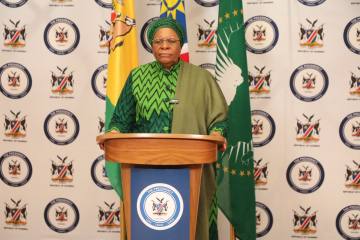
Renthia Kaimbi
Namibian spouses can no longer be forced to prove adultery, cruelty or desertion to end their marriage, according to a guidance note issued by Judge President Petrus Damaseb to the public on the new divorce dispensation.
The guidance note, dated 2 June 2026, explains that the long-awaited Dissolution of Marriages Act, 2024 (DoMA) comes into effect on 3 June 2026 (today), abolishing a fault-based system that had previously governed divorce, thereby replacing it with a single ground of “irretrievable breakdown of the marriage.”
According to the document, the DoMA represents one of the most significant reforms in the history of Namibia’s family law system, seeking to modernise divorce law, reduce unnecessary hostility, simplify procedures and promote amicable resolution of disputes.
It further states that the new dispensation seeks to recognise the realities of marital breakdown and ensure that divorce proceedings are conducted consistently with constitutional values and the best interests of children.
The Act also empowers Magistrate Courts to grant divorces for the first time – a power previously reserved exclusively for the High Court.
Justice and Labour Relations minister Fillemon Wise Immanuel had earlier given the Judiciary the month of May for “housekeeping”, warning that otherwise, the Act would commence without the necessary court procedures in place.
According to senior judicial sources, the High Court has finalised its new Rules of Court and is ready. However, the magistracy has yet to publicly confirm its preparedness for today’s start date.
The guidance note makes clear that the DoMA applies only to divorce proceedings instituted on or after 3 June 2026.
Any divorce proceeding already pending before that date will continue to be governed by the previous legal framework and the old Rules of Court until finalisation.
This means that spouses who filed for divorce before today cannot benefit from the “no-fault” provisions or the simplified application procedures, and their cases will still require proof of matrimonial offences such as adultery or cruelty.
Under the previous legal framework, a spouse seeking divorce had to rely on recognised matrimonial offences.
The DoMA abolishes the old fault-based grounds of divorce, and the only ground upon which a court may now dissolve a marriage is “irretrievable breakdown of the marriage.”
The Act defines “irretrievable breakdown” as the disintegration of the marriage relationship to the extent that there is no reasonable prospect of restoration.
The court must be satisfied that the marriage relationship has broken down completely and that there is no realistic prospect that the spouses will restore a normal marital relationship.
“The emphasis of the new law is no longer on identifying which spouse is morally blameworthy for the collapse of the marriage. The focus is now whether the marriage relationship has disintegrated beyond realistic restoration,” the document states.
It further directs courts to avoid reverting to fault-finding or moral condemnation, but also warns that courts are not expected to merely rubber-stamp divorce proceedings without a proper factual foundation.
A key reform outlined in the notes, is that divorce proceedings may now be instituted either by way of action proceedings or by way of application proceedings.
Where both spouses jointly seek divorce and there is no genuine dispute, the guidance note confirms that the proceedings must be brought by way of application, described as a simpler, faster and less hostile process.
The parties act jointly as applicants, the matter proceeds on affidavit, and no respondent is cited.
Where a spouse opposes the divorce, the document indicates they may do so only on the basis of a possibility of reconciliation.
The court is required to postpone the matter for three months, but only if the opposing spouse satisfies the court that there is no possibility of harm to the other spouse or the children.
If after three months the initiating party still wishes to proceed, the court is required by law to grant a divorce order, with no discretion unless custody disputes remain unresolved.
On division of assets, the document states that the court is now empowered to make just and equitable redistribution orders irrespective of the marital regime.
The court may consider the duration of the marriage, direct and indirect financial contributions, domestic contributions, childcare responsibilities, and any other relevant factor.
Domestic work and caregiving will now be recognised as important contributions within a marriage, while misconduct is generally irrelevant to redistribution unless it adversely affected the financial resources of the parties.
The new act also imposes strict disclosure obligations, requiring litigants to fully set out their assets and liabilities as part of their pleadings, with failure to comply constituting a criminal offence.
Under the DoMA, privacy protections will be strengthened, prohibiting publication of information that reveals the identity of a child or a party, with contravention attracting a fine of up to N$100,000 or five years’ imprisonment.