Patience Makwele
Omusati has positioned itself as one of Namibia’s leading agricultural regions, with more than N$120 million invested in irrigation, livestock infrastructure, farmer support and fisheries as the government seeks to boost food production, create jobs and stimulate the regional economy.
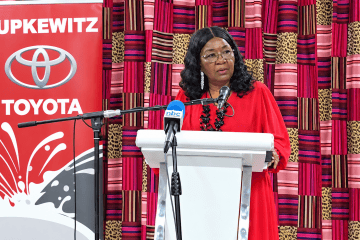
Delivering his second State of the Region Address (SORA) on Friday, Omusati Governor Immanuel Shikongo said agriculture remains the cornerstone of the region’s development agenda, with major investments already translating into increased production and employment opportunities.
“As the saying goes, agriculture is not an option; it is the heartbeat of survival,” Shikongo said.
Among the flagship projects is the N$78 million Etunda Feedlot, which Shikongo said is 40% complete and expected to be commissioned by December 2026.
The project has already created 50 temporary jobs and is expected to strengthen livestock production while opening new markets for local farmers.
“I am calling upon farmers and the business fraternity to position themselves and make use of the feedlot once it is completed,” he said.
The government has also invested N$14.5 million to rehabilitate water infrastructure at the Etunda Irrigation Scheme and a further N$900 000 in a cold storage facility.
The scheme produced maize, wheat, potatoes, watermelons and its first successful banana harvest during the reporting period, with total production valued at N$14.8 million.
Shikongo said 14 farmers have already been allocated small-scale farming plots at Etunda, while the government is exploring opportunities to allocate more land to youth groups and agricultural cooperatives.
“We are exploring opportunities for youth groups and cooperatives to venture into small-scale farming at the Etunda Irrigation Scheme,” he said.
Outside irrigation farming, the government invested N$1.5 million in dry-land farming subsidies, benefiting 8 353 farmers through ploughing, weeding, seed and fertiliser support.
Another N$1.6 million was channeled into poultry and horticulture production, benefiting 177 farmers, while 26 small-scale livestock farmers received support through a revolving fund worth more than N$702 000.
Government, through the Agricultural Marketing and Trade Agency (AMTA), procured more than 371 tonnes of locally produced mahangu worth N$2.7 million, while the University of Namibia’s Ogongo Campus, in partnership with the Food and Agriculture Organisation (FAO), launched a N$4.1 million pearl millet productivity project that will train more than 800 seed growers by 2027.
Livestock health also received significant attention, with more than 183 000 cattle vaccinated against lung sickness and N$15 million allocated to rehabilitate the Ombombo-Mawé quarantine facility.
In fisheries, more than 250 000 catfish and tilapia fingerlings were distributed to small-scale farmers.
Farmers harvested more than six tonnes of fish, while government fish farms produced almost 10 tonnes that were sold directly to local communities.
Beyond agriculture, Shikongo highlighted education as another major success story.
“This is a testament to the dedication of our teachers, learners, parents and non-teaching staff,” he said.
He said Omusati ranked third nationally in the 2025 Grade 12 Advanced Subsidiary examinations, with 73.5% of 1,738 learners obtaining at least three subjects.
At Grade 11 level, the region ranked fifth nationally, recording 37% in A-to-C grades.
The government also invested N$5 million in constructing six classrooms, two ablution facilities and renovating 37 classrooms, creating 112 construction jobs, while a further N$5.5 million was spent on procuring eight vehicles to improve education services.
Almost 1 500 teachers received continuous professional development training, while schools received smart televisions, playground equipment and thousands of new textbooks.
Shikongo further highlighted investments in sports infrastructure, youth empowerment and public services, saying the region continues to enjoy peace, stability and cooperation among political, traditional and local authority leaders.
He urged all public institutions to embrace President Netumbo Nandi-Ndaitwah’s call for “no business as usual” in accelerating development.
While welcoming the investments outlined in the address, University of Namibia associate professor Albert Shikongo said the region still needs stronger interventions to tackle unemployment and attract private investment.
“Government is doing more than enough,” Shikongo said.
However, he noted that most of the employment opportunities highlighted in the address were linked to construction projects, arguing that long-term job creation would require greater participation from the private sector.
“The missing part was the role of the private sector and SMEs. There was nothing in the speech regarding what is expected from investors or how they can contribute to sustainable employment,” he said.
He added that Omusati should actively market opportunities at the Etunda Irrigation Scheme and other agricultural projects to attract both local and international investors.
Shikongo also called for stronger monitoring and support for small businesses receiving government funding, saying many entrepreneurs have viable business ideas but lack the technical and financial management skills needed to sustain their enterprises.
On infrastructure development, he said progress was evident in education, water and sports facilities, although some constituencies had expected more projects to be announced.
“Let’s give him a chance. He is only about to complete his first year, and I believe the next round will focus on areas that were not covered this time,” he said.
Despite his concerns, Shikongo commended the government’s continued investment in water infrastructure, describing access to water as critical for both livestock farmers and rural communities facing recurring drought conditions.
The address also highlighted Omusati’s continued peace and stability, with the governor praising the cooperation between government institutions, traditional authorities and local leaders in advancing the region’s development agenda.