CHAMWE KAIRA
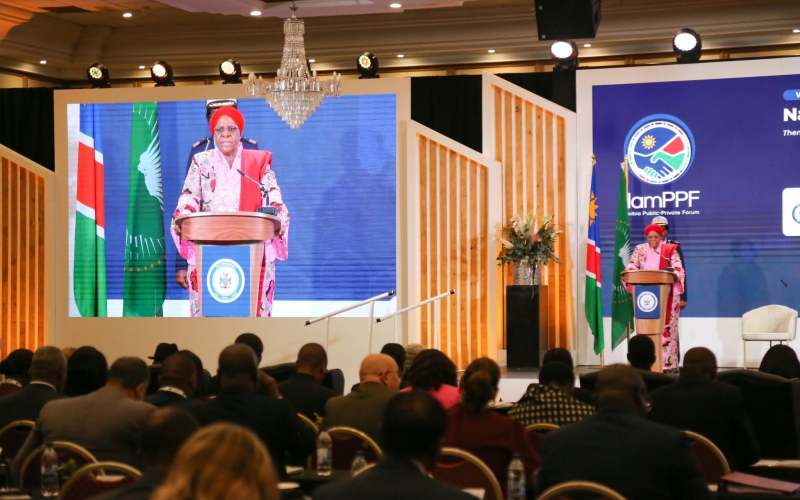
National Planning Commission (NPC) Director-General Kaire Mbuende has said the second Namibia Public-Private Forum (NamPPF), held in Windhoek on Wednesday, would assess progress made on the commitments and identify practical steps to ensure they translate into tangible results.
The inaugural forum, held 12 months ago, brought together nearly 500 participants and produced 171 proposed solutions and 34 commitments aimed at addressing economic and development challenges.
Mbuende said the NPC, the Namibia Investment Promotion and Development Board (NIPDB) and the forum secretariat had been tracking the implementation of the commitments.
The second forum is being held under the theme “From Commitment to Competitiveness: Accelerating Investment, Public-Private Partnerships and Job Creation”.
Mbuende said the theme reflects the urgency of advancing Namibia’s development objectives, particularly as the Sixth National Development Plan represents the final medium-term plan towards the country’s 2030 goals.
He said Namibia needed to pool resources and capabilities across the public and private sectors to strengthen competitiveness, attract investment and create employment.
The government must provide an enabling policy and regulatory environment, while the private sector contributes investment, innovation, expertise and productive capacity, he said.
Mbuende said neither sector could achieve the country’s development aspirations independently, adding that stronger collaboration was required to ensure projects move from conception to implementation and economic opportunities translate into jobs.
The forum is expected to provide a platform for stakeholders to discuss challenges affecting investment, identify bottlenecks and develop practical solutions to accelerate project implementation.
Mbuende called for focused and results-oriented discussions, urging participants to contribute their expertise and work towards common solutions.
He said the process was intended to strengthen the link between national development priorities and private-sector participation.
The value of the forum would ultimately be measured by the actions taken after the discussions, he said.
President Netumbo Nandi-Ndaitwah, who chairs the Namibia Public-Private Forum, is attending the second edition, alongside Prime Minister Elijah Ngurare, Vice-President Lucia Witbooi, ministers, members of parliament, industry representatives, development partners, labour and civil society organisations.
Nandi-Ndaitwah has called on government ministries and agencies to urgently implement 34 Cabinet directives arising from the Presidential Task Forces established following the inaugural Namibia Public-Private Forum (NamPPF), saying the country must move from commitments to measurable results.
The directives cover nine priority interventions and are intended to address constraints affecting investment, service delivery, economic activity and the quality of life, she said.
Nandi-Ndaitwah said institutions must take ownership of assigned actions, coordinate across government departments and provide clear progress reports.
She said the NPC, supported by the NIPDB, would be responsible for maintaining the tracking and accountability framework, while a dashboard being developed for the forum should make progress, delays and outstanding actions more visible.
The President said the second forum must assess what had been achieved since the inaugural meeting in October 2025, what remained outstanding and what was preventing implementation.
The inaugural forum led to the establishment of three Presidential Task Forces covering economic recovery, health, and housing and land delivery, alongside 10 working groups.
Nandi-Ndaitwah said progress had been recorded in areas including the operationalisation of the One-Stop Shop Business Facilitation Centre at the Business and Intellectual Property Authority (BIPA), the introduction of a five-year investor visa and reforms to the tax environment.
However, she said the business facilitation centre faced challenges, including a lack of digitalisation and poor interconnectivity between services.
The investment visa was performing well, with some individuals already benefiting, while the Investment and Tax Reform Bills were before the National Assembly.
She also raised concerns about the country’s permitting system, saying permits were too numerous, overlapping, sometimes contradictory and slow to process.
Nandi-Ndaitwah tasked the private sector with compiling a list of permits that hinder investment and recommending how they could be aligned without undermining their intended purpose. She said the recommendations should be submitted before the end of December 2026.
The President said Namibia’s economic outlook had been affected by the Middle East conflict and Foot-and-Mouth Disease, which were placing pressure on key sectors.
The Mid-Year Budget Review revised the government’s real GDP growth forecast for the 2025/26 financial year down from 4.5% to 3.3%, reflecting reduced activity in agriculture, diamond mining and manufacturing, as well as weaker performance in parts of the services sector.
The Namibia Statistics Agency recorded economic growth of 1.7% in 2025, while the Bank of Namibia projects growth of 2.1% in 2026.
Annual inflation reached 5.6% in October, compared with 3.6% a year earlier.
Nandi-Ndaitwah said fiscal pressures had also increased, with revenue expectations revised downward, expenditure demands remaining high and debt-service costs rising.
She said uranium and gold had provided some support to the economy, but broader economic activity remained insufficient to accelerate investment and employment.
Despite the challenges, she said Namibia retained investment opportunities in minerals, energy, agriculture, fisheries, tourism and services.
She called for increased investment in agriculture and agro-processing, fisheries, mining and mineral beneficiation, energy, oil and gas, manufacturing, tourism and the creative industries.
The President said the country needed to ensure its natural resources generated greater value locally through skills development, technology transfer, supplier development, local participation and competitive domestic value chains.
She also called for closer cooperation between education and training institutions, employers and public agencies to address the gap between skills development and labour market requirements.
The private sector, she said, should support workplace learning, apprenticeships, mentorship and employment opportunities, particularly for young people.
Nandi-Ndaitwah further urged businesses, including micro, small and medium enterprises, to be integrated into supply chains, improve access to finance and expand their access to markets.
She said the NamPPF should not be treated as an annual event, but as a continuous process of dialogue, monitoring commitments, resolving bottlenecks and ensuring decisions translate into outcomes.
The President said both the government and the private sector should be held accountable for their commitments, adding that the private sector was expected to comply with the law, invest responsibly and meet its obligations.
She said the second forum should produce implementable proposals and measurable commitments, with clear responsibilities and timeframes, rather than additional aspirations.