There is a difference between making a financial mistake and presiding over a system in which mistakes become routine, controls are ignored and those entrusted with public money cannot explain where it has gone. The Ministry of Finance’s internal audit report on the Otjiwarongo Municipality suggests that the town is confronting something considerably more serious than administrative inefficiency. It points to a worrying breakdown in financial discipline, management accountability and institutional oversight.
The findings deserve more than an expression of regret or another promise to improve procedures. They demand answers, consequences and decisive corrective action.
Consider the recruitment of four strategic executives. The municipality spent approximately N$394 000 outsourcing a process that its own human resources department should reasonably have been equipped to manage. The initial quotations totalled N$269 000, but the eventual expenditure rose substantially. To make matters worse, one of the four positions remained vacant, requiring the recruitment process to be repeated.
The municipality’s justification was that internal managers were themselves interested in applying for the positions, potentially creating a conflict of interest. That concern is legitimate. Executive recruitment must be fair, transparent and insulated from internal influence. But a legitimate concern does not automatically justify an expensive external appointment without demonstrating value for money or compliance with procurement requirements.
More troubling is that the appointed recruitment company allegedly failed to submit mandatory compliance documents. Management’s explanation was that this was an oversight, for which it accepted responsibility.
That admission is not reassuring. Compliance with public procurement legislation is not an administrative courtesy. It is a legal obligation designed to protect public institutions, ensure fair competition and prevent preferential treatment. When officials responsible for safeguarding public resources casually overlook mandatory requirements, the integrity of the entire procurement process is placed in question.
And recruitment is only one part of the problem.
The audit paints a picture of expenditure running substantially beyond approved budgets, with inadequate evidence of the necessary authorisations. Legal fees reached N$1.22 million against an allocation of N$450 000. Telephone expenses exceeded their N$250 000 budget by more than 200%. Copier and fax rentals amounted to N$301 444 against an allocation of N$32 000, an extraordinary overspend of approximately 842%.
These are not minor accounting discrepancies. They represent serious failures of financial planning and expenditure control. Unexpected litigation may explain some additional legal costs, but it does not explain why budgetary authorisation procedures were apparently not followed. Nor does it explain how expenditure on routine administrative services could balloon so dramatically without management intervention.
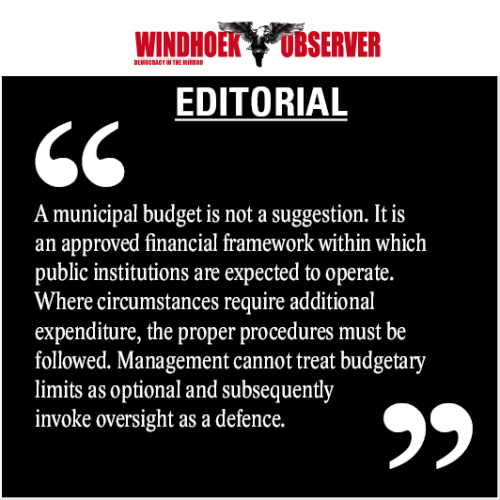
A municipal budget is not a suggestion. It is an approved financial framework within which public institutions are expected to operate. Where circumstances require additional expenditure, the proper procedures must be followed. Management cannot treat budgetary limits as optional and subsequently invoke oversight as a defence.
Perhaps the most disturbing aspect of the report is the apparent inability of management to account for its own financial position.
Revenue reached only 71.2% of projections. Proceeds from the sale of erven amounted to just 15.3% of the target. Government subsidies also fell substantially below expectations. Meanwhile, cash reserves declined from N$81 million to approximately N$20.5 million, a reduction of about 75%.
Consumer debtors stood at N$68.8 million, with N$54.3 million outstanding for more than 150 days.
These figures should have been at the centre of management’s attention. Instead, when auditors requested explanations for the deterioration in cash reserves and the increase in receivables, management reportedly indicated that it could not comment and needed clarity on where the figures originated.
That response should concern every resident of Otjiwarongo.
How can a municipality manage its finances if its leadership cannot adequately explain its financial statements? How can councillors make informed decisions about service delivery, infrastructure and development if the underlying financial position is not properly understood? And how can residents be expected to pay their municipal accounts when the institution collecting that money appears unable to demonstrate sufficient control over its own finances?
The situation is compounded by approximately N$5.9 million in unsupported revenue adjustments, an unreconciled suspense account of N$1.71 million and weaknesses in payment verification. Auditors also found instances where suppliers were paid without adequate certification that goods had been received or services satisfactorily completed.
These are precisely the circumstances in which financial irregularities can flourish. Strong internal controls are not bureaucratic obstacles. They are the first line of defence against waste, fraud and the misuse of public funds.
The municipality’s capital expenditure performance is equally concerning. Only 29.8% of the approved capital budget was spent, while major projects, including the Emergency Response Unit and sewer line construction, recorded no expenditure.
This is the contradiction at the heart of Otjiwarongo’s predicament: money is being overspent on administrative and operational items while essential development projects remain unimplemented.
Residents do not experience municipal performance through accounting entries. They experience it through reliable water supplies, functioning sewerage systems, roads, emergency services, refuse collection and properly maintained public infrastructure. Every delayed project has consequences for the quality of life, economic activity and public confidence.
The reported cyber incident adds another dimension. The municipality appears unable to provide auditors with sufficient evidence of the extent of the breach, its financial implications or the measures taken to secure affected systems. In an increasingly digital public administration, cybersecurity is a governance responsibility, not merely an IT concern.
It would be unfair to conclude from an internal audit alone that corruption or criminal conduct has occurred. Auditors have identified weaknesses and risks, not established criminal guilt. Those distinctions matter. Equally, management must be given an opportunity to respond fully and demonstrate that corrective measures are being implemented.
However, the recommendation for a full audit of the municipality’s accounts should not be treated as another routine administrative exercise. It should be acted upon urgently, alongside the recommended forensic investigation into the cyber incident and scrutiny of unsupported financial adjustments.
The Ministry of Urban and Rural Development and the Ministry of Finance must also insist on clear timelines, measurable corrective actions and regular reporting. The council and senior management must account publicly for progress. Where negligence, misconduct or breaches of the law are established, appropriate consequences must follow.
Otjiwarongo is an important commercial and administrative centre. Its residents and businesses deserve a municipality that is financially responsible, professionally managed and capable of delivering the services expected of a local authority.
Public office carries responsibility. It cannot be reduced to signing documents, issuing explanations and accepting responsibility after the damage has been done.
There is a limit to how often public money can be wasted and every failure dismissed as an oversight. At some point, oversight becomes a pattern. And when that pattern persists, it becomes a question of leadership.
Otjiwarongo does not need another assurance that things will improve. It needs evidence that they will. More importantly, it needs leadership that understands that accountability is not optional, and that public money belongs to the people, not the institution entrusted to manage it.