Patience Makwele
Learners with disabilities need more than specialized equipment to access quality education, with education minister Sanet Steenkamp warning that resources must reach classrooms and be backed by trained personnel to make a meaningful difference.
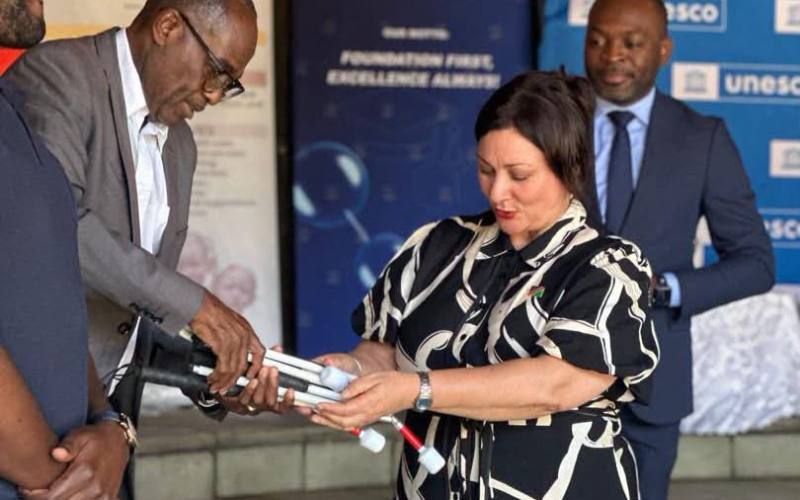
Steenkamp made the remarks in Windhoek on Thursday during the commemoration of International White Cane Day and the handover of educational equipment donated by UNESCO and other partners.
UNESCO donated equipment valued at N$340 000, including Braille materials, tactile graphics paper, audiovisual equipment and software intended to improve access to learning for learners with visual, hearing and intellectual impairments.
Bank BIC donated white canes to support mobility, while FNB contributed sun hats, sunscreen and other essential items valued at N$100 000 for persons with albinism.
Steenkamp said inclusive education could not be achieved through policy commitments alone, as learners have different needs that schools must be equipped to address.
“A learner who is blind must be able to access learning materials in Braille or other suitable accessible formats. A learner with a hearing impairment must be able to access instruction and information through appropriate communication methods,” she said.
She added that learners with intellectual disabilities may require adapted materials, differentiated teaching approaches and support suited to their individual learning needs.
“These are not additional privileges. They are necessary measures to make the right to education meaningful in practice,” Steenkamp said.
She said the donated equipment would also support the development of accessible materials for Life Skills-Based HIV and Health Education, which covers issues including personal safety, relationships, health and rights.
Steenkamp warned that learners with disabilities should not be shut out of information about personal protection, exploitation or abuse because it is provided in formats they cannot access.
The minister said the success of the handover would depend on how the equipment was used after the ceremony, rather than the number of items presented.
“Equipment alone does not deliver inclusion. It must be used effectively, supported by trained personnel, maintained appropriately and integrated into teaching and learning,” she said.
The support is expected to benefit approximately 85 000 learners with disabilities across Namibia, according to information provided at the event.
Steenkamp said the country’s Inclusive Education Policy provides a framework for ensuring that learners can access quality education regardless of their circumstances or abilities.
However, she said its principles must be reflected in everyday classroom practice.
“Equality does not always mean providing everyone with precisely the same resources. It means recognising different needs and responding appropriately so that each learner has a fair opportunity to learn, develop and succeed,” she said.
The commemoration also highlighted the barriers faced by people with visual impairments beyond the classroom.
Steenkamp said unsafe road crossings, inaccessible buildings, inadequate public transport and negative attitudes could restrict their independence.
She said the responsibility for removing these barriers extended to communities, public institutions and those responsible for planning and managing public spaces.
“The ability to travel to school, navigate a public space, pursue employment or participate in community life should not depend on the goodwill of others,” she said.
The minister cited the achievements of Namibian Paralympians Ananias Shikongo, Lahja Ishitile and Johannes Nambala as examples of what people with visual impairments can achieve when their abilities are supported and opportunities are available.
She called on government institutions, schools, development partners, businesses, families and communities to work together to make education and public spaces more accessible.
“Inclusion is not achieved through a single celebration, a policy document or a donation,” Steenkamp said.