CHAMWE KAIRA
The headline annual inflation rate for September, stood at 5.4%compared to 3.5% registered in September 2025.
On a monthly basis, the inflation rate was recorded at 0.4%, compared to 0.6%registered during the preceding month. Core inflation was observed at 4%, right below the headline inflation rate.
The September zonal inflation figures showed that Zone 2 (Khomas Region) recorded the highest annual inflation rate of 6.2%.
This was followed by Zone 3 (//Kharas, Erongo, Hardap, and Omaheke regions), which registered an annual inflation rate of 5.8%. In contrast, Zone 1 (Kavango East, Kavango West, Kunene, Ohangwena, Omusati, Oshana, Oshikoto, Otjozondjupa, and Zambezi regions) recorded the lowest annual inflation rate at 4.3%.
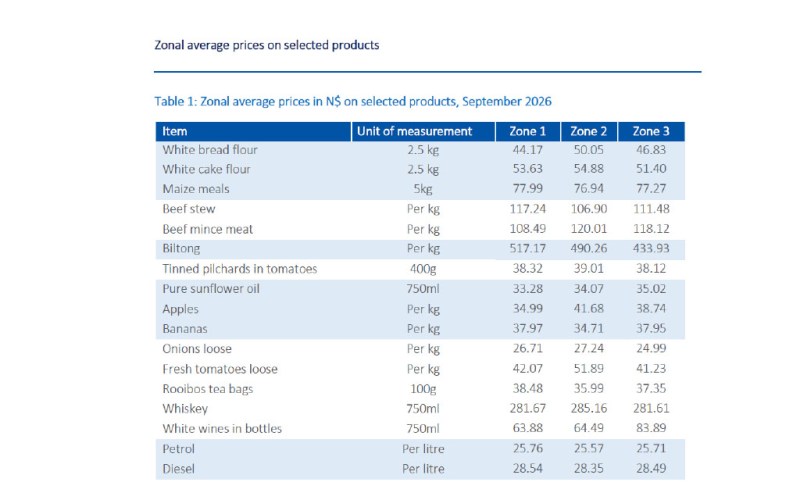
The analysis of average retail prices for selected products in September 2026 revealed that consumers in Zone 1 paid the highest average price for petrol, at N$25.76 per litre, followed by Zone 3 at N$25.71 per litre, while Zone 2 recorded the lowest average price at N$25.57 per litre.
Similarly, Zone 1 recorded the highest average price for diesel at N$28.54 per litre, followed by Zone 3 at N$28.49 per litre, while Zone 2 recorded the lowest average price at N$28.35 per litre.
Almandro Jansen of Simonis Storm commented on the inflation figures for August said the firm forecast a rate of 5.4% in October, 5.7% in November and 5.8% in December, and a calendar 2026 average of 4.2% (August: 4.3%–4.6%), reflecting the softer September outcome and the diesel freeze.
Jansen said the firm then sees inflation rising to 5.8% in January and 6.1% in February before peaking at about 6.2% in March 2027.
However, he said if oil stays elevated and the rand weakens, inflation peaks near 7.3% in March 2027 and averages about 6.4% over September 2026 to June 2027, likely requiring more than one further Bank of Namibia repo rate hike.
But he said if oil prices ease, inflation falls to about 3.0% by June 2027 and averages about 4.6% over the period.