Patience Makwele
The National Youth Service (NYS) has been urged to track the progress of young people after they leave its programmes, as the government considers expanding the role of national service.
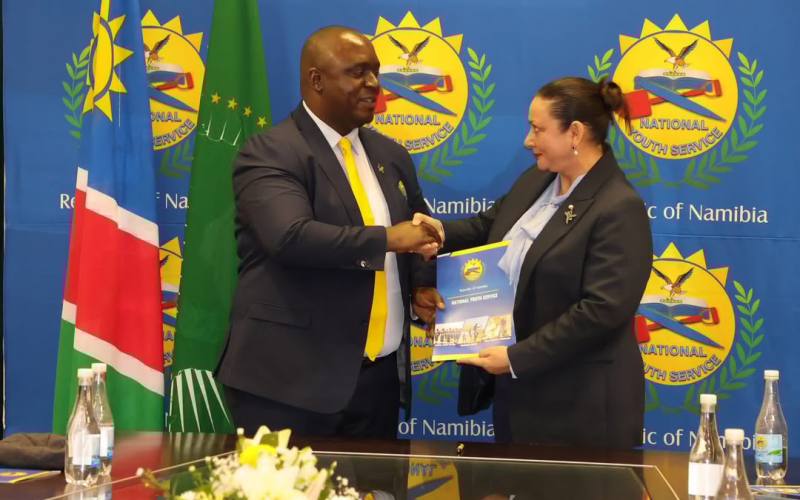
Education, innovation, youth, sport, arts and culture minister Sanet Steenkamp said recruitment and training figures alone should no longer be used to measure the success of the NYS.
“The number of young people recruited and trained is important, but it cannot be the only measure of success,” Steenkamp said during the inauguration of the new nine-member NYS Board in Windhoek on Monday.
She said the NYS should be able to account for how many former recruits go on to further education, secure employment, establish sustainable livelihoods and contribute to their communities.
The issue comes as demand for NYS programmes continues to grow, after about 18 000 young people applied for the 17th intake this year.
While the number shows strong interest among young people, Steenkamp said it also places pressure on the NYS to examine whether its infrastructure, capacity and funding are enough to meet demand.
The issue is particularly relevant as the government explores the possibility of compulsory national service for young people, particularly school-leavers.
Steenkamp stressed that the proposal remains under consideration and would require consultation, policy and legislative processes before any decision is taken.
Youth organisations have since raised different questions about what such an expansion would mean.
Swapo Party Youth League secretary Ephraim Nekongo emphasized that compulsory national service could equip young people with practical skills and help address unemployment, but warned that the NYS would need more resources before it could be expanded.
Students Union of Namibia board chairperson Benhard Kavau, however, questioned whether training alone could address wider problems facing young people, while Namibia National Students Organisation spokesperson Ndayola Mulongeni said any expansion should be properly resourced and should not interfere with education.
For the NYS, the issue of what happens after training is not entirely new.
The government has increasingly linked NYS training to employment opportunities. In December last year, President Netumbo Nandi-Ndaitwah announced that future recruitment into the Namibian Defence Force (NDF) police and correctional services would be limited to NYS graduates.
More than 600 graduates were expected to join the NDF, while another 430 were to be considered for the next Home Affairs recruitment.
Steenkamp said the new NYS Board should therefore focus on measurable outcomes, with inclusion, innovation and impact identified as its three priorities.
She said the NYS should strengthen areas such as digital skills, entrepreneurship, technical and vocational training, environmental sustainability and leadership.
The minister also called for a review of the NYS Act of 2005, saying the board should identify areas where the legislation and policy framework could be strengthened.
Board chairperson Nicolars Tembwe said the new Board would judge its performance by what changes it delivers for young people.
“Our measure of success will not be the frequency of our meetings, but the tangible, positive impact the Service will deliver in the lives of Namibian youth,” Tembwe said.
The nine-member board, whose three-year term took effect on 1 July, is responsible for providing strategic direction and overseeing the affairs, policies, investments and resources of the NYS.